Story maps · Grades 11–12
Money: A Story Map
The PDF is one tabloid page (11 × 17 in). On letter paper, choose “Fit to page.”
Eleven o’clock has just struck at the Bourse when Saccard enters Champeaux’ restaurant, all white and gold, with two high windows facing the Place. The chapter is called “The Temple of Mammon.” The hosted text is Vizetelly’s 1894 English, Project Gutenberg #56987, complete. Quote the novel, not the translator’s preface.
The central question
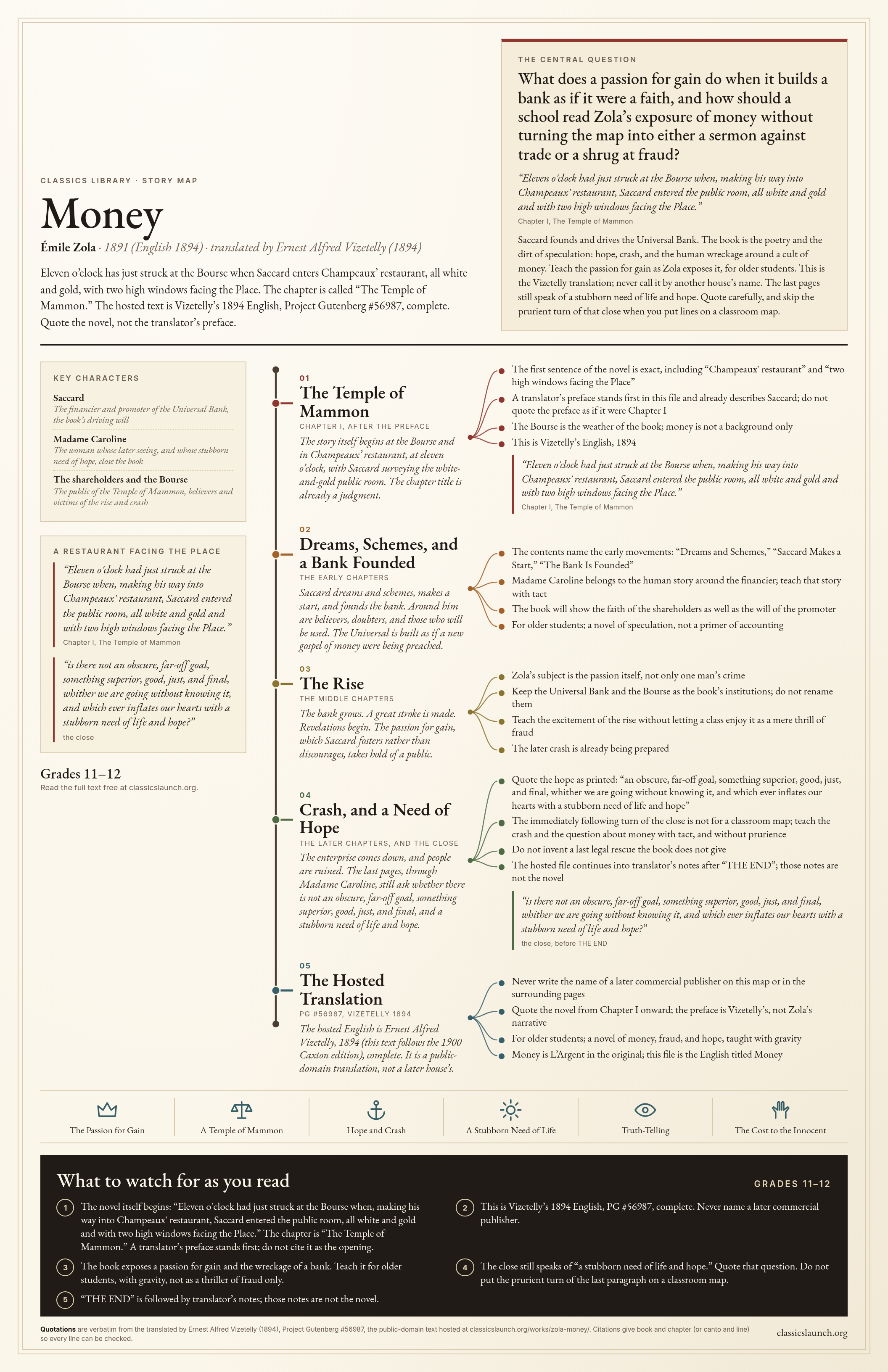
What does a passion for gain do when it builds a bank as if it were a faith, and how should a school read Zola’s exposure of money without turning the map into either a sermon against trade or a shrug at fraud?
“Eleven o'clock had just struck at the Bourse when, making his way into Champeaux' restaurant, Saccard entered the public room, all white and gold and with two high windows facing the Place.”
Saccard founds and drives the Universal Bank. The book is the poetry and the dirt of speculation: hope, crash, and the human wreckage around a cult of money. Teach the passion for gain as Zola exposes it, for older students. This is the Vizetelly translation; never call it by another house’s name. The last pages still speak of a stubborn need of life and hope. Quote carefully, and skip the prurient turn of that close when you put lines on a classroom map.
- 01
The Temple of Mammon
Chapter I, after the preface
The story itself begins at the Bourse and in Champeaux’ restaurant, at eleven o’clock, with Saccard surveying the white-and-gold public room. The chapter title is already a judgment.
- The first sentence of the novel is exact, including “Champeaux' restaurant” and “two high windows facing the Place”
- A translator’s preface stands first in this file and already describes Saccard; do not quote the preface as if it were Chapter I
- The Bourse is the weather of the book; money is not a background only
- This is Vizetelly’s English, 1894
“Eleven o'clock had just struck at the Bourse when, making his way into Champeaux' restaurant, Saccard entered the public room, all white and gold and with two high windows facing the Place.”
- 02
Dreams, Schemes, and a Bank Founded
The early chapters
Saccard dreams and schemes, makes a start, and founds the bank. Around him are believers, doubters, and those who will be used. The Universal is built as if a new gospel of money were being preached.
- The contents name the early movements: “Dreams and Schemes,” “Saccard Makes a Start,” “The Bank Is Founded”
- Madame Caroline belongs to the human story around the financier; teach that story with tact
- The book will show the faith of the shareholders as well as the will of the promoter
- For older students; a novel of speculation, not a primer of accounting
- 03
The Rise
The middle chapters
The bank grows. A great stroke is made. Revelations begin. The passion for gain, which Saccard fosters rather than discourages, takes hold of a public.
- Zola’s subject is the passion itself, not only one man’s crime
- Keep the Universal Bank and the Bourse as the book’s institutions; do not rename them
- Teach the excitement of the rise without letting a class enjoy it as a mere thrill of fraud
- The later crash is already being prepared
- 04
Crash, and a Need of Hope
The later chapters, and the close
The enterprise comes down, and people are ruined. The last pages, through Madame Caroline, still ask whether there is not an obscure, far-off goal, something superior, good, just, and final, and a stubborn need of life and hope.
- Quote the hope as printed: “an obscure, far-off goal, something superior, good, just, and final, whither we are going without knowing it, and which ever inflates our hearts with a stubborn need of life and hope”
- The immediately following turn of the close is not for a classroom map; teach the crash and the question about money with tact, and without prurience
- Do not invent a last legal rescue the book does not give
- The hosted file continues into translator’s notes after “THE END”; those notes are not the novel
“is there not an obscure, far-off goal, something superior, good, just, and final, whither we are going without knowing it, and which ever inflates our hearts with a stubborn need of life and hope?”
- 05
The Hosted Translation
PG #56987, Vizetelly 1894
The hosted English is Ernest Alfred Vizetelly, 1894 (this text follows the 1900 Caxton edition), complete. It is a public-domain translation, not a later house’s.
- Never write the name of a later commercial publisher on this map or in the surrounding pages
- Quote the novel from Chapter I onward; the preface is Vizetelly’s, not Zola’s narrative
- For older students; a novel of money, fraud, and hope, taught with gravity
- Money is L’Argent in the original; this file is the English titled Money
- The Passion for Gain
- A Temple of Mammon
- Hope and Crash
- A Stubborn Need of Life
- Truth-Telling
- The Cost to the Innocent
What to watch for as you read
Grades 11–12- The novel itself begins: “Eleven o'clock had just struck at the Bourse when, making his way into Champeaux' restaurant, Saccard entered the public room, all white and gold and with two high windows facing the Place.” The chapter is “The Temple of Mammon.” A translator’s preface stands first; do not cite it as the opening.
- This is Vizetelly’s 1894 English, PG #56987, complete. Never name a later commercial publisher.
- The book exposes a passion for gain and the wreckage of a bank. Teach it for older students, with gravity, not as a thriller of fraud only.
- The close still speaks of “a stubborn need of life and hope.” Quote that question. Do not put the prurient turn of the last paragraph on a classroom map.
- “THE END” is followed by translator’s notes; those notes are not the novel.
Every quotation is word for word from the translated by Ernest Alfred Vizetelly (1894) hosted in this library and is checked against that text each time the site is built. Citations give book and chapter (or canto and line).