Work record
Henry V
1599 · Renaissance Early Modern · Drama · English
Abstract
Background. Completing the cycle begun in Richard II and the two parts of Henry IV, Shakespeare drew on Holinshed's Chronicles and the older Famous Victories of Henry V. The Act V Chorus seems to allude to Essex's Irish expedition of 1599.
Plot. Assured by Canterbury that his title to France is lawful and stung by the Dauphin's tennis balls, Henry sails after executing the Southampton plotters Cambridge, Scroop and Grey, while Falstaff dies offstage. He storms the breach at Harfleur and marches his sickened army toward Calais, hanging Bardolph on the way. On the eve of Agincourt he moves cloaked among his men, debates Williams, and prays over his father's usurpation; next morning he gives the St. Crispin's Day speech, orders the prisoners killed after the attack on the baggage boys, and ascribes the victory to God. Burgundy pleads for ruined France and Henry woos Katherine.
Structure. Each act is introduced by the Chorus, who apologizes for the wooden O and asks spectators to supply horses, fleets and armies. Comic scenes with Pistol, Nym, Fluellen, Gower, Macmorris and Jamy set English, Welsh, Irish and Scottish voices beside the royal action.
Themes. Just war and the king's accountability for his soldiers, the hollowness of ceremony, the cost of the friendships Hal gave up, and victory received as providence.
Significance. The play's speeches on leadership remain among the most quoted in English, and it has been staged and filmed both as patriotic rallying cry, notably by Olivier in 1944, and as a sober study of war.
Main characters
- King Henry V: The reformed Prince Hal, now a pious and formidable war leader
- Chorus: Speaker of prologue, act openings and epilogue, summoning the audience's imagination
- Archbishop of Canterbury: Churchman who argues the Salic law does not bar Henry's claim
- The Dauphin: Mocking French heir who sends the gift of tennis balls
- Fluellen: Welsh captain learned in the ancient disciplines of war
- Michael Williams: Soldier who presses the disguised king on the reckoning owed for the dead
- Pistol: Bombastic survivor of Hal's old tavern circle, made to eat a leek
- Mistress Quickly: The Hostess, who reports how Falstaff died
- Bardolph: Old companion of Hal hanged for robbing a church
- Katherine: French princess whose English lesson and betrothal seal the peace
- Montjoy: French herald who finally concedes the day

Summary
Henry V follows the young King Henry, once the tavern-haunting Prince Hal, as he leads England to war with France and wins the battle of Agincourt in 1415. A Chorus opens each act, asking the audience to let their imaginations fill the small wooden theatre with the vasty fields of France. In Act I the Archbishop of Canterbury argues that Henry has a lawful claim to the French crown through his great-grandmother, and Henry, asking solemnly for the truth since lives will be spent on it, resolves on war; the Dauphin's insulting gift of tennis balls hardens him. Before sailing he unmasks three noblemen, Cambridge, Scroop and Grey, who have taken French gold to kill him, and sends them to execution; at the same time the Hostess reports the death of his old companion Falstaff, whose heart, his friends say, the king has broken. In France Henry rallies his troops at the breach of Harfleur, then threatens the governor with the horrors of a sack until the town yields. The French princess Katherine takes a comic English lesson, while Henry's army, weakened by sickness, marches toward Calais and his old friend Bardolph is hanged for robbing a church. The night before Agincourt, Henry borrows a cloak and walks among his soldiers; the common soldier Williams tells him that if the cause is not good the king has a heavy reckoning to make for those who die. Alone, Henry reflects on the burden of kingship and the emptiness of ceremony, and prays that God will not remember his father's usurpation. In the morning, outnumbered by the French, he answers the wish for more men with the St. Crispin's Day speech about a band of brothers. After the French kill the boys guarding the baggage, he orders the prisoners killed; then the French herald concedes the field, and Henry orders the Non nobis and Te Deum sung, giving the victory to God. Fluellen, the Welsh captain, settles accounts with the braggart Pistol by making him eat a leek. In Act V the Duke of Burgundy describes France ruined by war, Henry woos Katherine in plain soldier's speech, and the peace is sealed by their marriage. The Epilogue reminds the audience that Henry lived only a short time and that his son lost France.
Virtues in this work
- Fortitude: Henry leads a sick, outnumbered army into battle and refuses to wish for more men.
- Justice: He condemns the Southampton traitors and the church-robber Bardolph without regard to friendship.
- Humility: After Agincourt Henry forbids boasting and gives the victory to God with Non nobis.
- Piety: He prays before battle and orders psalms after it.
- Friendship: He calls the soldiers who fight with him his brothers.
Plot or Argument
- Prologue and Act I: The claim
The Chorus invokes a Muse of fire; the bishops justify Henry's claim by the Salic law; the Dauphin's tennis balls provoke the king's resolve.
- Act II: Traitors and a death
Henry exposes the Southampton conspirators; Falstaff dies offstage in the Hostess's tavern; the French court debates the threat.
- Act III: Harfleur to the march
Henry leads the assault at the breach and takes Harfleur; Katherine learns English; Bardolph is hanged and the sick army marches on.
- Act IV: Agincourt
Henry walks disguised among his soldiers, broods on ceremony and prays; he gives the St. Crispin's Day speech, orders prisoners killed after the attack on the boys, and gives God the victory.
- Act V and Epilogue: Peace
Fluellen makes Pistol eat a leek; Burgundy pleads for peace; Henry woos Katherine; the Epilogue foretells the loss of France under Henry VI.
Characters
- King Henry V, King of England
A former wild prince grown into a devout, eloquent, ruthless and charismatic war leader.
- Chorus, narrator
Speaks the Prologue, the act openings and the Epilogue, asking the audience to imagine what the stage cannot show.
- Archbishop of Canterbury, churchman
Lays out the legal case for Henry's claim to France.
- The Dauphin, heir of France
A scornful, boastful prince who mocks Henry's youth.
- Fluellen, Welsh captain
A pedantic, brave and loyal officer devoted to the discipline of the wars.
- Michael Williams, common soldier
Challenges the disguised king on the responsibility of kings for their soldiers' souls.
- Pistol, braggart
A swaggering former tavern companion of Hal's who survives the war in disgrace.
- Mistress Quickly, the Hostess
Pistol's wife, who describes Falstaff's death.
- Katherine, Princess of France
Daughter of the French king, whose English lesson and courtship bring comedy and peace.
- Montjoy, French herald
Carries the French defiance and finally the surrender of the field.
Lessons
The burden of command
The night scene shows Henry hearing a soldier argue that a king answers for the souls of men he leads into war. Henry replies that each subject's soul is his own, then feels the weight of rule alone. Shakespeare gives kingship both its grandeur and its cost.
- What is Williams's argument, and how does Henry answer it?
- What does Henry say ceremony gives a king?
- Why does he pray about his father's fault?
Words that make men brave
The Harfleur and St. Crispin's Day speeches show leadership by rhetoric: Henry makes common soldiers his brothers and turns fewness into honor. The play invites students to study how speech forms a company.
- How does Henry answer Westmorland's wish for more men?
- What does 'band of brothers' promise the soldiers?
Justice without favor
Henry sentences the traitors without pity for his friend Scroop and allows Bardolph, an old companion, to be hanged for sacrilege. The play shows a king who has put away the private loyalties of his youth.
- Why does Scroop's betrayal grieve Henry most?
- Is the hanging of Bardolph just?
Victory given to God
After Agincourt Henry forbids boasting and orders Non nobis and Te Deum. The play presents gratitude and humility as the right response to success in a just cause.
- Why does Henry insist that God fought for them?
- How does the Epilogue qualify the triumph?
Context
Henry V (reigned 1413-1422) renewed the Hundred Years' War, took Harfleur in 1415, and defeated a much larger French army at Agincourt on 25 October, St. Crispin's Day, largely through the English longbow and muddy ground. The Treaty of Troyes (1420) made him heir to France and husband of Catherine of Valois, but he died in 1422 and his infant son Henry VI lost the French lands. Shakespeare's play was written as Elizabeth's Earl of Essex led an army to Ireland, which the Chorus to Act V appears to mention.
Composition
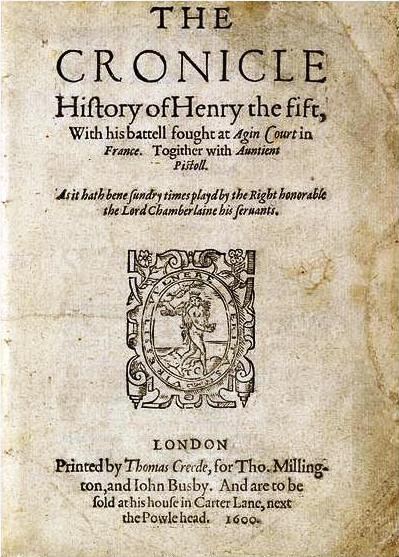
Shakespeare drew mainly on Raphael Holinshed's Chronicles (1587) and an older play, The Famous Victories of Henry V. Henry V was written in 1599, printed in a short quarto in 1600, and given in its full form in the First Folio of 1623.
Reception
The play has often been staged and filmed in times of national danger, notably Laurence Olivier's film of 1944, and in more searching productions such as Kenneth Branagh's of 1989. The St. Crispin's Day speech is one of the most quoted speeches on leadership in English.
Comparisons
- the-iliad
Homer's warriors seek glory and quarrel over honor; Henry gives glory to God and calls his soldiers brothers.
- julius-caesar
Both plays turn on persuasive public speech, but Antony moves a mob to revenge while Henry moves an army to courage.
- the-art-of-war
Sun Tzu advises winning without battle; Henry fights outnumbered and wins by morale and position.
- macbeth
Macbeth seizes a crown by murder and is destroyed; Henry prays to be spared the guilt of his father's usurpation.
Quotes
Frequently cited
“O for a Muse of fire, that would ascend The brightest heaven of invention”
Frequently cited
“Once more unto the breach, dear friends, once more”
Frequently cited
“his nose was as sharp as a pen, and ’a babbled of green fields”
Frequently cited
“Every subject’s duty is the King’s; but every subject’s soul is his own”
Frequently cited
“We few, we happy few, we band of brothers”
“Can this cockpit hold The vasty fields of France”
“In peace there’s nothing so becomes a man As modest stillness and humility”
“if the cause be not good, the King himself hath a heavy reckoning to make”
“Not today, O Lord, O, not today, think not upon the fault My father made in compassing the crown”
“For he today that sheds his blood with me Shall be my brother”
“Praised be God, and not our strength, for it”
“Small time, but in that small most greatly lived This star of England”
For Students
A reading companion for classical Christian high school students. See the student guide.
Reading Guide
Watch for
- The Chorus's speeches before each act and how they ask you to imagine more than the stage shows.
- Henry's charge to the Archbishop in Act 1, Scene 2 to speak truly because lives will be spent on his answer.
- The contrast between the Harfleur speech and Henry's threats to the governor of Harfleur in Act 3, Scene 3.
- The disguised king's argument with Williams, Bates and Court in Act 4, Scene 1, and the soliloquy that follows.
- How Henry responds to victory in Act 4, Scenes 7 and 8.
Key terms and names
- Chorus
- A narrator figure, from Greek drama, who introduces each act and bridges time and place.
- Salic law
- A French rule barring inheritance through the female line; the Archbishop argues it does not apply to France.
- Agincourt
- The battle in northern France on 25 October 1415 in which Henry's smaller army defeated the French.
- St. Crispin's Day
- The feast of the martyrs Crispin and Crispinian on 25 October, the day of the battle.
- Non nobis
- Psalm 115, 'Not unto us, O Lord,' which Henry orders sung after the victory.
- Ceremony
- The outward show of royalty; Henry calls it an idol that cannot give a king the sleep of a laborer.
Seminar Questions
- Comprehension Why does Henry go to war with France, and what does he demand of the Archbishop before deciding?
- Comprehension What do Williams and Henry argue about the night before the battle?
- Comprehension Why does Henry order the French prisoners killed?
- Interpretation Henry rejected Falstaff in Henry IV and allows Bardolph to hang here. Is he a better king, a harder man, or both?
- Interpretation Does Henry's answer to Williams settle the question of a king's responsibility for his soldiers?
- Interpretation How does the Epilogue change the meaning of the victory at Agincourt?
- Big Question What makes a war just, and who bears responsibility for its deaths?
Faith Connections
- Psalm 115:1 (Scripture)
"Not unto us, O Lord, not unto us, but unto thy name give glory." Henry orders this psalm, the Non nobis, sung after Agincourt.
- Ezekiel 18:20 (Scripture)
The son shall not bear the iniquity of the father. Henry's prayer that God not punish him for his father's usurpation reaches toward this teaching.
- Augustine, City of God XIX.7 (Church Fathers)
Augustine teaches that the wise man wages just wars with grief at their necessity. Henry's insistence on a lawful claim and his praise of peace reflect this tradition.
Logic and Rhetoric
Central argument: Henry claims France lawfully and wages war under God. He leads by speech, discipline and shared danger, and wins against great odds. Yet the play also shows the costs: traitors and friends executed, prisoners killed, a sick army, a ruined France and the loss of everything under his son. Therefore the play argues that even a just and glorious war is a heavy reckoning that only humility before God can rightly bear.
Rhetorical device: anaphora and inclusive address. In the St. Crispin's Day speech Henry repeats the feast's name and moves from 'we few' to 'we band of brothers,' drawing every soldier into a shared future memory.
Debate: Resolved: that Henry V was justified in ordering the killing of the French prisoners.
Memory Work
We few, we happy few, we band of brothers
Every subject’s duty is the King’s; but every subject’s soul is his own
Writing Prompts
Essay: Compare Henry's public speeches with his private soliloquy and prayer in Act 4, Scene 1. Argue what the private Henry adds to our judgment of the public king.
Comparison with Julius Caesar: Antony and Henry V are both great persuaders. Compare the funeral oration with the St. Crispin's Day speech and argue which uses rhetoric for a better end.
Medical Lens
The play records the bodily costs of war: Henry admits his army is much enfeebled by sickness on the march from Harfleur (historically dysentery), Fluellen's description of Bardolph's carbuncled face draws on tavern drinking, and the Hostess's account of Falstaff's death, with fumbling at the sheets, a sharp nose and cold feet, reads like a period description of the signs of approaching death. Nym's view that the king has run bad humours on the knight uses humoral language for heartbreak. The killing of prisoners and Burgundy's speech on a ruined France complete the picture of war's harm.
- Act 2, Scene 1 and Scene 3
Falstaff falls sick; Nym says the king has run bad humours on him, and the Hostess describes his death.
- Act 3, Scene 6
Fluellen describes Bardolph's face as all bubukles and whelks just before he is hanged; Henry admits his people are much enfeebled with sickness.
- Act 4, Scenes 6 and 7
The deaths of York and Suffolk, the slaughter of the boys with the baggage, and the order to kill the prisoners.
- Act 5, Scene 2
Burgundy describes the vineyards, fields and children of France gone wild through war.
Listen to the book
Public-domain audiobook from LibriVox, read by Various volunteers. Recording: Henry V on LibriVox (Internet Archive).
LibriVox recordings are volunteer readings released into the public domain. The reading may follow a different edition from the text in this library.
Creative Prompts
- Classroom
Read the Harfleur and St. Crispin's Day speeches aloud and mark each rhetorical move: appeal to honor, to family, to memory, to fellowship.
- Essay
Is Henry V an ideal Christian king? Weigh his prayers and humility against the threats at Harfleur and the order to kill the prisoners.
- Dialogue
Write the conversation between Henry and Williams after the glove is revealed, in your own words.
- Fiction
Write the night before Agincourt from the point of view of the boy who served Falstaff's old companions.
Further Reading
- Henry IV, Part 1, William Shakespeare
- Chronicles of England, Scotland and Ireland, Raphael Holinshed
Shakespeare's main source.
- Agincourt: The King, the Campaign, the Battle, Juliet Barker
- The Face of Battle, John Keegan
Includes a classic study of Agincourt.
Verification notes
Plot, sources and history are standard. Act and scene locators follow the attached Gutenberg text. The identification of the army's sickness as dysentery is historical, not stated in the play. Quotes are verified against the attached text.
No verification flags recorded.