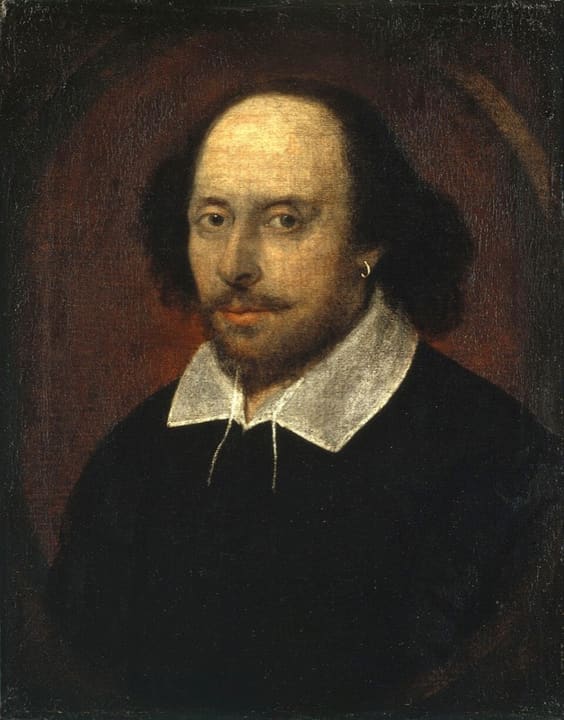
1564-1616 · English playwright, poet, and actor from Stratford-upon-Avon
Posthumous or imagined likeness of William Shakespeare. Source · Public domain
About William Shakespeare
William Shakespeare (1564-1616) was an English playwright, poet and actor from Stratford-upon-Avon whose plays and sonnets are the central achievement of English literature. The Taming of the Shrew is one of his earliest comedies, probably written in the early 1590s when he was newly established in the London theatre, and it was first printed in the First Folio of 1623.
“All the world’s a stage, And all the men and women merely players; They have their exits and their entrances, And one man in his time plays many parts”
“Last scene of all, That ends this strange eventful history, Is second childishness and mere oblivion, Sans teeth, sans eyes, sans taste, sans everything.”
“There’s a special providence in the fall of a sparrow. If it be now, ’tis not to come; if it be not to come, it will be now; if it be not now, yet it will come. The readiness is all”
“Life’s but a walking shadow; a poor player, That struts and frets his hour upon the stage, And then is heard no more: it is a tale Told by an idiot, full of sound and fury, Signifying nothing”
“Friends, Romans, countrymen, lend me your ears; I come to bury Caesar, not to praise him. The evil that men do lives after them, The good is oft interred with their bones;”
“I to the world am like a drop of water That in the ocean seeks another drop, Who, failing there to find his fellow forth, Unseen, inquisitive, confounds himself.”
“We few, we happy few, we band of brothers. For he today that sheds his blood with me Shall be my brother; be he ne’er so vile, This day shall gentle his condition;”
“And gentlemen in England now abed Shall think themselves accurs’d they were not here, And hold their manhoods cheap whiles any speaks That fought with us upon Saint Crispin’s day.”
c. 1590-92 (First Folio 1623) · Renaissance Early Modern · Drama
The Taming of the Shrew is a play within a play. In the Induction, the drunken tinker Christopher Sly is thrown out of an alehouse and falls asleep on the heath.
c. 1592-93 (published 1597) · Renaissance Early Modern · Drama
Richard III follows Richard, Duke of Gloucester, youngest brother of the Yorkist King Edward IV, from his first soliloquy to his death at Bosworth Field in 1485. The Wars of the Roses are over and peace has come, but Richard, born misshapen and unfit for courtship, tells the audience he has determined to prove a villain and win the crown.
c. 1594 (First Folio 1623) · Renaissance Early Modern · Drama
The Comedy of Errors takes place in a single day in the Greek city of Ephesus, where two sets of identical twins, separated as babies, are mistaken for each other until the whole town seems bewitched. Egeon, an old merchant of Syracuse, has been arrested because the two cities are at war and any Syracusan found in Ephesus must pay a thousand marks or die.
A Midsummer Night's Dream begins in Athens with a legal crisis: Egeus demands that Hermia marry Demetrius, while Hermia loves Lysander and faces punishment under Theseus's law. The lovers flee into the wood, followed by Demetrius and Helena, and the play transfers civic conflict into a night world governed by Oberon, Titania, Puck, and the flower whose juice alters desire.
c. 1595 (published 1597) · Renaissance Early Modern · Drama
Romeo and Juliet is a tragedy of two young lovers from feuding families in Verona, compressed by Shakespeare into about four days. A sonnet Prologue announces that a pair of star-crossed lovers will end their parents' strife by their deaths.
c. 1596-97 (published 1600) · Renaissance Early Modern · Drama
The Merchant of Venice joins two stories, a bond for a pound of flesh and a lottery of caskets, and moves between the commercial city of Venice and Belmont, the country estate of the heiress Portia. Antonio, a wealthy merchant, opens the play sad without knowing why.
c. 1596-97 (published 1598) · Renaissance Early Modern · Drama
Henry IV, Part 1 shows King Henry IV, who took the crown from Richard II, troubled by rebellion and by his own son. In Act I the king, hoping to lead a crusade to atone for Richard's fall, hears instead of war on the Welsh and Scottish borders, and envies the Earl of Northumberland his son Harry Percy, called Hotspur, who has won a victory at Holmedon, while his own heir, Prince Hal, wastes his days in the taverns of Eastcheap with the fat old knight Sir John Falstaff.
c. 1598-99 (published 1600) · Renaissance Early Modern · Drama
Much Ado About Nothing is set in Messina, Sicily, where the governor Leonato welcomes Don Pedro, Prince of Aragon, and his officers home from a victorious war. With the Prince come the young Florentine lord Claudio and the witty Paduan soldier Benedick, and also the Prince's sullen half-brother Don John, lately reconciled after a rebellion.
c. 1599 (First Folio 1623) · Renaissance Early Modern · Drama
As You Like It begins with two households divided by envy. Orlando, youngest son of the late Sir Rowland de Boys, complains to the old servant Adam that his elder brother Oliver keeps him like a peasant and denies him the education his father willed him.
Henry V follows the young King Henry, once the tavern-haunting Prince Hal, as he leads England to war with France and wins the battle of Agincourt in 1415. A Chorus opens each act, asking the audience to let their imaginations fill the small wooden theatre with the vasty fields of France.
Julius Caesar, Shakespeare's tragedy of the assassination of 44 BC, begins as Rome celebrates Caesar's triumph over the sons of Pompey. The tribunes rebuke the fickle crowd, a soothsayer warns Caesar to beware the Ides of March, and Caesar is offered a crown three times by Mark Antony and refuses it, then falls in a fit of the falling sickness.
Mark Antony's funeral oration, which opens Friends, Romans, countrymen, lend me your ears, is the turning point of Shakespeare's Julius Caesar (1599). Caesar has been stabbed to death in the Capitol by Brutus, Cassius and the other conspirators.
The St Crispin's Day speech is King Henry's address to his nobles in Act 4, Scene 3 of Shakespeare's Henry V, first performed in 1599. It is set on the morning of 25 October 1415 at Agincourt in northern France, where a small English army, worn down by sickness and a long march, faces a much larger French host.
Hamlet opens on the battlements of Elsinore, where sentries and the scholar Horatio see the ghost of the late King Hamlet of Denmark. Prince Hamlet, called home from university at Wittenberg for his father's funeral, is grieving and disgusted that his mother Gertrude has married his uncle Claudius, now king, within two months.
Twelfth Night begins with shipwreck, loss, and disguise. Viola believes her brother Sebastian drowned, enters Illyria as Cesario, and serves Duke Orsino, who sends her to woo Olivia.
c. 1603-04 (published 1622) · Renaissance Early Modern · Drama
Othello is the tragedy of a Moorish general in the service of Venice who is brought, step by step, to murder the wife who loves him. The play opens at night in a Venetian street, where the ensign Iago, furious that Othello has promoted the Florentine Michael Cassio over him, rouses the senator Brabantio with crude news that his daughter Desdemona has eloped with the Moor.
King Lear begins with a political and familial error: Lear divides Britain according to a public love test, accepts the fluent flattery of Goneril and Regan, rejects Cordelia's plain truth, and banishes Kent for trying to correct him. The abdication leaves Lear with the name of king but without the substance of rule, and the tragedy strips away retinue, shelter, authority, sanity, and finally family.
Macbeth opens on a Scottish heath where three witches plan to meet Macbeth. Returning from victory over rebels and Norwegian invaders, Macbeth and his fellow general Banquo meet the witches, who hail Macbeth as Thane of Glamis, Thane of Cawdor and future king, and tell Banquo that his descendants will be kings.
Sonnet 116 is Shakespeare's most famous definition of love, and it works by saying first what love is not. The speaker opens with a phrase borrowed from the church's marriage service: he will not admit impediments to the marriage of true minds.
Shakespeare's Sonnets is a sequence of 154 fourteen-line poems, nearly all in the form now named after him: three quatrains rhyming abab cdcd efef and a closing couplet gg, in iambic pentameter. The sequence has no plot in the ordinary sense, but readers since the eighteenth century have traced a loose story.
c. 1610-11 (First Folio 1623) · Renaissance Early Modern · Drama
The Tempest opens with a ship breaking apart in a storm off a remote island. On shore, the magician Prospero tells his fifteen-year-old daughter Miranda that he was once Duke of Milan.