Work record
First Inaugural Address ("The only thing we have to fear")
1933 · Early 20th Century · Oratory · English
Abstract
Background. Four months separated Roosevelt's election from his swearing-in, and in that gap a fresh banking panic shut doors across the country. Unemployment stood near a quarter of the labor force when he rose to speak.
Content. The new president pairs frank admission of hardship with assurance of recovery, calling panic the chief obstacle. He blames financiers who cling to discredited methods, rejects wealth as the measure of success, and outlines remedies: public employment, aid to farmers and mortgage holders, thrift in government, and close regulation of credit. Overseas affairs wait behind domestic repair. He hopes Congress will cooperate but reserves the option of requesting authority comparable to wartime command.
Themes. Confidence as a moral and economic good, work as a source of dignity, office as a public trust, and the strain between urgent action and constitutional balance. A good-neighbor pledge sketches the foreign policy.
Form. Gospel imagery, short commanding sentences, and an extended military metaphor carry a speech meant as much for radio listeners at home as for the crowd at the Capitol.
Significance. Within two days a nationwide bank holiday was declared, and Congress soon convened for the Hundred Days. The sentence about fear remains among the most quoted words of any American president.
Key figures
- Franklin D. Roosevelt: Thirty-second president, taking office
- Herbert Hoover: Outgoing president present on the platform
- Charles Evans Hughes: Chief Justice who swore Roosevelt in on his family's Dutch Bible
- Raymond Moley: Adviser who drafted the speech with Roosevelt
- Louis Howe: Aide traditionally credited with the line about fear

Summary
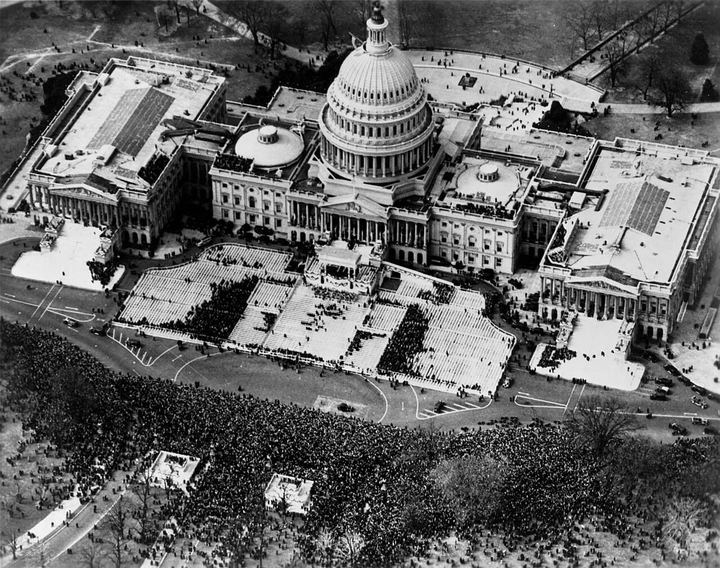
Franklin Roosevelt was inaugurated on Saturday, 4 March 1933, at the low point of the Great Depression. About a quarter of the work force was unemployed, farm prices had collapsed, and in the weeks before the ceremony a wave of bank runs had led governors in most states to close or restrict their banks. The address, spoken from the East Portico of the Capitol and carried nationwide by radio, ran to about 1,900 words. Roosevelt opens by promising candor and asserting that the nation will revive, then gives the line for which the speech is remembered: the only thing we have to fear is fear itself, a nameless, unreasoning terror that paralyzes the effort to turn retreat into advance. He lists the material damage plainly, values shrunk, savings gone, farmers without markets, and insists that the trouble is no failure of substance; there is no plague of locusts. The fault lies with the rulers of exchange, the money changers who have fled from their high seats in the temple of our civilization. The middle of the speech turns from diagnosis to remedy. Happiness lies in achievement, not possession; public office must not be prized for profit; and above all the nation asks for action, and action now. Roosevelt sketches the lines of attack: direct government employment, help for agriculture, relief from foreclosure, reduced government cost, oversight of banking, an end to speculation with other people's money, and a sound currency. Abroad he pledges the policy of the good neighbor. The close shifts to the image of a trained and loyal army. Roosevelt hopes the normal balance of executive and legislative power will suffice, but warns that if Congress fails to act he will ask for broad executive power to wage a war against the emergency. He ends by asking the blessing of God. Within days he declared a national bank holiday and called Congress into the special session that became known as the Hundred Days.
Virtues in this work
- Fortitude: Roosevelt calls a frightened nation to face its conditions honestly and refuses to let nameless terror paralyze the effort at recovery.
- Hope: He insists that the nation will revive and prosper, since the distress comes from no failure of substance.
- Industry: He places happiness in the joy of achievement and creative work, and names putting people to work as the greatest primary task.
- Justice: He demands an end to speculation with other people's money and to treating public office as a source of personal profit.
Plot or Argument
- Candor and fear itself (Paragraph 1)
Roosevelt promises to speak the whole truth, affirms that the nation will endure and revive, and names fear, nameless and unreasoning, as the one enemy that paralyzes recovery.
- The diagnosis: no failure of substance (Paragraphs 2-6)
He catalogues the collapse of values, trade, savings, and employment, but insists that nature's bounty remains. The failure belongs to the rulers of exchange, whose outworn methods have collapsed, and the money changers must be driven from the temple of civilization.
- True values (Paragraphs 7-8)
Happiness lies in the joy of achievement and creative work, not in money; public office must not be valued for pride or profit; and confidence can live only on honesty, honor, and faithful obligation.
- Action now: the lines of attack (Paragraphs 9-16)
The greatest task is to put people to work, by direct government recruiting and public projects, aided by farm relief, mortgage relief, economy in government, national planning of utilities, and strict supervision of banking and credit. Domestic recovery comes first, and abroad the nation will be a good neighbor.
- Discipline, the Constitution, and emergency power (Paragraphs 17-23)
Roosevelt asks the people to move like a trained and loyal army, praises the Constitution's flexibility, and warns that if Congress does not act he will ask for broad executive power equal to that granted in time of invasion.
- Pledge and prayer (Paragraphs 24-26)
He speaks of national unity and old moral values, declares that the people have given a mandate for direct, vigorous action, and closes by asking God's blessing and guidance.
Key claims
The main steps of the argument, in order, and how they fit together.
- The nation will endure and revive, and its chief obstacle is a nameless, unreasoning fear that paralyzes effort.How it is supported: A promise of candor and an appeal to national confidence at the opening.
- The crisis is no failure of material substance, since nature's bounty and the nation's resources remain.How it is supported: A plain catalogue of losses set against the image of plenty still at hand.
- The failure belongs to the rulers of exchange, whose outworn methods have collapsed.How it is supported: The biblical image of money changers driven from the temple.
- Happiness lies in achievement and creative work rather than money, and public office is a trust rather than a source of profit.How it is supported: Moral appeal to older values of work and service.
- Confidence can thrive only on honesty, honor, and faithful keeping of obligations.How it is supported: Appeal to the moral basis of banking and public trust.
- The greatest task is to put people to work, supported by farm and mortgage relief, thrift, and strict banking oversight.How it is supported: A concrete list of remedies and lines of attack.
- The people have demanded direct, vigorous action and must move together with the discipline of a loyal army.How it is supported: An extended military metaphor and the mandate of the election.
- The Constitution can meet the emergency, but broad executive power will be sought if Congress does not act.How it is supported: Comparison to the authority granted in time of foreign invasion.
Argument map
Supported by
- 3The failure belongs to the rulers of exchange, whose outworn methods have collapsed.
which rests on
- 2The crisis is no failure of material substance, since nature's bounty and the nation's resources remain.
- 5Confidence can thrive only on honesty, honor, and faithful keeping of obligations.
which rests on
- 1The nation will endure and revive, and its chief obstacle is a nameless, unreasoning fear that paralyzes effort.
- 4Happiness lies in achievement and creative work rather than money, and public office is a trust rather than a source of profit.
- 6The greatest task is to put people to work, supported by farm and mortgage relief, thrift, and strict banking oversight.
which rests on
- 7The people have demanded direct, vigorous action and must move together with the discipline of a loyal army.
- 8The Constitution can meet the emergency, but broad executive power will be sought if Congress does not act.
Therefore
Plain-language summaries of the author's argument, not quotations.
Lessons
Naming the real enemy
Roosevelt's most famous sentence identifies fear itself as the danger: a panic that stops people from spending, lending, and working and so deepens the very collapse it dreads. A leader's first task in a crisis, the speech suggests, is to tell the truth about conditions while refusing to let terror govern the response.
- How can fear make an economic crisis worse? Think of what a bank run is.
- Why does Roosevelt describe the fear as nameless, unreasoning, and unjustified?
- Can a speech by itself restore confidence, or must action follow at once?
Wealth and its proper place
The address argues that the Depression exposed a false standard of success. Happiness lies in achievement and creative effort; public office is a trust, not a source of profit; and confidence depends on honesty and honor. Roosevelt frames economic reform as the recovery of older moral truths.
- What does Roosevelt mean by restoring the temple to the ancient truths?
- Why does he say these dark days will be worth all they cost if they teach a certain lesson?
- Is it fair to blame a crisis chiefly on the money changers? What might they have answered?
Emergency and constitutional limits
Roosevelt praises the Constitution's flexibility and hopes the ordinary balance between Congress and the executive will be enough, but he warns that he may ask for war-like power over the emergency. The speech raises a perennial question: how far a free government may concentrate authority in a crisis without losing its essential form.
- What two courses does Roosevelt expect Congress to take, and what will he ask for if it takes neither?
- Why does he compare the Depression to a war and the people to an army?
- What dangers come with granting a leader emergency powers, and what safeguards does the speech mention?
Context
Since the stock market crash of 1929 the American economy had shrunk by roughly a quarter, and thousands of banks had failed. The Twentieth Amendment, ratified in January 1933, would later move inaugurations to January, but Roosevelt still waited four months after his election to take office, and in February 1933 a renewed panic forced bank closures across the country while Herbert Hoover and the president-elect could not agree on joint action. On inauguration morning, banks in most states were shut or restricted. Abroad, Hitler had become chancellor of Germany five weeks earlier.
Composition
Roosevelt's adviser Raymond Moley prepared drafts from Roosevelt's instructions, and Roosevelt rewrote the text in his own hand at Hyde Park; Louis Howe is generally credited with adding the line about fear, which does not appear in Moley's typescript. The thought has older precedents, including Montaigne's essay on fear. The stored Avalon text is the printed version, which omits the brief opening Roosevelt spoke on the day, and it contains the misprint stem performance of duty where the familiar text reads stern.
Reception
The crowd responded most loudly not to the line about fear but to the warning about broad executive power. By common accounts, nearly half a million letters reached the White House in Roosevelt's first week in office. Roosevelt proclaimed a national bank holiday on 6 March, Congress passed the Emergency Banking Act on 9 March, and the special session that followed enacted much of the early New Deal. The fear sentence became one of the most quoted lines in American political speech.
Comparisons
- lincoln-second-inaugural-address
Both inaugurals face a national ordeal and lean on Scripture, but Lincoln ventures no prediction and submits the outcome to God's purposes, while Roosevelt promises bold action and asks God to guide it.
- pearl-harbor-address
Roosevelt's two most famous speeches bracket his presidency's two crises; the war metaphor he used against the Depression in 1933 became literal in December 1941.
- kennedy-inaugural-address
Kennedy's 1961 inaugural shares Roosevelt's confidence and call to sacrifice, but its subject is the Cold War abroad, where Roosevelt kept foreign policy secondary to recovery at home.
- washington-farewell-address-and-selected-letters
Washington's Farewell praises the Constitution and warns against usurped power; Roosevelt's address tests the same framework by contemplating emergency authority within it.
Quotes
Frequently cited
“So, first of all, let me assert my firm belief that the only thing we have to fear is fear itself--nameless, unreasoning, unjustified terror which paralyzes needed efforts to convert retreat into advance.”
“This is preeminently the time to speak the truth, the whole truth, frankly and boldly.”
“They have no vision, and when there is no vision the people perish.”
“The money changers have fled from their high seats in the temple of our civilization. We may now restore that temple to the ancient truths.”
“Happiness lies not in the mere possession of money; it lies in the joy of achievement, in the thrill of creative effort.”
“This Nation asks for action, and action now.”
“I shall ask the Congress for the one remaining instrument to meet the crisis--broad Executive power to wage a war against the emergency, as great as the power that would be given to me if we were in fact invaded by a foreign foe.”
“In this dedication of a Nation we humbly ask the blessing of God. May He protect each and every one of us. May He guide me in the days to come.”
For Students
A reading companion for classical Christian high school students. See the student guide.
Reading Guide
Watch for
- The opening promise to speak the whole truth, immediately followed by the reassurance that the nation will revive.
- The plain list of losses in Paragraph 2, set beside the claim in Paragraph 4 that there is no failure of substance.
- The biblical imagery of Paragraphs 4-7: locusts, money changers in the temple, people perishing without vision.
- The repeated It can be helped in Paragraph 11, closing with it can never be helped merely by talking about it.
- The army metaphor in Paragraphs 17-18 and the warning about broad executive power in Paragraph 22.
Key terms and names
- Bank run
- A rush of depositors to withdraw their money for fear a bank will fail; the runs of February 1933 are the fear Roosevelt's famous sentence addresses.
- Money changers
- Roosevelt's name, borrowed from the Gospels, for the bankers and financiers he blames for the collapse.
- Foreclosure
- The seizure of a mortgaged home or farm when the owner cannot pay; Roosevelt promises to prevent the growing loss of small homes and farms.
- Good neighbor
- Roosevelt's phrase for a foreign policy of mutual respect and kept agreements, later applied especially to Latin America.
- Special session
- A meeting of Congress called outside its regular schedule; Roosevelt promises to bring detailed measures before one at once.
- Executive power
- The authority of the president; Roosevelt warns he may ask for powers as broad as those given in wartime.
Seminar Questions
- Comprehension What material losses does Roosevelt list in Paragraph 2, and what does he say is not the cause of the nation's distress?
- Comprehension What specific lines of attack does Roosevelt propose, and which does he call the greatest primary task?
- Interpretation Why does Roosevelt place the sentence about fear itself at the very beginning, before any proposal?
- Interpretation How do the images of the money changers and the temple shape the listener's view of the bankers and of reform?
- Interpretation What does Roosevelt gain and what does he risk by describing the people as a trained and loyal army?
- Big Question Is it ever right for a free people to give a leader war-like powers in peacetime, and if so under what limits?
- Big Question Roosevelt says happiness lies in achievement and creative effort. Is he right, and what would a Christian add to his account of happiness?
Faith Connections
- Matthew 21:12-13 (Scripture)
Jesus overturns the tables of the money changers and calls the Temple a house of prayer. Roosevelt borrows the scene to cast financial reform as cleansing and restoration.
- Proverbs 29:18 (Scripture)
Where there is no vision, the people perish. Roosevelt applies the proverb to leaders who knew only the rules of self-seekers.
- Mark 10:45 (Scripture)
The Son of man came not to be ministered unto but to minister. Roosevelt echoes the words in hoping the Depression will teach Americans to minister to their fellow men.
- Montaigne, Essays I.18, Of Fear (Great Conversation)
Montaigne writes that the thing he fears most is fear itself, since it can overpower judgment more than any other passion. Roosevelt's sentence turns the same observation into a public diagnosis.
Logic and Rhetoric
Central argument: The nation's resources are intact, so the crisis is a failure of those who managed exchange and of the fear that paralyzes recovery; restoring confidence requires honest values and immediate action to put people to work and regulate banking; the people have demanded such action; therefore the new president will lead it, through Congress if possible and with emergency power if necessary.
Rhetorical device: Anaphora. In Paragraph 11 Roosevelt opens sentence after sentence with It can be helped, then breaks the pattern: it can never be helped merely by talking about it.
Debate: Resolved: Roosevelt was right to warn that he would seek war-like executive power if Congress failed to act.
Memory Work
So, first of all, let me assert my firm belief that the only thing we have to fear is fear itself--nameless, unreasoning, unjustified terror which paralyzes needed efforts to convert retreat into advance.
Happiness lies not in the mere possession of money; it lies in the joy of achievement, in the thrill of creative effort.
Writing Prompts
Essay: Roosevelt calls the crisis no failure of substance and blames fear and the money changers. Analyze how the address combines moral diagnosis, practical program, and appeals to unity, and judge which element does the most persuasive work.
Comparison with Second Inaugural Address: Compare how Lincoln in 1865 and Roosevelt in 1933 speak about God's role in a national crisis. What does each ask of God, and what does each ask of the people?
Medical Lens
The famous sentence describes collective panic in nearly clinical terms: a nameless, unreasoning, unjustified terror that paralyzes needed effort. Read beside the bank runs of February 1933, it is a description of contagious anxiety and avoidance at the scale of a whole economy, and it is often cited in discussions of fear and behavior. Roosevelt's own paralysis after the illness of 1921 was diagnosed as poliomyelitis; some later writers have proposed Guillain-Barre syndrome instead, a retrospective reading that remains debated. The speech itself does not refer to his illness.
- Paragraph 1
Fear itself described as nameless, unreasoning, unjustified terror that paralyzes the effort to convert retreat into advance.
Creative Prompts
- Classroom
Divide the class into the groups Roosevelt addresses or blames: unemployed workers, farmers, small depositors, bankers, and members of Congress. Each group writes a one-paragraph reaction to the speech as heard on the radio on 4 March 1933.
- Essay
Trace Roosevelt's biblical images (the plague of locusts, the money changers in the temple, the people perishing without vision, ministering rather than being ministered unto) and explain how they turn an economic program into a moral appeal.
- Fiction
Write a short story set on the morning of 4 March 1933 in a small town whose bank has just closed its doors, ending as the family gathers around the radio for the inaugural.
Further Reading
- Freedom from Fear: The American People in Depression and War, 1929-1945, David M. Kennedy
Pulitzer Prize-winning history of the Depression and the war years, with a full account of the banking crisis and the inauguration.
- The Defining Moment: FDR's Hundred Days and the Triumph of Hope, Jonathan Alter
A narrative of the interregnum, the inaugural, and the first months of the New Deal.
- Nothing to Fear: FDR's Inner Circle and the Hundred Days That Created Modern America, Adam Cohen
- After Seven Years, Raymond Moley
Memoir by the adviser who drafted the address with Roosevelt and later broke with him.
Verification notes
The date, setting, banking crisis, and the bank holiday and Emergency Banking Act that followed are well documented. The respective shares of Moley, Howe, and Roosevelt in the drafting are reported differently in different accounts; the fear line is absent from Moley's typescript and is generally credited to Howe, though the participants' later recollections differ. The figure of nearly half a million letters in the first week is widely repeated in secondary accounts, some of which connect the mail to the first fireside chat of 12 March; it is given as approximate. The stored Avalon text omits the short opening Roosevelt spoke on the day and reads stem where the familiar text has stern; quotations follow the stored text and avoid that sentence. Paragraph numbers follow the 26 paragraphs of the stored text.
No verification flags recorded.