Work record
The Arabian Nights Entertainments
1898 · 19th Century · Short Stories · Arabic (Lang's English retelling, largely from Galland's French)
Abstract
Background. Lang issued this volume in the format of his coloured Fairy Books, drawing on Galland's French rather than the Arabic, cutting the poetry and adult episodes, and leaving Ali Baba out because it had already appeared in The Blue Fairy Book.
Content. A bride doomed to die at dawn keeps a vengeful ruler listening night after night. Her early tales nest inside one another: a genie loosed from a jar, a healer slain by an ungrateful monarch, an enchanted lake of coloured fish. Later pieces stand alone, from the seafarer's seven shipwrecks and the comic corpse of a hunchback to the magic lamp, a mechanical flying horse, and three royal children who recover a speaking bird from a mountain of black stones.
Form. The storyteller's dawn interruptions appear only at the opening; afterward the tales run whole, and the outer story is never formally closed.
Themes. Wit outmatching force, the punishment of envy and ingratitude, fortune lost through greed or carelessness, a ruler who learns the truth by walking among his subjects, and narration itself as a means of rescue.
Significance. For generations of English-speaking children this was the doorway to the Nights, fixing the familiar shapes of the genie, the roc and the lamp in the nursery imagination.
Main characters
- Scheherazade: Vizir's daughter who tells tales to save her life and others'
- Schahriar: Sultan who executes each new bride until curiosity stops him
- Dinarzade: Younger sister who prompts each night's story
- Sindbad the Sailor: Bagdad merchant who survives seven voyages
- Aladdin: Tailor's son served by the genies of a ring and a lamp
- Haroun-al-Raschid: Caliph who roams Bagdad by night in disguise
- Douban: Physician betrayed by the king he healed
- Parizade: Lost princess who wins the Talking Bird

Summary
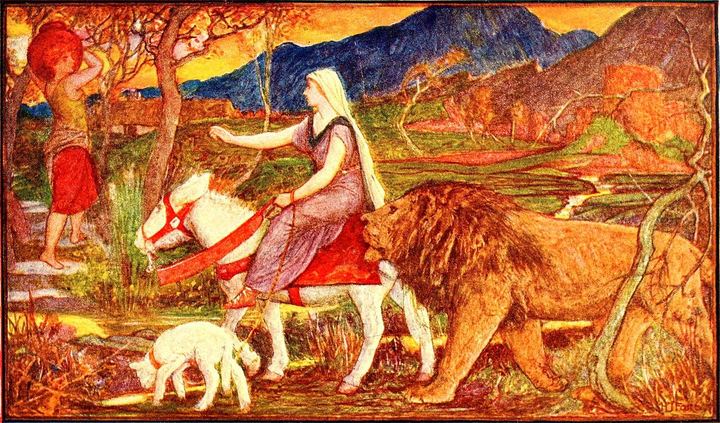
The Arabian Nights Entertainments is Andrew Lang's 1898 selection of the Thousand and One Nights for children, retold in English from Antoine Galland's early eighteenth-century French version. The frame story comes first. The Sultan Schahriar, betrayed by his wife, marries a new bride each evening and has her strangled each morning, until Scheherazade, the grand-vizir's learned and courageous elder daughter, insists on marrying him. Her sister Dinarzade wakes her before dawn to ask for a story; Scheherazade always stops at the most exciting point, and the curious Sultan spares her another day. Lang keeps this device only for the first tales and does not narrate the frame's ending. The merchant who killed a genie's son with a date-stone is saved when three old men tell stories of a hind, two black dogs and a mule. A poor fisherman nets a sealed copper jar, releases a furious genie and tricks him back inside; within his tale comes the Greek king who executes the physician Douban, who had cured his leprosy, and is killed by the poisoned pages of the dead man's book. The fisherman's four-coloured fish lead a Sultan to the young King of the Black Isles, half turned to marble by his wife. A Bagdad porter, three sisters, three one-eyed calenders and the disguised Caliph Haroun-al-Raschid exchange astonishing histories, including the tale of the Envious Man. Sindbad the Sailor tells the porter Hindbad of seven voyages: a whale mistaken for an island, the roc and the valley of diamonds, a man-eating giant, burial alive with his dead wife, the Old Man of the Sea, a river of jewels, and the graveyard of the elephants. The Little Hunchback, apparently killed by a fishbone, is passed from a tailor to a Jewish doctor, a purveyor and a broker, each believing himself guilty, and the garrulous barber tells of his brothers, including Alnaschar who smashes his glassware while daydreaming. Then come Camaralzaman and Badoura, lovers brought together by genies; Noureddin and the Fair Persian; Aladdin, who outwits an African magician with the ring and the lamp and loses his palace to the cry of new lamps for old; Haroun's nights among the blind Baba-Abdalla, Sidi-Nouman and his ghoul wife, and Ali Colia's gold hidden in an olive jar; the Enchanted Horse that carries Prince Firouz Schah to the Princess of Bengal; and the Two Sisters, whose plot against their younger sister is undone by the Talking Bird, the Singing Tree and the Golden Water. Lang's preface explains that verses and passages unsuitable for children are left out; H. J. Ford drew the pictures.
Virtues in this work
- Fortitude: Scheherazade insists on becoming the Sultan's bride, knowing she may be strangled at dawn, to end his killing of the kingdom's daughters.
- Prudence: The old fisherman, threatened with death, asks the genie to prove he fitted in the jar and slams the lid on him.
- Charity: Sindbad feeds the complaining porter Hindbad, tells him his history and sends him home each day with a hundred sequins.
- Justice: The Caliph, having heard Ali Colia's case judged by a child at play, has the child decide the real case and restores the stolen gold.
- Magnanimity: Parizade climbs the mountain without looking back at the mocking voices that turned her brothers to stone, and frees them.
Plot or Argument
- The frame: Scheherazade and the Sultan
Schahriar's daily executions end when Scheherazade volunteers as his bride and, with Dinarzade's help, begins a story before dawn that the Sultan wants finished.
- The Merchant, the Fisherman and the Physician Douban
Three old men buy a merchant's life with tales; a fisherman tricks a genie back into his jar and tells how the Greek king's ingratitude to the physician Douban was punished.
- The Black Isles and the Three Calenders
The coloured fish reveal an enchanted kingdom and a half-marble king; in Bagdad, the porter, Zobeida's household, the calenders and the disguised Caliph trade histories, including the Envious Man.
- The Seven Voyages of Sindbad the Sailor
Sindbad shows the porter Hindbad that his fortune was won through shipwreck, rocs, giants, burial alive, the Old Man of the Sea and slavery among elephant hunters.
- The Little Hunchback and the Barber's Brothers
A comic chain of supposed killers each confesses to save another, and the talkative barber's tales of Alnaschar and the Barmecide's imaginary feast entertain the Sultan of Kashgar; the barber draws the fishbone out with pincers and the hunchback lives.
- Camaralzaman and Badoura; Noureddin and the Fair Persian
Genies bring together a prince and princess who have each refused marriage and are each thought mad; a young spendthrift and a learned slave girl are rescued by the Caliph's favour.
- Aladdin and the Wonderful Lamp
An idle tailor's son is used and abandoned by an African magician, discovers the genies of the ring and the lamp, wins the Sultan's daughter, loses everything to the magician's trick and wins it back.
- The Caliph's night walks
Haroun-al-Raschid hears Baba-Abdalla's tale of greed punished by blindness, Sidi-Nouman's account of his ghoul wife Amina, and the case of Ali Colia's gold, judged first by a child at play.
- The Enchanted Horse
A mechanical horse flies Prince Firouz Schah to the Princess of Bengal; when she is stolen away to Cashmere she feigns madness, and he rescues her disguised as a physician.
- The Two Sisters Who Were Jealous of Their Younger Sister
Jealous sisters replace the Sultana's babies with animals and a log; the children, raised by the gardener, win the Talking Bird, Singing Tree and Golden Water, and the bird tells the Sultan the truth.
Characters
- Scheherazade, storyteller
The grand-vizir's elder daughter, educated in philosophy, medicine and history, who risks her life to stop the Sultan's cruelty.
- Dinarzade, sister
Scheherazade's younger sister, who asks for a story an hour before dawn each night.
- Schahriar, Sultan
The betrayed ruler who marries and executes a bride each day until curiosity stays his hand.
- The Fisherman, hero of a tale
A poor old fisherman who frees a murderous genie from a jar and outwits him.
- Douban, physician
A learned physician who cures the Greek king's leprosy and is repaid with execution.
- Sindbad the Sailor, narrator of the voyages
A rich Bagdad merchant who tells of seven perilous voyages to the porter Hindbad.
- Hindbad, porter
A tired porter who envies Sindbad's wealth and is invited in to hear what it cost.
- Haroun-al-Raschid, Caliph of Bagdad
The Caliph who walks the city in disguise with his vizir Giafar and hears strange histories.
- Aladdin, hero
The idle son of Mustapha the tailor who becomes master of the lamp and husband of the Sultan's daughter.
- The African magician, villain
A sorcerer who pretends to be Aladdin's uncle to get the lamp and later steals it back.
- Camaralzaman and Badoura, lovers
A Persian prince and the Princess of China who each refuse marriage until genies show them to each other.
- Prince Firouz Schah, hero
The Persian prince carried by the Enchanted Horse who rescues the Princess of Bengal.
- Parizade, heroine
The Sultan's lost daughter who succeeds where her brothers Bahman and Perviz fail and wins the Talking Bird.
Lessons
A story can save a life
Scheherazade has no army and no weapon, only learning, courage and the power to make a listener want to know what happens next. The frame turns storytelling itself into an act of rescue for the girls of the kingdom.
- Why does Scheherazade want to marry the Sultan when everyone else is afraid?
- How does she make sure the Sultan will let her live another day?
- Have you ever wanted so badly to hear the end of a story that you could not stop listening?
Ingratitude and envy bring their own punishment
The Greek king kills the physician who cured him and dies by the physician's poisoned book; the jealous sisters lose everything when the Talking Bird speaks. Again and again the tales show envy and ingratitude turning back on the one who harbours them.
- Why does the grand-vizir want the king to distrust Douban?
- What should the king have said to his vizir?
- How is the truth finally told in the story of the Two Sisters?
Cleverness against brute power
A small fisherman shuts a giant genie back in his jar by asking him to prove he fits; Sindbad gets the Old Man of the Sea drunk; the Princess of Bengal pretends to be mad. The weak survive by quick thinking rather than strength.
- How does the fisherman trick the genie into the jar?
- Which clever escape in the book do you like best, and why?
Riches are earned by hardship, and greed loses them
Sindbad tells the envious porter that his wealth came through years of danger, and he shares it with him. Baba-Abdalla, who already had forty camels laden with treasure, loses his sight by demanding the dervish's last box of ointment.
- What does Sindbad want Hindbad to understand about his wealth?
- Why does Baba-Abdalla ask strangers to strike him?
- Is Aladdin's fortune earned or only lucky?
Context
The Thousand and One Nights grew over centuries from Persian, Indian and Arabic story traditions; the frame and many tales were written down in Arabic in the Middle Ages, and the oldest substantial manuscript is usually dated to the fourteenth or fifteenth century. Many tales are set in the Bagdad of the Abbasid Caliph Haroun al-Raschid (reigned 786-809), whom Lang's preface names along with his Barmecide vizir. The book reached Europe through Antoine Galland's French Les Mille et une nuits (1704-1717), which added tales such as Aladdin that are not found in the earlier Arabic manuscripts.
Composition
Lang's preface says the stories are translated from Galland, shortened in places, with the verses and passages suitable only for adult readers omitted, and that the translations are by the writers of the tales in his Fairy Books. Longmans, Green and Co. published the volume in 1898 with illustrations by H. J. Ford, uniform with the Fairy Books. Ali Baba and the Forty Thieves is not in this volume; Lang had already printed it in The Blue Fairy Book (1889).
Reception
Lang's selection became one of the standard children's versions in English and stayed in print through the twentieth century, alongside the fuller adult translations of Edward Lane, John Payne and Richard Burton. Aladdin, Sindbad and the fisherman's genie entered English pantomime, illustration and film largely through such versions, and Lang's preface records his own delight at reading the Nights at six.
Comparisons
- the-blue-fairy-book
Lang's first Fairy Book, made by the same team in the same format, contains Ali Baba and the Forty Thieves and an earlier version of the Aladdin story's world of genies and magic objects.
- the-odyssey
Lang's preface suggests Sindbad's adventures may come from the Odyssey; the man-eating giant of the third voyage, whom Sindbad blinds with a heated spit, closely parallels Odysseus and the Cyclops.
- the-canterbury-tales
Both are frame-tale collections in which a larger story gives the reason for telling many smaller ones; Chaucer's pilgrims compete for a supper, Scheherazade tells for her life.
- tanglewood-tales
Hawthorne retold Greek myths for American children as Lang retold the Nights for British children: both soften and shorten old adult material while keeping its marvels.
- just-so-stories
Kipling's tale of the Butterfly that Stamped features Suleiman-bin-Daoud, Balkis and a Djinn, drawing on the same world of Eastern legend that the Nights made familiar to English children.
- aesops-fables
Several embedded tales, such as the husband and the parrot, are told by vizirs to prove a point to a king, much as fables were used to teach prudence through short, pointed stories.
- lane-thousand-and-one-nights
Edward William Lane's scholarly translation (1838-41) works directly from the Arabic rather than Galland's French and adds extensive notes on Arab customs; it gives fuller adult versions of tales Lang retells for children, such as the Fisherman and the Jinnee.
Quotes
Frequently cited
“My dear sister, if you are not asleep, tell me I pray you, before the sun rises, one of your charming stories.”
“If I fail, my death will be a glorious one, and if I succeed I shall have done a great service to my country.”
“The Sultana told a story, and the Sultan let her live to finish it.”
“do not trifle thus with me, a poor fisherman, who can hardly support his family!”
“see how cruelty and injustice are punished.”
“I have only reached this happy state after having for years suffered every possible kind of toil and danger.”
“who can help laughing to see an old fool offering to exchange fine new lamps for old ones?”
“the cure depended neither on them nor their skill, but only on the princess herself.”
For Students
A reading companion for classical Christian high school students. See the student guide.
Reading Guide
Watch for
- The plan Scheherazade makes with Dinarzade before her wedding night, and the place where she stops each story.
- Stories told inside other stories, such as the Greek King and Douban inside the Fisherman.
- How Sindbad begins each voyage by deciding to go to sea again, even after the last disaster.
- The cry of new lamps for old in Aladdin, and who in the palace does not know what the old lamp is.
- The Talking Bird's speech to the Sultan about a cucumber stuffed with pearls.
Key terms and names
- Genius (genie)
- A powerful spirit of the Nights; some, like the fisherman's genie, are cruel, while the Slaves of the Ring and the Lamp must obey whoever holds them.
- Vizir
- A Sultan's chief minister; Scheherazade's father is the grand-vizir, and envious vizirs cause trouble in several tales.
- Caliph
- The ruler of the Faithful in Bagdad; Haroun-al-Raschid walks the city in disguise to learn what his people are doing.
- Calender
- A wandering dervish; the three calenders who visit Zobeida's house are princes who each lost an eye.
- Roc
- A bird so huge it can carry off elephants; Sindbad ties himself to one to escape an island.
- Frame story
- The outside story, here Scheherazade and the Sultan, that gives a reason for telling all the other stories.
Seminar Questions
- Comprehension Why does the Sultan stop killing a new wife each morning after Scheherazade begins her first story?
- Comprehension How does the fisherman get the genie back into the copper jar?
- Comprehension How does Aladdin first get out of the cave after the magician shuts him in?
- Interpretation The Greek king was cured by Douban and then had him killed. Why did he listen to his vizir instead of trusting his own good memory?
- Interpretation Sindbad keeps going back to sea after terrible dangers. Is he brave, greedy or something else?
- Interpretation Parizade succeeds where her two brothers failed on the mountain. What did she do differently?
- Big Question Can a good story change a hard heart? What does Scheherazade's plan suggest?
Faith Connections
- Esther 4:14-16 (Scripture)
Queen Esther goes uninvited before a Persian king to save her people, saying that if she perishes, she perishes. Scheherazade likewise risks death before a Persian sultan for the sake of others.
- Proverbs 14:30 (Scripture)
Envy is the rottenness of the bones. The Envious Man, the vizir who slanders Douban and the jealous sisters of the last tale are all destroyed by it.
- Luke 12:15 (Scripture)
Jesus warns against covetousness, for life does not consist in the abundance of possessions. Baba-Abdalla, given forty camels of treasure, loses his sight by demanding the last box of ointment.
- G. K. Chesterton, Orthodoxy, chapter 4 (The Ethics of Elfland) (Great Conversation)
Chesterton argues that fairy tales teach the doctrine of conditional joy: everything depends on one condition kept. Aladdin keeps his palace only while he keeps the lamp, and loses it the moment he leaves it on a cornice.
Logic and Rhetoric
Central argument: The Sultan has concluded that no wife can be trusted and acts on it with cruelty. Scheherazade cannot argue him out of it directly, but every night she places before him stories of ingratitude punished, mercy rewarded and truth revealed, and each morning his curiosity keeps her alive. Therefore patient storytelling, not force, is shown overcoming a ruler's hardened judgment.
Rhetorical device: frame narrative with embedded tales. In The Story of the Fisherman, the fisherman tells the genie the tale of the Greek King and Douban, and inside that the king tells a vizir's tale of the husband and the parrot, each story used as an argument against the listener.
Debate: Resolved: that the fisherman was right to let the genie out of the jar a second time.
Memory Work
If I fail, my death will be a glorious one, and if I succeed I shall have done a great service to my country.
The Sultana told a story, and the Sultan let her live to finish it.
Writing Prompts
Essay: Choose two tales in which someone is repaid with evil for doing good, such as Douban and the fisherman. Explain how each story makes sure that justice is done in the end.
Comparison with The Odyssey: Compare Sindbad's escape from the man-eating giant in the Third Voyage with Odysseus's escape from the Cyclops. What do the two heroes do the same, and what is different?
Medical Lens
For a children's book, Lang's selection carries a surprising number of physicians and feigned or imputed madness. The physician Douban cures the Greek king's leprosy by a drug hidden in the hollow handle of a polo club, absorbed as the king sweats at play and followed by a bath and sleep, a tale often noticed as a literary picture of medieval Islamic learned medicine and of the court physician's precarious position; his revenge by a book with poisoned pages is a poisoning-by-contact motif. In The Little Hunchback a Jewish doctor, eager for a fee, stumbles over the body in the dark and believes he has killed his patient. Madness is a recurrent social device: the King of China confines Badoura as insane for refusing marriage and promises her to whoever can cure her, Camaralzaman's own father thinks him out of his senses, and the Princess of Bengal feigns madness so convincingly that court doctors, city doctors and foreign professors fail, some prescribing harmless potions from sight alone, until Firouz Schah comes disguised in a physician's robe. These are readings of folk narrative, not case histories, but they show a world in which marriageability, honour and madness were bound together and in which the physician was both honoured and suspected. Other details include Sindbad's companions maddened by a herb given them by cannibals in the fourth voyage, his burial alive with his dead wife, the blinding of Baba-Abdalla with an ointment, and the one-eyed calenders.
- The Story of the Greek King and the Physician Douban
Douban cures the king's leprosy with a drug in the handle of a polo club, is executed through the vizir's slander, and kills the king by a poisoned book.
- The Little Hunchback
The hunchback chokes on a fishbone; a Jewish doctor, a purveyor and a broker each believe they have killed him until the barber revives him.
- The Adventures of Prince Camaralzaman and the Princess Badoura
Badoura is shut up as insane for refusing to marry, with a cure promised to any suitor; Marzavan, posing as an astrologer, brings the lovers together.
- The Seven Voyages of Sindbad the Sailor, Fourth Voyage
Sindbad's companions are given a herb that drives them mad before they are fattened to be eaten; later he is buried alive with his dead wife by local custom.
- The Story of the Blind Baba-Abdalla
A dervish's ointment shows hidden treasure when applied to one eye but blinds the greedy Baba-Abdalla when applied to the other.
- The Enchanted Horse
The Princess of Bengal feigns madness; doctors are summoned from far and wide, and the prince gains access to her disguised as a physician.
Listen to the book
Public-domain audiobook from LibriVox, read by Various volunteers. Recording: Arabian Nights Entertainments on LibriVox (Internet Archive).
LibriVox recordings are volunteer readings released into the public domain. The reading may follow a different edition from the text in this library.
Creative Prompts
- Classroom
Draw a set of nesting boxes to show how the Fisherman's story holds the Greek King's story, which holds the story of the husband and the parrot. Label who is telling each one.
- Fiction
Write an eighth voyage for Sindbad, and end it at an exciting moment, as Scheherazade would, so that the listener must ask for more.
- Dialogue
Write the conversation between Hindbad and his family when he comes home with Sindbad's gift of a hundred sequins.
- Essay
Who is braver, Scheherazade or Sindbad? Use one scene from each to support your answer.
Further Reading
- The Blue Fairy Book, Andrew Lang (ed.)
Contains Ali Baba and the Forty Thieves.
- The Arabian Nights, Husain Haddawy (trans.)
Translation for adults from the fourteenth-century Syrian manuscript edited by Muhsin Mahdi.
- The Arabian Nights: A Companion, Robert Irwin
- Tales from the Arabian Nights, James Riordan
Verification notes
Contents, story order, character names and all quotations follow the attached Project Gutenberg text (#128), whose title page credits Lang and the Longmans 1898 edition; every quote was found by search in that file. The statement that the translations are by the writers of the Fairy Books, the omission of verses, and the credit to Mr. Ford for pictures come from Lang's own preface. That Ali Baba is absent here is confirmed by searching the file; its earlier appearance in The Blue Fairy Book (1889) is from general knowledge. The dating of the oldest Arabic manuscript (14th-15th century) and Galland's dates (1704-1717) are standard but given approximately. Lang's text locates Aladdin's city inconsistently (the magician 'left Persia', later travels to 'the capital of China'), so the record does not name the city. The contents list and heading say 'Ali Colia', but the tale itself calls him 'Ali Cogia'; the record keeps the heading's form.
- Whether the James Riordan retelling is still in print under that exact title.
- Exact span of Galland's volumes (1704-1717 is commonly given; some sources end at 1715 for the volumes published in his lifetime).
- Which Fairy Book collaborators translated which tales in this volume (the preface names none individually).