Work record
The Thirty-Nine Steps
1915 · Early 20th Century · Novel · English
Abstract
Background. Bedridden during the opening months of the Great War, Buchan wrote what he called a shocker for his friend Tommy Nelson. Blackwood's magazine ran it first, and the firm issued the book that autumn.
Plot. When the frightened American who confided a conspiracy to him is stabbed, Hannay becomes suspect and quarry at once. Disguised in turn as milkman, road-mender and drover, he crosses the Scottish uplands, breaks Scudder's cipher, escapes the spy chief's farmhouse with a charge of explosive and survives fever in a cottage box-bed. A London official finally trusts him; the premier dies as foretold, an impostor walks out of a defence council with the fleet's plans in his head, and the clue of a beach staircase leads to arrests on the Kentish cliffs.
Form. Hannay tells the tale himself in breezy, slangy prose; most chapter titles name the adventure of some chance encounter, giving a picaresque rhythm of pursuit and refuge.
Themes. Courage that coexists with fear, the kindness of strangers on a remote road, the power and limits of disguise, and patient reasoning from fragments of evidence. Buchan also sketches the anxious mood of a peaceful country unaware of how near war has come.
Significance. The innocent man chased by police and foreign agents alike became a governing pattern for twentieth-century espionage fiction, renewed by Hitchcock's 1935 film.
Main characters
- Richard Hannay: Rhodesian mining engineer turned fugitive and amateur agent
- Franklin P. Scudder: American informant murdered in Hannay's flat
- The old man of the Black Stone: Spy chief with hooded hawk's eyes and many masks
- Sir Walter Bullivant: Foreign Office man and keen trout fisherman
- Sir Harry: Earnest young Liberal candidate in the Borders
- Alexander Turnbull: Road-mender whose spectacles and barrow Hannay borrows
- Marmaduke Jopley: Snobbish idler robbed of his motor-car

Summary
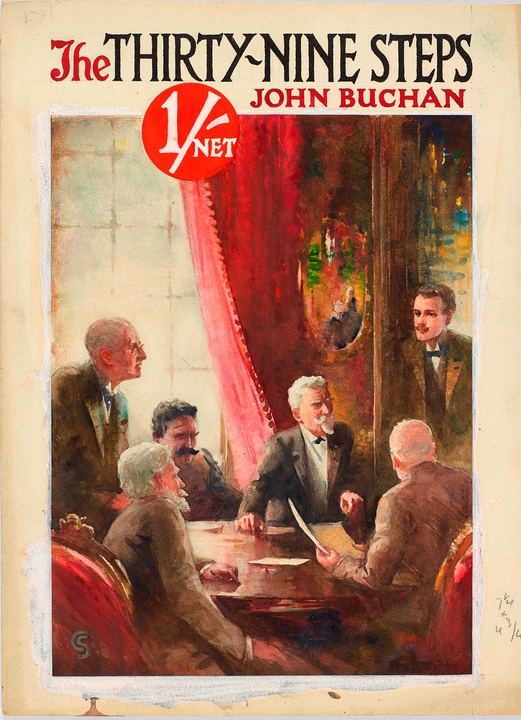
Richard Hannay, a thirty-seven-year-old Scottish-born mining engineer who has made his money in Rhodesia, has come home to London in the spring of 1914 and finds himself bored almost to despair. One May evening a neighbor from the top floor of his building, an American named Franklin P. Scudder, begs to be taken in. Scudder has faked his own death and explains that he has uncovered a plot: agents of a German ring called the Black Stone mean to murder the Greek premier Constantine Karolides in London on 15 June and set Europe at war. Four days later Hannay comes home to find Scudder pinned to the floor with a knife through his heart. Knowing that the police will suspect him and that the killers will come for him next, Hannay borrows the milkman's cap and overalls, slips out of the building, and takes the train to Galloway, carrying Scudder's little black notebook. In the Scottish hills both the police and the enemy hunt him, the enemy even from a monoplane. At a lonely inn a young innkeeper who longs to write adventure stories hides him, and Hannay cracks Scudder's cipher with the key word Julia Czechenyi; the notebook reveals that the real plan is to steal British naval plans when a French general visits London. Escaping in his pursuers' own car, he crashes to avoid Sir Harry, a young Liberal candidate, and has to give a political speech in his place. Sir Harry sends him to his godfather Sir Walter Bullivant of the Foreign Office. On the run again, Hannay passes himself off as a drunken roadman, Alexander Turnbull, under the eyes of his enemies, and steals the car of the snobbish Marmaduke Jopley. He then blunders into the moorland house of a bald, kindly-seeming archaeologist who turns out to be the man Scudder most feared, the one who could hood his eyes like a hawk. Locked in a storeroom, Hannay blows his way out with an explosive called lentonite, hides on top of a dovecot, discovers a secret airfield, and reaches Turnbull's cottage, where the roadman nurses him through a bout of malaria. At Bullivant's Thames-valley cottage he is believed. Karolides is shot, and at a secret conference in London Hannay realizes that the First Sea Lord who has just left the room is an impostor, one of the Black Stone in disguise. Working from Scudder's note about thirty-nine steps and a high tide at 10.17, he traces the spies to a villa on a Kentish headland whose private staircase to the beach has exactly thirty-nine steps. Over a game of bridge he sees through their disguise and has them arrested; one escapes down the steps, but their yacht, the Ariadne, has already been seized. Seven weeks later war breaks out and Hannay joins the army. Written while Buchan was ill in the first months of the war, the novel was serialized in Blackwood's Magazine and published as a book by William Blackwood and Sons in 1915.
Virtues in this work
- Fortitude: Hannay sets the lentonite charge in the locked storeroom knowing it may kill him, because the alternative is certain death and failure.
- Charity: Turnbull nurses the fevered stranger for ten days and has to be pressed to accept any payment.
- Justice: Hannay takes up the murdered Scudder's mission because he hates to see a good man downed.
- Prudence: Hannay solves the riddle of the thirty-nine steps by listing what he knows and ruling out harbours and steamers before consulting a coastguard.
Plot or Argument
- Chapter I: The Man Who Died
Bored with London, Hannay takes in his frightened neighbor Scudder, who tells him of a plot to kill Karolides on 15 June and set off a European war. Scudder lives hidden in Hannay's flat for four days, until Hannay finds him stabbed to death.
- Chapter II: The Milkman Sets Out on his Travels
Expecting to be charged with the murder or killed himself, Hannay resolves to carry on Scudder's work. He bribes the milkman for his clothes and cans, leaves the building in disguise, and takes the night train north to Galloway.
- Chapter III: The Adventure of the Literary Innkeeper
On the moors he sees a monoplane searching for him. A young innkeeper who wants to write like Kipling shelters him; Hannay decodes Scudder's notebook and learns that the true aim is to steal British naval plans. He escapes in the car of two of his pursuers.
- Chapter IV: The Adventure of the Radical Candidate
Hannay wrecks the car to avoid another, meets Sir Harry, and saves the young man's political meeting at Brattleburn with a speech about Australia. Sir Harry believes his story and gives him a letter for Sir Walter Bullivant.
- Chapter V: The Adventure of the Spectacled Roadman
Hannay takes the place of the hung-over roadman Turnbull, deceives three of the enemy who stop to question him, and then commandeers the car of Marmaduke Jopley.
- Chapter VI: The Adventure of the Bald Archaeologist
Taking refuge in a moorland house, Hannay finds that his genial host is the chief of the Black Stone. Locked in a storeroom, he blasts his way out with lentonite, hides on a dovecot, and spies a hidden aerodrome.
- Chapter VII: The Dry-Fly Fisherman
Turnbull nurses Hannay through malaria. At Artinswell on the Kennet a fisherman proves to be Sir Walter Bullivant, who clears him of the murder but doubts Scudder's story until word comes that Karolides has been shot.
- Chapter VIII: The Coming of the Black Stone
Restless in London, Hannay fights his way to Bullivant's house and sees a man he takes for the First Sea Lord, Lord Alloa, leave a secret conference. He proves that the visitor was an impostor who has memorized the naval plans.
- Chapter IX: The Thirty-Nine Steps
Hannay reasons from Scudder's note to a stretch of coast with private stairs and a tide at 10.17. A coastguard points him to the Ruff near Bradgate in Kent, where a villa called Trafalgar Lodge has a staircase of thirty-nine steps and a yacht lies offshore.
- Chapter X: Various Parties Converging on the Sea
The three men at Trafalgar Lodge seem to be ordinary Englishmen, and Hannay nearly gives up. A small gesture during a game of bridge betrays the old man; the spies are seized, the youngest escapes down the steps, and the yacht Ariadne is already taken.
Characters
- Richard Hannay, narrator and hero
A Scottish-born mining engineer back from Rhodesia, resourceful, plain-spoken and quick in disguise, who carries on a dead man's mission.
- Franklin P. Scudder, American freelance spy
Hannay's nervous, theatrical neighbor, who discovers the Black Stone's plans and is murdered in Hannay's flat.
- The bald archaeologist, chief of the Black Stone
An old man with a young voice and hooded eyes, who poses as a genial scholar on the moors and later as a retired stockbroker named Appleton.
- Sir Walter Bullivant, Foreign Office official
Sir Harry's godfather, a shrewd fisherman who believes Hannay and sets the government's machinery to work.
- Sir Harry, Liberal parliamentary candidate
A kindly young politician whose meeting Hannay rescues, and who sends him to Bullivant.
- Alexander Turnbull, roadman
A Scottish road-mender whose job and spectacles Hannay borrows, and who later nurses him through fever without asking his name.
- The literary innkeeper, young host of a moorland inn
A would-be writer who hides Hannay and helps him outwit his pursuers.
- Marmaduke Jopley, society idler
A snobbish young man whose car Hannay commandeers and who later tries to have him arrested in London.
- Karolides, Greek premier
The statesman whose assassination Scudder predicted.
- Paddock, Hannay's manservant
The servant who finds Scudder's body and raises the alarm.
Lessons
Carrying on another man's work
Hannay has no duty to Scudder beyond four days of hospitality, yet the sight of the dead man's face makes him resolve to finish what Scudder began. Buchan presents courage as an ordinary man's decision to keep faith with someone who trusted him, not as fearlessness.
- Why does Hannay decide in Chapter II not to go to the police?
- What does Hannay mean when he calls himself an ordinary sort of fellow?
- How does Bullivant's description of Scudder in Chapter VII change your view of him?
Strangers who help
Almost every stage of Hannay's escape depends on someone who chooses to trust or help a stranger: the milkman, the innkeeper, Sir Harry, Turnbull and the drover Hislop. Turnbull's silent nursing in Chapter VII is the quietest and most generous act in the book.
- Why do the innkeeper and Sir Harry believe Hannay's story?
- What does Turnbull's refusal to ask Hannay's name show about him?
- Which helper takes the greatest risk for Hannay?
Disguise and the inner part
Hannay learns from an old Rhodesian scout that a disguise works only if a man thinks himself into the part. The same principle explains the enemy's success: the spies at Trafalgar Lodge are dangerous because they have become, for the moment, the comfortable English gentlemen they pretend to be. Recognition finally comes from a small habit that no disguise has erased.
- How does Hannay prepare to play the roadman in Chapter V?
- Why does Hannay nearly abandon his suspicion of the three men in Chapter X?
- What finally gives the old man away, and why could he not hide it?
Reasoning from scraps
In Chapter IX Hannay works out the meaning of Scudder's note by writing down what he knows, what follows from it, and what can be ruled out, then asks the right expert, a coastguard. Buchan shows careful reasoning winning out where force and luck cannot.
- Which facts does Hannay use to rule out a harbour or a regular steamer?
- How does the coastguard's knowledge complete the solution?
- Where else in the book does Hannay win by thinking rather than fighting?
Context
The story is set in May and June 1914, the weeks before the outbreak of the First World War, and draws on the anxieties of those years: German espionage, the Anglo-French military conversations, the naval race, and unrest in the Balkans. Hannay's background in Rhodesia and the Matabele War reflects Buchan's own years on Lord Milner's staff in South Africa after the Boer War. Karolides is fictional, though his assassination recalls the killing of Archduke Franz Ferdinand at Sarajevo.
Composition
Buchan wrote the book while confined to bed by illness in the first months of the war, as he later recalled, to keep his mind off grim realities. The title is usually traced to a wooden staircase to the beach at Broadstairs in Kent, where he was convalescing. In the dedication to his friend Thomas Arthur Nelson, dated September 1915, he calls the book a shocker, the kind of tale Americans call a dime novel. It was serialized in Blackwood's Magazine and published in book form by William Blackwood and Sons in October 1915.
Reception
The novel was an immediate popular success, not least among soldiers at the front, and Hannay became one of the best-known heroes of the British adventure story. Its pattern of an innocent man hunted by both police and enemy agents became a model for the modern spy thriller. Alfred Hitchcock's free film adaptation of 1935 made it widely known, and several later films and a long-running comic stage version followed.
Comparisons
- kidnapped
Stevenson's David Balfour also flees across the Scottish heather with enemies and soldiers behind him; Buchan, a great admirer of Stevenson, gives the same landscape to a modern fugitive with trains, motor-cars and an aeroplane.
- the-scarlet-pimpernel
Both heroes survive by disguise and by being underestimated, though Sir Percy plays the fool on purpose while Hannay succeeds by thinking himself into humble parts like the roadman.
- the-adventures-of-sherlock-holmes
Hannay's reasoning about the thirty-nine steps and the tide in Chapter IX follows Holmes's method of eliminating possibilities from small data, but Hannay is an amateur who must also run and fight.
- all-quiet-on-the-western-front
Buchan's novel ends seven weeks before the war that Remarque's soldiers endure in the trenches; reading them together sets the confident adventure of 1914 beside the experience of the front.
- treasure-island
Like Jim Hawkins, Hannay narrates his own adventure in a brisk first person, and both stories turn on a document whose meaning the hero must work out before his enemies do.
Quotes
Frequently cited
“the romance where the incidents defy the probabilities, and march just inside the borders of the possible”
Frequently cited
“I was the best bored man in the United Kingdom.”
Frequently cited
“the secret of playing a part was to think yourself into it.”
Frequently cited
“But I had done my best service, I think, before I put on khaki.”
“I am an ordinary sort of fellow, not braver than other people, but I hate to see a good man downed”
“He was a true friend in need, that old roadman.”
“I think he was the bravest man in the world, for he was always shivering with fright, and yet nothing would choke him off.”
“This man was more than a spy; in his foul way he had been a patriot.”
For Students
A reading companion for classical Christian high school students. See the student guide.
Reading Guide
Watch for
- Each disguise Hannay adopts (milkman, roadman, motorist, drover) and how he makes it convincing.
- The helpers who trust a hunted stranger, from the milkman to the drover Hislop.
- Scudder's first story in Chapter I and how much of it the notebook in Chapter III contradicts.
- The hooded eyes of the old man, from Scudder's warning to the moment of recognition at the bridge table.
- Hannay's step-by-step reasoning about the steps and the tide in Chapter IX.
Key terms and names
- The Black Stone
- Der Schwarze Stein, the name of the German spy ring that kills Scudder and plans to steal the British naval dispositions.
- Shocker
- Buchan's word in the dedication for a fast, improbable adventure story, the British cousin of the American dime novel.
- Lentonite
- The fictional explosive Hannay recognizes from his mining days and uses to blast open the archaeologist's storeroom.
- The Ruff
- A chalk headland near Bradgate in Kent, where the villa called Trafalgar Lodge has a private staircase of thirty-nine steps to the beach.
- Cipher key
- The name Julia Czechenyi, whose letters give Hannay the substitutions that unlock Scudder's notebook.
- Veld
- The open grassland of southern Africa, where Hannay learned the scouting skills he uses on the Scottish moors.
- Foreign Office
- The British government department for foreign affairs, where Sir Walter Bullivant holds a senior post.
Seminar Questions
- Comprehension What does Scudder tell Hannay in Chapter I, and why has he faked his own death?
- Comprehension How does Hannay escape from his flat, and why does he choose Galloway?
- Comprehension How does Hannay finally recognize the old man at Trafalgar Lodge?
- Interpretation Why does Hannay believe Scudder's notebook even after learning that Scudder's spoken story was partly false?
- Interpretation Why does Buchan let the chief spy look and act like a harmless English gentleman? What makes him so dangerous?
- Interpretation What does Hannay mean when he calls the captured old man a patriot in his foul way?
- Big Question Should a person risk his life and freedom for a cause he learned about by accident from a stranger?
Faith Connections
- Luke 10:30-37 (Scripture)
The Samaritan cares for a wounded stranger and pays for his lodging. Turnbull, carrying his pocket Bible on the Sabbath, takes in the fevered Hannay, nurses him for days and never asks his name.
- Proverbs 28:1 (Scripture)
The wicked flee when no man pursues, but the righteous are bold as a lion. Hannay must flee like a guilty man, yet he flees toward his duty, and by the end he is the pursuer.
- Matthew 10:16 (Scripture)
Christ sends his disciples out as sheep among wolves, to be wise as serpents and harmless as doves. Hannay survives by cunning and disguise but keeps faith with the dead Scudder and with every person who helps him.
- John Bunyan, The Pilgrim's Progress (Great Conversation)
Buchan, raised in a Scottish minister's home, loved Bunyan and later built Mr Standfast around his allegory. Hannay's road through hostile country, with helpers and deceivers along the way, already has something of Christian's journey.
Logic and Rhetoric
Central argument: A great danger may be known only to one ordinary man; if he keeps silent or seeks safety, the danger will be realized; therefore he must act, even at the cost of his freedom and his life. The novel adds that such a man can succeed only through the trust of strangers and careful reasoning from the clues he has.
Rhetorical device: understatement. In Chapter II Hannay calls himself an ordinary sort of fellow, not braver than other people, just as he decides to take on a spy ring alone; the modest tone makes the courage more believable.
Debate: Resolved: that Hannay was right not to go to the police after Scudder's murder.
Memory Work
I am an ordinary sort of fellow, not braver than other people, but I hate to see a good man downed
I think he was the bravest man in the world, for he was always shivering with fright, and yet nothing would choke him off.
Writing Prompts
Essay: Hannay succeeds through disguise, deduction and the help of strangers. Argue which of the three matters most to the outcome of the novel, using at least three chapters.
Comparison with Kidnapped: Compare Hannay's flight across the Scottish hills with David Balfour's flight in the heather in Kidnapped. What does each hero learn about himself and about the people who help him?
Medical Lens
Medicine is incidental in this adventure, but a few episodes are concrete. After blowing his way out of the storeroom in Chapter VI, Hannay suffers nausea, giddiness, a swoon and a crushing headache from the explosive fumes, with his shoulder and arm feeling as if struck by palsy. In Chapter VII he recognizes the return of malaria, presumably acquired in Africa, brought out by a wet night; Turnbull puts him to bed in a box-bed and nurses him for the better part of ten days, after which he is out of bed in five days but slow to recover his strength. Turnbull's own hangover after his daughter's wedding in Chapter V, and his sober Sabbath dress afterward, are drawn with comic sympathy. Bullivant's portrait of Scudder as always shivering with fright yet brave is an interesting lay description of chronic anxiety mastered by purpose; it is a character sketch, not a diagnosis.
- Chapter VI
Hannay escapes the storeroom after the lentonite blast, sick, giddy and half-poisoned by the fumes, and swoons on top of the dovecot.
- Chapter VII
A bout of malaria lays Hannay low at Turnbull's cottage, and the roadman nurses him for about ten days.
- Chapter V
Turnbull, still drunk from his daughter's wedding, fears losing his job and gladly lets Hannay take his place.
- Chapter VII
Bullivant describes Scudder as half crank, half genius, always frightened yet never deterred.
Listen to the book
Public-domain audiobook from LibriVox, read by Tom Haire. Recording: Thirty-Nine Steps (Version 2) on LibriVox (Internet Archive).
LibriVox recordings are volunteer readings released into the public domain. The reading may follow a different edition from the text in this library.
Creative Prompts
- Classroom
Map Hannay's journey from Portland Place to Galloway, the Border hills, Artinswell, London and the Kent coast, marking each disguise he uses.
- Fiction
Tell the day of the roadman's deception from Alexander Turnbull's point of view, as he lies in bed wondering who has taken his place.
- Essay
Is Hannay brave because he is fearless, or because he acts in spite of fear? Use Chapters II, VI and X.
- Dialogue
Write the conversation in which the literary innkeeper tries to turn Hannay's adventure into the novel he has always wanted to write.
- Classroom
Give students a short coded message and a key word, and have them decode it by the method Hannay describes in Chapter III.
Further Reading
- Greenmantle, John Buchan
The second Hannay novel, set during the war.
- Mr Standfast, John Buchan
The third Hannay novel, built around The Pilgrim's Progress.
- Memory Hold-the-Door, John Buchan
Buchan's autobiography, published in 1940.
- John Buchan: The Presbyterian Cavalier, Andrew Lownie
- The Riddle of the Sands, Erskine Childers
An earlier British invasion-scare spy novel of 1903.
Verification notes
Plot details, place names, the cipher key, Turnbull's nursing and the closing lines were checked against the attached Gutenberg text. Serialization in Blackwood's Magazine in 1915, book publication by William Blackwood and Sons, Buchan's illness while writing, and the Broadstairs staircase origin of the title were confirmed via the Wikipedia article on the novel (https://en.wikipedia.org/wiki/The_Thirty-Nine_Steps) and the National Library of Scotland exhibition page (https://nls.uk/exhibitions/the-39-steps). Quotes were checked against the attached text.
- Exact months of the Blackwood's Magazine serialization (sources give July or August through September 1915).
- Which of Buchan's family counted the Broadstairs steps; accounts differ.