Work record
Lines Composed a Few Miles above Tintern Abbey
1798 · 18th Century · Poetry · English
Abstract
Background. Wordsworth had first walked this valley alone in 1793. Returning with Dorothy in summer 1798, he composed these lines in his head on the road to Bristol, and they were set at the very end of the anonymous Lyrical Ballads he published with Coleridge.
Content. Seated beneath a sycamore, the poet surveys cliffs, orchards and woodsmoke, then reckons what the remembered valley has done for him in the years between: it calmed him in cities, may have nourished his kindness, and opened moods of visionary stillness. Granting that this could be illusion, he contrasts his headlong boyhood delight with a graver adult love attentive to human sorrow and to a spirit moving through all things. He closes by blessing his sister.
Form. Unrhymed pentameter carries long, qualified sentences, and Wordsworth later said he hoped the shifts of feeling would recall an ode. Like Coleridge's conversation poems, it speaks as if to a listener actually present, who is revealed only near the close.
Themes. Memory as nourishment, the exchange of youthful rapture for mature sympathy, nature as moral teacher, and the bond of brother and sister.
Significance. It is perhaps the founding English Romantic meditation on landscape and the self; Keats wrote about it with admiration, and Wordsworth expanded its story of his own growth in The Prelude.
Main characters
- The speaker: The poet, back at the river after five years and measuring how he has changed
- The Sister: Dorothy Wordsworth, his walking companion, blessed in the final lines

Summary
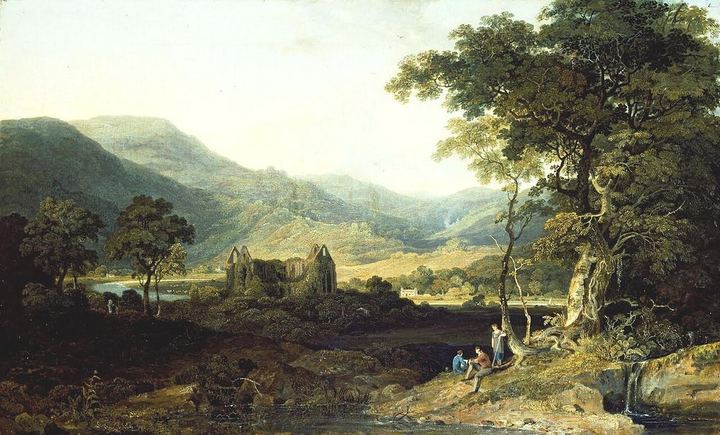
Tintern Abbey, as the poem is usually called, is a meditation in blank verse spoken on the banks of the River Wye a few miles upstream of the ruined Cistercian abbey on the border of England and Wales. Its first title dates it to 13 July 1798, when Wordsworth was on a walking tour with his sister Dorothy, and it was printed that autumn as the last poem in Lyrical Ballads. The poem moves through five verse paragraphs. In the first, the speaker notes that five years have passed since he last stood here, and he looks again at the cliffs, the orchards, the hedgerows run wild and the smoke rising from the woods. In the second, he says that these remembered forms have not been lost to him: in lonely rooms and noisy towns they have brought him tranquil restoration, perhaps prompted small unremembered acts of kindness, and given him a blessed mood in which the body is laid asleep and an eye made quiet sees into the life of things. The third paragraph admits that this may be a vain belief, but says how often his spirit has turned to the sylvan Wye. The fourth contrasts his younger self, who bounded over the hills like a roe and loved nature as an appetite, with the man he is now. That earlier rapture is gone, but he has gained a mind that hears the still, sad music of humanity and feels a presence, a motion and a spirit, that rolls through all things; nature has become the anchor of his purest thoughts and the guardian of his moral being. In the last paragraph he turns to his companion, his dear Sister, sees his own former self in her wild eyes, and blesses her: nature will lead her from joy to joy, and in later years her mind will be a mansion for these scenes, and she will remember that they stood here together. Wordsworth later said he composed the whole poem in his head between leaving Tintern and reaching Bristol.
Virtues in this work
- Hope: The speaker dares to hope that this moment will be life and food for future years, for himself and for his sister.
- Charity: He prizes the little, nameless, unremembered acts of kindness and love as the best portion of a good man's life.
- Friendship: The final paragraph turns from his own vision to a loving blessing on Dorothy, his dearest Friend.
- Fortitude: He meets the loss of his youthful raptures without mourning and counts what has followed as recompense.
Plot or Argument
- Verse paragraph 1: the return
After five years the speaker sees the Wye valley again: the cliffs, the sycamore, the orchards, hedgerows and the smoke that hints at vagrants or a hermit in the woods.
- Verse paragraph 2: what memory gave
The remembered landscape has restored him in towns and cities, may have shaped his kindness, and has given a serene mood in which he sees into the life of things.
- Verse paragraph 3: the doubt
He allows that this may be a vain belief, yet affirms how often he has turned in spirit to the Wye amid the fever of the world.
- Verse paragraph 4: then and now
His boyhood love of nature was physical and thoughtless; now he hears the music of humanity and senses a spirit in all things, and calls nature the guardian of his moral being.
- Verse paragraph 5: the blessing on his sister
He addresses Dorothy, sees his former self in her, and prays that nature will lead her from joy to joy and that she will remember this day and him.
Characters
- The speaker, the poet revisiting the Wye
A man of about twenty-eight comparing his present self with the youth who first came to the valley five years before.
- The Sister, his companion, Dorothy Wordsworth
Addressed as his dearest Friend in the final paragraph; in her wild eyes he reads his own former pleasures.
Lessons
Memory as a store laid up
The speaker says the scene has lived in him for five years and that in this moment there is life and food for future years. The poem treats remembered beauty as a reserve that sustains a person in dull rooms and noisy cities.
- What has the memory of the Wye done for the speaker during his years away?
- What does he hope the scene will do for his sister in later years?
- Is there a place whose memory has done something similar for you?
Loss and recompense
The speaker admits that the dizzy raptures of his youth are gone and will not come back, but he refuses to mourn: he has gained a sober, thoughtful love that includes the sad music of humanity. The poem is a model of growing older without bitterness.
- How does the speaker describe his younger self, and why does he compare him to a man fleeing from something?
- What gifts does he say have followed for his loss?
What is the presence in nature?
The speaker feels a presence, a motion and a spirit that rolls through all things, and calls nature the guardian of his moral being. Readers have long asked whether this describes the Creator known through creation or a spirit within nature itself; the poem keeps its language deliberately open.
- Where does the speaker say this presence dwells?
- How does his description compare with the biblical claim that the heavens declare the glory of God?
- Can nature be a moral teacher, as the speaker claims?
Context
Wordsworth first walked through the Wye valley alone in August 1793, a troubled time after his stay in revolutionary France. By 1798 he was living in Somerset near Coleridge, and the two were planning a joint volume of experimental poems in plain language. The Wye tour was a favorite route of the picturesque travelers of the period, and Tintern Abbey, a Cistercian house founded in 1131 and dissolved in 1536, was one of its famous ruins, though the poem does not describe the abbey itself.
Composition
According to Wordsworth's later note dictated to Isabella Fenwick, he began the poem on leaving Tintern, finished it as he entered Bristol after four or five days' walking with Dorothy, and wrote none of it down until he arrived. It was added late to Lyrical Ballads, published anonymously in 1798 with Coleridge's Rime of the Ancyent Marinere as its first poem. In the 1800 edition Wordsworth added a note saying he had not ventured to call the poem an ode but hoped its transitions and impassioned music would recall that form. The stored text is the 1798 first edition.
Reception
The poem became one of the defining texts of English Romanticism and of the meditative nature poem. Keats, in a letter of May 1818, discussed Tintern Abbey and its burden of the mystery as a sign of Wordsworth's depth. Wordsworth expanded its account of his own growth in The Prelude. Its closing hopes for Dorothy took on further weight for later readers who knew of her long illness in old age.
Comparisons
- gods-grandeur
Hopkins also finds the world charged with a presence, but names it the grandeur of God and the Holy Ghost where Wordsworth speaks more openly of a spirit that rolls through all things.
- ode-on-a-grecian-urn
Keats, who admired this poem, also meditates on a single object that holds time still, but he finds permanence in art where Wordsworth finds it in nature and memory.
- elegy-written-in-a-country-churchyard
Gray's Elegy is the great earlier meditation spoken in a rural English landscape at evening; Wordsworth's poem turns the same meditative stance toward his own growth rather than the village dead.
- confessions
Augustine in Book X also searches the vast halls of memory and questions the earth and sky about God, who answer that they are not God but that he made them.
Quotes
Frequently cited
“Five years have passed; five summers, with the length Of five long winters! and again I hear These waters, rolling from their mountain-springs With a sweet inland murmur.”
Frequently cited
“that best portion of a good man’s life; His little, nameless, unremembered acts Of kindness and of love.”
Frequently cited
“While with an eye made quiet by the power Of harmony, and the deep power of joy, We see into the life of things.”
Frequently cited
“The still, sad music of humanity, Not harsh nor grating, though of ample power To chasten and subdue.”
Frequently cited
“And I have felt A presence that disturbs me with the joy Of elevated thoughts; a sense sublime Of something far more deeply interfused, Whose dwelling is the light of setting suns, And the round ocean, and the living air, And the blue sky, and in the mind of man, A motion and a spirit, that impels All thinking things, all objects of all thought, And rolls through all things.”
“when the fretful stir Unprofitable, and the fever of the world, Have hung upon the beatings of my heart”
“Knowing that Nature never did betray The heart that loved her;”
For Students
A reading companion for classical Christian high school students. See the student guide.
Reading Guide
Watch for
- The repeated phrase once again in the first paragraph and the details the speaker names as he looks: sycamore, orchards, hedgerows, smoke.
- The blessed mood in the second paragraph, where the body is laid asleep and the speaker sees into the life of things.
- The words If this be but a vain belief that open the third paragraph and introduce doubt.
- The contrast in the fourth paragraph between the boy who bounded like a roe and the man who hears the still, sad music of humanity.
- The sudden turn to the speaker's sister in the fifth paragraph and the blessing he gives her.
Key terms and names
- River Wye
- The river along the border of England and Wales whose valley the speaker revisits; he addresses it as sylvan Wye.
- Tintern Abbey
- A ruined Cistercian monastery on the Wye; the poem is set a few miles upstream and never describes the ruin.
- Blank verse
- Unrhymed iambic pentameter, the meter of the poem, which lets the sentences run on like thought.
- Sublime
- In the eighteenth century, the feeling of awe before something vast or powerful; the speaker feels a sense sublime of a presence in nature.
- Recompense
- Compensation for a loss; the speaker says the thoughtful love of his adulthood is abundant recompense for lost youthful raptures.
- Lyrical Ballads
- The 1798 volume by Wordsworth and Coleridge in which this poem appeared last.
Seminar Questions
- Comprehension How long has the speaker been away from the Wye, and what does he see on his return?
- Comprehension What three things does the speaker say he owes to his memory of the landscape in the second paragraph?
- Comprehension Who is the speaker's companion, and what does he hope for her?
- Interpretation Why does the speaker say his younger self was more like a man flying from something he dreads than one seeking what he loved?
- Interpretation What is the still, sad music of humanity, and why could the boy not hear it?
- Interpretation Why does the poem end with the sister rather than with the speaker's own vision?
- Big Question Can the beauty of the natural world make a person morally better, and if so, how?
Faith Connections
- Romans 1:20 (Scripture)
Paul says the invisible things of God are clearly seen, being understood by the things that are made. Wordsworth's sense of a presence in setting suns and the living air can be read alongside this verse, which names the presence as the Creator.
- Psalm 19:1-4 (Scripture)
The heavens declare the glory of God, and their voice goes out though there is no speech. The psalm and the poem both hear a message in the sky; the psalm names whose glory it is.
- Acts 17:27-28 (Scripture)
Paul tells the Athenians that God is not far from any of us, for in him we live and move and have our being. The poem's motion and spirit that impels all thinking things comes close to this language while leaving its source unnamed.
- Augustine, Confessions X.6 (Church Fathers)
Augustine asks the earth, sea and sky whether they are his God, and they answer that they are not, but that God made them. His questioning of creation is a fair partner for Wordsworth's: both are moved by nature, and Augustine insists on the distinction between creature and Creator.
Logic and Rhetoric
Central argument: The speaker has lost the thoughtless raptures of youth; but memory of nature has sustained him, and nature now teaches him sympathy with humanity and a sense of a spirit in all things; therefore the loss is repaid, nature is the guardian of his moral being, and he can confidently bless his sister with the same gift.
Rhetorical device: apostrophe. In verse paragraph 3 the speaker turns to address the river, O sylvan Wye, and in verse paragraph 5 he addresses his sister directly.
Debate: Resolved: that the presence Wordsworth describes in verse paragraph 4 is best understood as the God of Scripture known through creation.
Memory Work
that best portion of a good man’s life; His little, nameless, unremembered acts Of kindness and of love.
The still, sad music of humanity, Not harsh nor grating, though of ample power To chasten and subdue.
Writing Prompts
Essay: Trace the speaker's three stages of relation to nature (the boy's appetite, the young man's memory, the grown man's thoughtful love) and argue whether the poem presents the last as a true gain or a consolation for loss.
Comparison with God's Grandeur: Wordsworth and Hopkins both find a presence in nature. Compare how each describes that presence and argue which poem gives the clearer account of where nature's power comes from.
Medical Lens
The poem describes a restorative use of memory in language that touches the physiology of its day. Remembered scenes bring sensations felt in the blood and along the heart and pass into the mind as tranquil restoration; in the blessed mood the breath and even the motion of the blood seem almost suspended until the speaker is laid asleep in body and becomes a living soul. His phrase about letting his genial spirits decay draws on the older idea of vital and animal spirits, and appears to echo Milton's Samson Agonistes. The poem has been read as an early account of nature and memory as consolation in low spirits, connected with Wordsworth's own unsettled state on his 1793 visit; such readings are interpretive. The fever of the world is figurative.
- Verse paragraph 2
Remembered landscape gives sensations felt in the blood and heart and tranquil restoration, then a trance-like mood in which bodily motion seems suspended.
- Verse paragraph 3
The speaker turns in spirit to the Wye amid the fretful stir and fever of the world.
- Verse paragraph 5
He hopes his sister will have healing thoughts in solitude, fear, pain or grief, and speaks of his own genial spirits.
Creative Prompts
- Classroom
Divide the class into five groups, one for each verse paragraph. Each group writes one sentence stating what its paragraph claims, and the class assembles the sentences into the poem's argument.
- Poetry
Write a blank-verse poem of about twenty lines about returning to a place after several years, noting what has stayed the same and what has changed in you.
Further Reading
- Lyrical Ballads, William Wordsworth and Samuel Taylor Coleridge; R. L. Brett and A. R. Jones (eds.)
Standard edition of the 1798 and 1800 texts with notes.
- William Wordsworth: A Life, Stephen Gill
- Wordsworth's Poetry, 1787-1814, Geoffrey H. Hartman
Verification notes
Dates of the tours, the publication history and the Fenwick note are standard. Line numbers differ between the 1798 text stored here and later revised texts, so quotes are located by verse paragraph. The echo of Milton in genial spirits and any link between the poem and Wordsworth's state of mind in 1793 are critical readings, presented as such. The stored text contains two editor's note markers ([4] and [5]) that are not part of the poem; quotes avoid them.
No verification flags recorded.