Work record
Ode on a Grecian Urn
written 1819; published 1820 · 19th Century · Poetry · English
Abstract
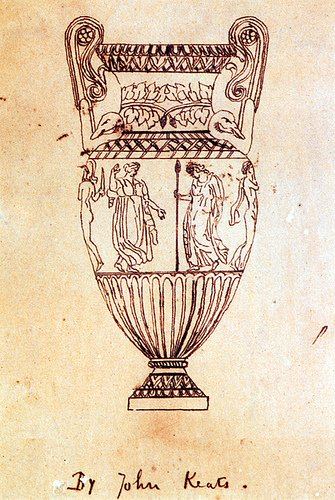
Background. Composed at Hampstead during Keats's extraordinary spring of odes in 1819, two years after he had first seen the Parthenon sculptures in the British Museum. The vase it describes appears to be a composite rather than one identifiable object.
Content. Questions about gods, chase and revelry give way to praise of a music no ear catches and a courtship that never ends. Admiration for unchanging joy then tips into a comparison with the feverish aftermath of real desire. A ritual procession prompts thoughts of a deserted hometown, and the close imagines the vessel surviving to offer later ages its aphorism.
Form. Every stanza joins an alternately rhymed quatrain to a flexible six-line close, the stanza Keats developed for his 1819 odes. Direct address to an object that cannot reply governs the whole, and the speaker even turns aside to speak to the vanished town.
Themes. The poem weighs permanence against life, imagination against sensation, and the consolations of art against its coldness, ending on an equation of beauty with truth whose speaker and scope remain disputed.
Significance. Overlooked by early reviewers, it is now central to the Romantic canon, and its final couplet has provoked more critical commentary than almost any lines Keats wrote, from Eliot's objection to Brooks's defence.
Main characters
- The speaker: Viewer who interrogates the vase and relays its closing maxim
- The urn: Marble vessel personified as bride, foster-child and woodland chronicler
- The piper: Youth whose silent song under the trees never ends
- The bold lover and the maiden: Pair fixed forever just short of an embrace
- The mysterious priest: Leader of a sacrificial procession with a garlanded heifer

Summary
In the Ode on a Grecian Urn Keats addresses an ancient vase carved with figures and asks what it can tell us that living speech cannot. The first stanza piles up names for the urn, a still unravished bride of quietness, a foster-child of silence and slow time, a sylvan historian, and then a rush of questions about the scene on its side: men or gods, reluctant maidens, mad pursuit, pipes and timbrels, wild ecstasy. The second stanza turns paradox into argument. Heard melodies are sweet, but unheard ones are sweeter, so the carved pipes should go on playing to the spirit. A young musician under the trees can never leave his song, and the trees can never lose their leaves. A bold lover leans toward a maiden he will never kiss, yet he need not grieve, for she will never fade and he will love forever. The third stanza repeats the word happy until the praise starts to strain: this carved love is forever warm and panting and young, far above human passion, which leaves a heart cloyed, a burning forehead and a parching tongue. In the fourth stanza the speaker turns the urn and finds a procession leading a heifer to sacrifice under a mysterious priest. He wonders what little town has been emptied of its people that pious morning, and realizes that its streets will be silent forever, since no one can return to say why it is desolate. The last stanza steps back. The urn is an Attic shape, a cold pastoral, a silent form that teases thought out of us as eternity does. When this generation has wasted away it will remain, a friend to man, saying that beauty is truth and truth beauty, and that this is all we know on earth and all we need to know. Who speaks those final words, and how far Keats endorses them, has been argued over ever since. The poem has five ten-line stanzas in iambic pentameter, each a quatrain followed by a varied sestet. Written in 1819, it first appeared in Annals of the Fine Arts in January 1820 and then in Keats's 1820 volume.
Virtues in this work
- Temperance: The ode contrasts the urn's untouched love with human passion that leaves a heart cloyed, a burning forehead and a parching tongue.
- Hope: The urn remains in midst of other woe as a friend to man, offering each generation something beyond its sorrows.
- Prudence: The speaker's questions test the urn's beauty rather than simply accepting it, and his praise turns to clear-eyed sight of its coldness.
Plot or Argument
- Stanza 1: the urn questioned
The speaker names the urn as bride, foster-child and sylvan historian, then asks a string of questions about the legend on its side: who the figures are, whether gods or mortals, and what the pursuit, struggle and music mean.
- Stanza 2: unheard melodies and the unfinished kiss
Imagined music is sweeter than heard music. The piper's song and the trees' leaves will never end, and the lover will never reach the maiden, but she will never fade and his love will last forever.
- Stanza 3: happy, happy love
The speaker praises the happy boughs, the tireless melodist and the forever warm, forever young love of the carving, contrasting it with human passion that ends in satiety, a burning forehead and a parching tongue.
- Stanza 4: the sacrifice and the empty town
A new scene shows a priest leading a garlanded heifer to a green altar. The speaker imagines the little town the worshippers left, and grieves that its streets will be silent forever with no one to explain its emptiness.
- Stanza 5: the cold pastoral speaks
Addressing the urn as an Attic shape and cold pastoral that teases us out of thought like eternity, the speaker foresees it outlasting his generation and offering its message that beauty is truth, truth beauty, all we know and need to know.
Characters
- The speaker, Questioner
A viewer who studies the urn, questions it, praises and then doubts its frozen happiness, and finally reports its message.
- The urn, Addressee
An ancient Greek vase, called bride, foster-child, sylvan historian and cold pastoral, whose carved scenes outlast every generation.
- The piper, Carved figure
A fair youth beneath the trees who plays a song no one hears and can never stop playing.
- The bold lover and the maiden, Carved figures
A young man who leans toward a maiden he can never kiss; she will never fade and he will love forever.
- The mysterious priest, Carved figure
The leader of a procession bringing a garlanded heifer to sacrifice at a green altar.
Lessons
What art preserves and what it withholds
The urn keeps its lovers young and its trees in leaf, but only by stopping them before the kiss and before autumn. Keats shows that the permanence of art and the fullness of life cannot be had together. The ode praises the urn's stillness while quietly counting its cost.
- What does the bold lover gain and lose by being carved rather than alive?
- Why does the word happy repeat so many times in stanza 3, and does the repetition sound convincing?
- Is there anything the poem suggests is better about changing human life than about the frozen scene?
The silence of the little town
Stanza 4 imagines something the urn does not show: the town emptied by the procession, whose streets will be silent forever. The carving's permanence becomes a kind of desolation. Keats lets a single invented detail turn the poem from delight toward loss.
- Why does the speaker imagine a town that is not carved on the urn?
- What makes the little town desolate, since nothing bad has happened to it?
- How does this stanza change the way we read the happy figures of stanzas 2-3?
Beauty and truth
The famous closing equation is offered by the urn as a friend to man in the midst of other woe. Whether it is a doctrine Keats holds, a consolation fitting only for an artifact, or a riddle meant to tease us out of thought, it forces readers to ask how beauty relates to truth. The ode does not settle the question but makes it impossible to avoid.
- Who speaks the words after the quotation marks in the last two lines, the urn or the poet?
- In what sense might beauty be truth, and in what sense might the claim be too simple?
- Why does Keats call the urn a cold pastoral just before it gives its message?
Context
The ode belongs to the remarkable spring of 1819 in which Keats wrote the Ode to Psyche, the Ode to a Nightingale, the Ode on Melancholy and the Ode on Indolence. The British Museum had acquired the Elgin Marbles from the Parthenon in 1816, and Keats saw them and wrote sonnets about them in 1817. Greek art was a living subject among his friends, including the painter Benjamin Robert Haydon. No single original vase for the poem has been identified; the urn seems to combine scenes Keats had seen in sculpture and engravings.
Composition
Keats probably wrote the ode in May 1819, while living at Wentworth Place in Hampstead. It was first printed in Annals of the Fine Arts in January 1820 and collected in Lamia, Isabella, The Eve of St. Agnes, and Other Poems in July 1820. The punctuation of the last two lines differs between the 1820 volume, which places quotation marks around Beauty is truth, truth beauty, and other early witnesses that lack them, and this difference lies at the root of the debate over who speaks the ending.
Reception
Early reviewers paid the ode less attention than the narrative poems in the 1820 volume, but by the later nineteenth century it was among Keats's most admired works. Its final lines became the most discussed in English Romantic poetry; T. S. Eliot called them a blemish, while Cleanth Brooks defended them as dramatically fitting in The Well Wrought Urn. It is a standard text for teaching the Romantic ode.
Comparisons
- ozymandias
Both poems of 1817-1819 describe an ancient artifact outlasting its makers. Shelley's ruined statue mocks its king's boast of permanence; Keats's intact urn really does remain to speak to future generations.
- elegy-written-in-a-country-churchyard
Gray asks whether a storied urn can call back the fleeting breath and answers no; Keats's urn cannot restore life either, but it keeps a moment of life from ever ending.
- sonnet-116
Shakespeare's love survives by bearing change to the edge of doom; Keats's carved love survives by never changing at all, and the two poems offer contrasting pictures of permanence.
- tintern-abbey
Wordsworth's meditation moves from landscape to memory and finds lasting meaning in the mind; Keats's moves from an artifact to an aphorism and leaves its meaning in dispute.
Quotes
Frequently cited
“Thou still unravish'd bride of quietness, Thou foster-child of silence and slow time,”
Frequently cited
“Heard melodies are sweet, but those unheard Are sweeter;”
Frequently cited
“"Beauty is truth, truth beauty,"--that is all Ye know on earth, and all ye need to know.”
“Bold Lover, never, never canst thou kiss, Though winning near the goal--yet, do not grieve; She cannot fade, though thou hast not thy bliss, For ever wilt thou love, and she be fair!”
“More happy love! more happy, happy love! For ever warm and still to be enjoy'd, For ever panting, and for ever young;”
“That leaves a heart high-sorrowful and cloy'd, A burning forehead, and a parching tongue.”
“And, little town, thy streets for evermore Will silent be; and not a soul to tell Why thou art desolate, can e'er return.”
“Thou, silent form, dost tease us out of thought As doth eternity: Cold Pastoral!”
For Students
A reading companion for classical Christian high school students. See the student guide.
Reading Guide
Watch for
- The three names Keats gives the urn in lines 1-3 (bride, foster-child, sylvan historian) and what each implies about its age and silence.
- The run of seven questions that ends stanza 1, which the poem never directly answers.
- The word happy repeated six times in stanza 3, and the sudden turn to human passion's burning forehead and parching tongue.
- The little town in stanza 4, which is not on the urn at all but imagined by the speaker.
- The quotation marks in line 49 and the question of who speaks the final line and a half.
Key terms and names
- ode
- A formal lyric poem of praise or address, often to an object or abstraction. Keats's ode addresses the urn throughout as thou.
- sylvan historian
- A woodland storyteller. The urn tells a flowery tale of leafy scenes more sweetly than the poet's rhyme can.
- Tempe or the dales of Arcady
- A valley in Thessaly and the region of Arcadia in Greece, both traditional settings of pastoral poetry and idyllic country life.
- timbrels
- Hand drums or tambourines, part of the wild music the speaker sees or imagines on the urn in line 10.
- Attic
- From Attica, the region of Athens. Calling the urn an Attic shape marks it as classical Greek work.
- brede
- An embroidered or interwoven pattern. In line 41 it names the band of carved figures woven around the urn.
- Cold Pastoral
- A pastoral is a scene of shepherds and country life; this one is cold because it is marble and lifeless as well as unchanging.
Seminar Questions
- Comprehension What three scenes does the speaker describe on the urn across stanzas 1-4?
- Comprehension Why, according to stanza 2, should the lover not grieve that he can never kiss the maiden?
- Comprehension What does the speaker say will happen to the urn when old age shall this generation waste?
- Interpretation In stanza 3, is the speaker's repetition of happy sincere praise, or does it suggest he is trying to convince himself?
- Interpretation Why does the speaker imagine the empty little town in stanza 4, and how does it change the mood of the poem?
- Interpretation Why does Keats call the urn both a friend to man and a Cold Pastoral in the same stanza?
- Big Question Is beauty a form of truth? Can something be beautiful and false, or true and ugly?
Faith Connections
- 1 Corinthians 13:12 (Scripture)
Now we see through a glass, darkly, but then face to face. The urn that teases us out of thought as doth eternity points toward a knowledge beyond earthly sight, which Paul places in the life to come.
- Ecclesiastes 3:11 (Scripture)
God has made everything beautiful in its time and set the world (many modern translations render eternity) in the human heart. Keats's speaker feels exactly that pull toward the eternal in a beautiful made thing.
- Augustine, Confessions X.27 (Church Fathers)
Augustine addresses God as Beauty ever ancient, ever new, and says he sought him in the lovely things God made. His prayer offers a Christian answer to the ode's equation: beauty and truth are one because both are names of God.
Logic and Rhetoric
Central argument: Art cannot move or change, so it cannot reach fulfilment: the lover never kisses and the song never ends (stanza 2). But for the same reason it cannot fade or be cloyed as human passion is (stanza 3). Its permanence also brings silence and desolation (stanza 4). Yet because it remains when generations pass, it can offer every age a truth about beauty (stanza 5). Therefore art is a friend to man precisely in its strange, cold permanence, though what its message finally means remains in question.
Rhetorical device: apostrophe. From the first line the speaker addresses the silent urn directly as thou, and in stanza 4 he even turns to address the imagined little town, so that the poem is a conversation with things that cannot answer.
Debate: Resolved: that the frozen love on Keats's urn is happier than any human love.
Memory Work
Heard melodies are sweet, but those unheard Are sweeter;
"Beauty is truth, truth beauty,"--that is all Ye know on earth, and all ye need to know.
Writing Prompts
Essay: Trace the word for ever and its variants through stanzas 2-4 and argue whether the ode presents eternity in art as a blessing, a loss, or both, giving attention to the little town and the Cold Pastoral.
Comparison with Ozymandias: Keats's urn and Shelley's broken statue are both ancient artifacts that speak to later generations. Compare what each object says, who reports its words, and what each poem concludes about whether art can outlast time.
Medical Lens
Keats had trained at Guy's Hospital and qualified as an apothecary in 1816, and in the months before the 1819 odes he had nursed his brother Tom until his death from tuberculosis in December 1818. The ode has no illness scene, but stanza 3 describes the aftermath of human passion in bodily terms, a cloyed heart, a burning forehead and a parching tongue, the vocabulary of fever. Readers have connected this physical precision to Keats's medical training and to his experience of consumption at home; such links are biographical readings rather than anything the poem states.
- Stanza 3, lines 28-30
Human passion is set against the urn's carved love and described through bodily signs of satiety and fever.
Creative Prompts
- Poetry
Choose an object in a museum or at home that shows a scene, a painting, a photograph, a carved box. Write a poem that questions it as Keats questions the urn, then imagines something just outside the frame, like his little town.
- Classroom
Show images of Greek vases with processions and musicians. Have students match each stanza's scene to an image and discuss what Keats adds that no vase shows.
- Dialogue
Write a short dialogue between the bold lover on the urn and Shakespeare's speaker in Sonnet 116 on whether love is better kept from change or tested by it.
Further Reading
- John Keats, Walter Jackson Bate
Pulitzer Prize-winning life with close readings of the odes.
- The Odes of John Keats, Helen Vendler
- The Well Wrought Urn, Cleanth Brooks
Its chapter Keats's Sylvan Historian argues that the ending fits the poem's dramatic context.
- Letters of John Keats, John Keats
Keats's letters, including his remarks on beauty and truth and on negative capability.
Verification notes
Publication in Annals of the Fine Arts (January 1820) and in the 1820 volume is certain; May 1819 as the month of composition is the usual scholarly dating but is not documented exactly. The variation in quotation marks around the closing lines is well known; the attached text follows the 1820 volume. Stanza and line numbers count fifty lines in five ten-line stanzas. The urn's composite origin is the common scholarly view.
No verification flags recorded.