Work record
Sonnet 116
1609 · Renaissance Early Modern · Poetry · English
Abstract
Background. Thomas Thorpe's 1609 quarto printed 154 sonnets under Shakespeare's name, most addressed to an unnamed young man or a dark lady. Number 116 falls within the young-man group but names no addressee, and it reads as a general definition rather than a private appeal.
Content. Borrowing the wedding liturgy's language of impediments, the speaker denies that a union of minds can be dissolved by change in either partner. Two nautical figures follow, a coastal beacon braving storms and the pole star whose altitude sailors calculate though its value escapes them. Time then appears as a reaper who claims youthful complexions, yet cannot make love his jester, since it holds firm until Judgment Day.
Form. Each quatrain carries one stage of the case: refusal, image, defiance. Lines 6 and 8 end on an unstressed extra syllable, and the couplet is set off as a challenge resting on two plainly false conditions.
Themes. Constancy, mortality and the limits of measurement meet here. Physical beauty is conceded to decay so that fidelity can be claimed as something beyond it, and the poet's own authorship becomes the pledge of his claim.
Significance. Largely ignored until Malone's 1780 edition revived interest in the sequence, the sonnet now ranks among the most recited English lyrics, a staple of marriage ceremonies and classroom anthologies alike.

Summary
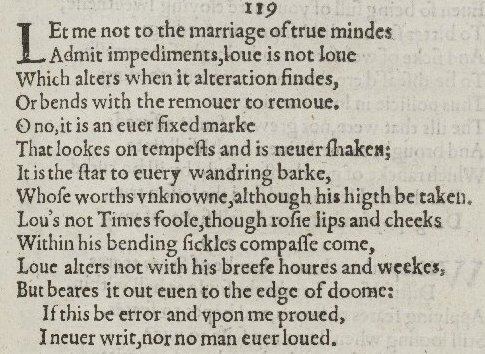
Sonnet 116 is Shakespeare's most famous definition of love, and it works by saying first what love is not. The speaker opens with a phrase borrowed from the church's marriage service: he will not admit impediments to the marriage of true minds. The marriage here is a union of minds and wills rather than a wedding ceremony, and the speaker refuses to grant that anything can lawfully part it. Love that changes when the beloved changes, or that withdraws when the other withdraws, is not love at all. The second quatrain turns from denial to two images of fixity. Love is a sea-mark, a beacon or tower that faces storms without being shaken, and it is the star by which every wandering ship steers. Sailors can measure the star's height with their instruments, yet its true worth lies beyond their reckoning. The image joins practical navigation to something close to wonder. The third quatrain brings in Time as a reaper whose curved sickle cuts down rosy lips and cheeks. Beauty falls within its sweep, but love is not Time's fool, not a jester at Time's mercy. It does not shift with brief hours and weeks; it endures to the edge of doom, the Last Judgment. The closing couplet stakes everything on the claim: if this is error and can be proved against him, then the speaker never wrote and no man ever loved. Since the poem itself stands as proof that he wrote, the challenge closes the argument. The poem follows the English or Shakespearean pattern of three quatrains and a couplet rhyming abab cdcd efef gg, with the feminine endings of lines 6 and 8 and a strong turn at line 9. It sits among the sonnets addressed to the young man, though nothing in it names an addressee. Little noticed in its own century, it has become one of the most quoted poems in English and is often read at weddings.
Virtues in this work
- Fortitude: Love is pictured as an ever-fixed mark that looks on tempests and is never shaken.
- Charity: The sonnet defines love as bearing it out to the edge of doom, the enduring love Paul describes in 1 Corinthians 13.
- Faith: The speaker's love keeps faith with the beloved when beauty fades within the sickle's compass.
- Friendship: The marriage of true minds is a union of wills, the bond of the closest friendship as well as of spouses.
Plot or Argument
- Lines 1-4: what love is not
The speaker echoes the marriage service and declines to admit impediments to the marriage of true minds. He then defines love negatively: it does not alter when it finds alteration in the beloved, and it does not bend away when the other removes.
- Lines 5-8: the sea-mark and the star
With an exclamation the poem turns to positive images. Love is an ever-fixed mark that looks on tempests unshaken, and the star that guides every wandering bark. Its height can be taken with a sailor's instrument, but its worth remains unknown.
- Lines 9-12: love against Time
Time is pictured as a reaper whose bending sickle sweeps away rosy lips and cheeks. Love is not Time's fool; it does not alter with brief hours and weeks but bears it out to the edge of doom, the end of the world.
- Lines 13-14: the wager
The couplet sets a legal challenge. If the speaker's account is error and can be proved upon him, then he never wrote and no man ever loved, a pair of conditions the reader knows to be false, so the definition stands.
Lessons
Constancy as the test of love
Shakespeare locates love not in feeling or beauty but in what refuses to change when circumstances change. A love that alters when it finds alteration was only ever a response to conditions. The sonnet teaches that fidelity is the measure of love, especially once youth and beauty begin to fall to Time's sickle.
- Why does the poem begin by saying what love is not?
- What two kinds of change does the speaker name in lines 3-4?
- Is a love that cannot alter still free, or is constancy itself a choice renewed?
The star whose worth is unknown
The navigational image allows that love can be partly measured: its height can be taken, and it gives direction. Yet its worth lies beyond calculation. Shakespeare suggests that the most important things in life guide us without being fully understood by us.
- What does a sailor gain by taking a star's height, and what remains unknown?
- How does the sea-mark differ from the star as an image of love?
- What else in human life guides us even though we cannot fully account for its worth?
Love outlasting the body
The third quatrain concedes that beauty belongs to Time: lips and cheeks come within the sickle's compass. Love, however, is not Time's fool and lasts to the edge of doom. The poem separates the beloved's perishable features from the bond itself, a distinction that gives weight to vows made for old age and sickness.
- What does it mean to call someone Time's fool?
- Why does the speaker mention the edge of doom rather than simply death?
- How does this quatrain relate to the promise in sickness and in health?
Context
The sonnet came into English from Italy through Wyatt and Surrey in the sixteenth century, and the 1590s saw a fashion for sonnet sequences such as Sidney's Astrophil and Stella and Spenser's Amoretti. Shakespeare's sequence stands apart in addressing most of its poems to a young man and in its long meditation on Time. The opening of Sonnet 116 draws on the marriage service of the Book of Common Prayer, in which the minister asks whether anyone knows an impediment to the marriage, and its imagery comes from the navigation of an island nation of sailors.
Composition
The date of composition is unknown; scholars generally place most of the sonnets in the 1590s and early 1600s. Francis Meres mentioned Shakespeare's sugared sonnets among his private friends in 1598, and two sonnets appeared in The Passionate Pilgrim in 1599. Sonnet 116 was first printed in the 1609 quarto Shake-speares Sonnets, published by Thomas Thorpe. Whether Shakespeare authorized that printing is disputed.
Reception
The 1609 sonnets were not reprinted in their own form during Shakespeare's lifetime, and a 1640 edition by John Benson rearranged and altered them. Serious attention came with Edmond Malone's edition of 1780 and grew through the nineteenth century. Sonnet 116 is now among the best known of all English poems and is a fixture of wedding readings, as well as a set text in schools.
Comparisons
- on-his-blindness
Milton's Petrarchan sonnet turns at line 8 to patient waiting; Shakespeare's English sonnet holds its turn for line 9 and closes with a couplet wager. Both define a virtue by what endures when circumstance fails.
- ozymandias
Shelley shows Time levelling a king's boast in the desert sand; Shakespeare grants Time the lips and cheeks but denies it power over love. Two sonnets on what survives Time's sweep, with opposite verdicts.
- death-be-not-proud
Donne defies Death directly and ends by declaring that Death shall die; Shakespeare defies Time and ends with a wager on his own writing. Both sonnets argue rather than lament.
- ode-on-a-grecian-urn
Keats's lovers are kept forever young by being frozen in marble, never reaching their kiss; Shakespeare's love survives precisely by passing through change and age without altering.
- shakespeares-sonnets
Sonnet 116 is one of the 154 sonnets of the 1609 quarto, printed in the library in full; read in sequence it sits among the poems addressed to a young man, where its vow that love does not alter answers neighbouring sonnets about time, absence and fault.
Quotes
Frequently cited
“Let me not to the marriage of true minds Admit impediments.”
Frequently cited
“Love is not love Which alters when it alteration finds, Or bends with the remover to remove:”
Frequently cited
“Love’s not Time’s fool, though rosy lips and cheeks Within his bending sickle’s compass come;”
Frequently cited
“If this be error and upon me prov’d, I never writ, nor no man ever lov’d.”
“O, no! it is an ever-fixed mark, That looks on tempests and is never shaken;”
“It is the star to every wandering bark, Whose worth’s unknown, although his height be taken.”
“Love alters not with his brief hours and weeks, But bears it out even to the edge of doom.”
For Students
A reading companion for classical Christian high school students. See the student guide.
Reading Guide
Watch for
- The legal and liturgical word impediments in line 2, borrowed from the marriage service.
- The wordplay of alters/alteration and remover/remove in lines 3-4, where the repeated root acts out the change love refuses.
- The shift from the fixed sea-mark (line 5) to the guiding star (line 7): one stands still in storms, the other gives direction.
- Time pictured as a reaper with a bending sickle in lines 9-10, and the phrase edge of doom in line 12.
- The couplet's if-then wager in lines 13-14, which uses the existence of the poem itself as evidence.
Key terms and names
- impediments
- Lawful obstacles to a marriage. The Prayer Book service asks the congregation and the couple to declare any; the speaker refuses to admit them to a marriage of true minds.
- ever-fixed mark
- A sea-mark, such as a beacon or tower on a coast, that sailors steer by. In line 5 it stands unshaken while tempests beat on it.
- bark
- A small sailing ship. Every wandering bark in line 7 is any lost vessel that needs the star to find its way.
- height be taken
- To measure a star's altitude above the horizon with a navigational instrument, which tells a sailor his latitude.
- Time's fool
- A jester or plaything at Time's mercy. Love, says line 9, is not that, even though Time takes lips and cheeks.
- edge of doom
- The brink of Doomsday, the Last Judgment. Love lasts until the end of the world itself.
- Shakespearean sonnet
- Fourteen lines of iambic pentameter in three quatrains and a couplet rhyming abab cdcd efef gg, the form Sonnet 116 follows exactly.
Seminar Questions
- Comprehension In lines 2-4, what two kinds of love does the speaker say are not love?
- Comprehension What images of love does the speaker give in lines 5-8, and what does each do?
- Comprehension What does Time take in lines 9-10, and what can it not take?
- Interpretation Why does the poem open with a phrase from the marriage service and then say marriage of true minds rather than of bodies or persons?
- Interpretation Line 8 says the star's worth is unknown although its height is taken. What does this suggest about the limits of measuring love?
- Interpretation Is the couplet a proof, a boast, or a wager? How does it depend on the reader holding the poem in hand?
- Big Question Can a human love really be unalterable, or does the poem describe an ideal that only divine love fully meets?
Faith Connections
- 1 Corinthians 13:4-8 (Scripture)
Paul says charity beareth all things, endureth all things, and never faileth. Sonnet 116's love that bears it out even to the edge of doom echoes this description of love that outlasts every other gift.
- Song of Solomon 8:6-7 (Scripture)
Love is strong as death, and many waters cannot quench it. The sonnet's sea-mark that looks on tempests unshaken gives the same claim a sailor's image.
- Book of Common Prayer, The Form of Solemnization of Matrimony (Great Conversation)
The service asks whether any know cause or impediment why the couple may not be joined, and binds them for better for worse, in sickness and in health. Shakespeare's opening and his quatrain on fading beauty draw directly on that setting.
- Augustine, Confessions IV.9 (Church Fathers)
Augustine writes that the one who loves his friend in God loses no one dear to him, because all are dear in One who is never lost. He grounds the unchanging love that Sonnet 116 asserts in the God who does not change.
Logic and Rhetoric
Central argument: Whatever changes when its object changes is not love. True love does not change with circumstance (lines 2-4), stands fixed in trouble and guides those who are lost (lines 5-8), and survives the decay of beauty to the end of time (lines 9-12). If this account could be proved false, no man ever loved and the poet never wrote; but men have loved and the poem exists. Therefore the definition stands.
Rhetorical device: polyptoton. In lines 3-4 the speaker repeats words in changed forms, alters and alteration, remover and remove, so that the sound shifts while the root stays the same, enacting the change that love refuses to follow.
Debate: Resolved: that a love which changes when the beloved changes was never true love.
Memory Work
Love is not love Which alters when it alteration finds, Or bends with the remover to remove:
Love’s not Time’s fool, though rosy lips and cheeks Within his bending sickle’s compass come;
Writing Prompts
Essay: Trace the images of motion and fixity in Sonnet 116, from alters and bends in lines 3-4 through the fixed mark, the wandering bark and Time's bending sickle. Argue how these images build the poem's case that love does not move.
Comparison with On His Blindness (Sonnet XIX): Shakespeare and Milton each write a sonnet defining a virtue that holds when circumstances fail: constant love in Sonnet 116, patient service in Milton's sonnet. Compare how each poem's form, English and Petrarchan, shapes its argument and its turn.
Listen to the book
Public-domain audiobook from LibriVox, read by Various volunteers. Recording: Sonnet 116 on LibriVox (Internet Archive).
LibriVox recordings are volunteer readings released into the public domain. The reading may follow a different edition from the text in this library.
Creative Prompts
- Poetry
Write a fourteen-line poem in Shakespeare's pattern that defines friendship by first listing two things it is not, then giving two fixed images of what it is, and closing with a couplet wager.
- Classroom
Bring a picture of a sextant or quadrant and explain how sailors took a star's height. Then discuss what line 8 means by saying the star's worth is unknown even when its height is known.
- Essay
Compare Sonnet 116 with the vows in the Book of Common Prayer marriage service. Which promises does the poem restate, and what does it add?
Further Reading
- Shakespeare's Sonnets, William Shakespeare, ed. Stephen Booth
Yale edition with facsimile of the 1609 quarto and a detailed commentary.
- The Art of Shakespeare's Sonnets, Helen Vendler
A close reading of every sonnet in the sequence.
- Shakespeare's Sonnets (Arden Shakespeare, Third Series), William Shakespeare, ed. Katherine Duncan-Jones
Verification notes
Text, form and 1609 publication are certain. The date of composition is unknown and given only as the scholarly range. The connection to the marriage service's question about impediments is a standard gloss. Quotations come from the Project Gutenberg modern-spelling text attached to this record and were matched against it.
No verification flags recorded.