Work record
Ozymandias
1818 · 19th Century · Poetry · English
Abstract
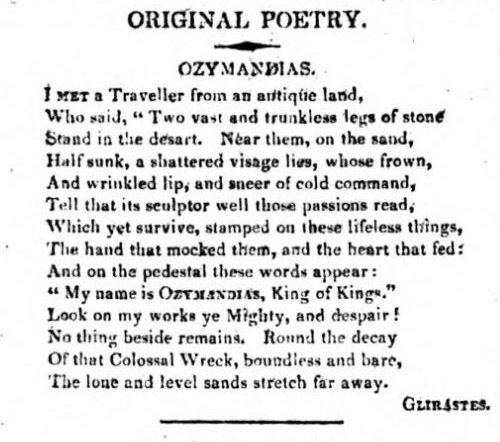
Background. Shelley composed these lines while competing with Horace Smith, each writing a sonnet on one theme, and Leigh Hunt's radical weekly carried the result under a pseudonym. Diodorus Siculus supplied the Greek name and the gist of the royal inscription.
Content. A visitor describes two stone legs standing without a body amid the desert, beside a fallen head whose scowl still conveys tyrannical coldness. That expression, he says, proves the carver understood the monarch, whose feelings now outlive both artist and ruler. An engraved base proclaims the pharaoh supreme among rulers and dares other potentates to compare their achievements with his. Empty, flat wasteland surrounds the fragments in every direction.
Form. Neither Italian nor English in its rhymes, the sonnet nests one voice inside another, so the ruler speaks only through layers of report. Alliteration in the final pair of lines slows the reading and stretches the barren horizon outward.
Themes. Tyranny, the erosion of fame, and the survival of art over its patrons are the central concerns. Irony replaces sermonizing: the king's own words convict him.
Significance. Few English sonnets are more often reprinted. Its central image of broken greatness half buried in sand became shorthand for the fall of regimes and the futility of monumental pride.
Main characters
- The speaker: Unnamed I who passes on what he was told
- The traveller: Witness returning from an ancient country with news of the ruin
- Ozymandias: Pharaoh, known to Greeks by this name, whose boast survives his works
- The sculptor: Artist who captured the ruler's arrogance in stone

Summary
Ozymandias is a fourteen-line sonnet about a ruined statue of an Egyptian king in the desert, and it has become the best-known English poem on the vanity of earthly power. Shelley wrote it in late 1817, in a friendly sonnet-writing contest with his friend Horace Smith on the same subject, and Leigh Hunt printed it in The Examiner on 11 January 1818. The name Ozymandias is the Greek form, recorded by the historian Diodorus Siculus, of a royal name of Ramesses II, the long-reigning pharaoh of the thirteenth century BC. The poem is told at two removes. The speaker reports what a traveller from an antique land told him: two huge legs of stone, without a trunk, still stand in the desert. Nearby, half sunk in the sand, lies a shattered face. Its frown, wrinkled lip, and sneer of cold command show that the sculptor read the king's passions well; those passions survive, stamped on lifeless stone, outlasting both the hand of the artist who mocked them and the heart of the king that fed them. On the pedestal are carved the king's words, in which he names himself king of kings and commands the mighty to look on his works and despair. Shelley then turns the inscription against its author with a bare statement: nothing beside remains. Around the colossal wreck, the lone and level sands stretch away to the horizon. The boast meant to make rival kings despair of matching him now invites despair of a different kind, at the emptiness of all such ambition. The sonnet bends the usual forms, with a rhyme scheme that belongs neither to the Italian nor to the English model, and its frame of voices (speaker, traveller, sculptor, king) layers report on report. Its ironies of time, art, and tyranny made it a favorite of anthologies and a touchstone whenever empires and monuments fall.
Virtues in this work
Plot or Argument
- The traveller's report (lines 1-2)
The speaker introduces a traveller from an antique land and begins relaying his account, so that everything after is secondhand testimony from a distant place.
- The broken statue and the sculptor's art (lines 2-8)
Two vast trunkless legs stand in the desert, and a shattered face lies half sunk nearby. Its frown and sneer reveal that the sculptor read the king's passions well, and those passions outlive both the mocking hand and the feeding heart.
- The inscription (lines 9-11)
The pedestal bears the king's proud words, naming himself king of kings and commanding the mighty to look on his works and despair.
- The desert answer (lines 12-14)
Nothing else remains. Around the colossal wreck the lone and level sands stretch far away, silently refuting the boast.
Characters
- The speaker, Narrator
The I of the first line, who frames the poem by repeating what the traveller told him.
- The traveller, Witness
A visitor from an antique land whose description of the ruined statue makes up most of the poem.
- Ozymandias, The king
The Greek name for Ramesses II; his sneering face and boastful inscription survive while his works have vanished.
- The sculptor, Artist
The unnamed carver who read and recorded the king's passions so well that they outlast both men.
Lessons
Pride undone by time
The king's inscription meant that no ruler could ever equal his works. Time has turned the same words into a warning that all such works perish. The poem lets the empty desert, rather than a moralizing narrator, deliver the verdict.
- How does the meaning of the word despair change between the king's intention and the reader's experience?
- Why does Shelley avoid stating a moral outright?
- What modern monuments or boasts invite the same reversal?
Art outlasts its subject and its maker
What survives is not the king's empire but the sculptor's reading of his character. The artist's hand mocked, meaning both imitated and scorned, the passions it carved. The poem itself repeats the act, preserving the king only as an emblem of arrogance.
- What are the two meanings of mocked in line 8, and why do both matter?
- Whose achievement survives in the poem: the king's, the sculptor's, or the poet's?
- Is art a defense against time, or only a slower form of ruin?
Testimony at second hand
The speaker never sees the statue; he reports a traveller who reports a sculptor who recorded a king. Each layer distances the reader from Ozymandias, so that the mighty pharaoh reaches us as a rumor from the sand.
- Why might Shelley frame the description through a traveller instead of describing the statue himself?
- How does the frame affect the authority of the king's own words?
- What does the poem suggest about how history reaches us?
Context
The poem appeared as Europe was fascinated with Egypt after Napoleon's expedition (1798-1801) and the antiquities it publicized. Shelley's interest in fallen tyrants also reflects the years after Napoleon's own defeat in 1815 and his radical hostility to monarchy. His source for the inscription was the Greek historian Diodorus Siculus, who records an inscription on a statue of Osymandyas boasting that anyone who would know his greatness must surpass one of his works.
Composition
Shelley and Horace Smith each wrote a sonnet on the subject at the end of 1817. Shelley's appeared in Leigh Hunt's Examiner on 11 January 1818 under the pen name Glirastes; Smith's followed in the same paper a few weeks later. Shelley reprinted the poem in the Rosalind and Helen volume of 1819.
Reception
Ozymandias became one of the most anthologized English sonnets, and its title, the phrase king of kings, and the image of trunkless legs in the sand are regularly invoked when regimes or monuments fall. Smith's companion sonnet is now remembered chiefly because of Shelley's.
Comparisons
- elegy-written-in-a-country-churchyard
Gray's churchyard and Shelley's desert both answer human pride with oblivion, but Gray mourns the obscure poor while Shelley mocks the famous king.
- ode-on-a-grecian-urn
Keats, Shelley's contemporary, also meditates on an ancient artwork that outlasts its makers; his urn preserves beauty, while Shelley's statue preserves only arrogance.
- the-histories
Herodotus's Book II describes the pyramids and monuments of Egyptian kings with the same mix of wonder and irony at royal ambition that Shelley compresses into fourteen lines.
- the-bible
Daniel 4 tells of Nebuchadnezzar boasting over the great Babylon he built and being humbled at once, a scriptural pattern of royal pride brought low.
Quotes
Frequently cited
“I met a traveller from an antique land”
Frequently cited
“‘My name is Ozymandias, king of kings: Look on my works, ye Mighty, and despair!’”
Frequently cited
“Nothing beside remains. Round the decay Of that colossal wreck, boundless and bare The lone and level sands stretch far away.”
“whose frown, And wrinkled lip, and sneer of cold command,”
“The hand that mocked them, and the heart that fed:”
For Students
A reading companion for classical Christian high school students. See the student guide.
Reading Guide
Watch for
- The chain of voices: the I of line 1, the traveller, the sculptor who read the king, and the king's inscription.
- The face in lines 4-5, with its frown, wrinkled lip, and sneer of cold command.
- The double meaning of mocked in line 8.
- The abrupt shift after the inscription to Nothing beside remains at the start of line 12.
- The alliteration of boundless and bare and lone and level in the last two lines.
Key terms and names
- Ozymandias
- The Greek rendering of a throne name of Ramesses II, preserved by Diodorus Siculus, from whom Shelley took the inscription.
- Antique land
- An ancient country, here Egypt; antique means old, not merely quaint.
- Visage
- A face; the shattered visage half sunk in the sand is the only part of the king that still expresses anything.
- Mocked
- In line 8, both copied in stone and ridiculed; the sculptor imitated the king's passions and exposed them.
- Irony
- A gap between what is said and what is meant or what happens; the king's command to despair now applies to his own vanished works.
- Frame narrative
- A story told within another telling; the statue reaches the reader only through the speaker's report of the traveller's account.
Seminar Questions
- Comprehension What exactly remains of the statue, according to the traveller?
- Comprehension What do the words on the pedestal say, and whom are they addressed to?
- Interpretation What did Ozymandias mean by telling the Mighty to despair, and what reason for despair does the poem give them instead?
- Interpretation Why does Shelley credit the sculptor with reading the king's passions well? What does the sculptor accomplish that the king does not?
- Interpretation How do the sounds of the last two lines create the sense of an endless, empty landscape?
- Big Question If every human work will crumble, is ambition foolish, or does the poem only condemn a particular kind of ambition?
- Big Question What, if anything, can outlast the sands that swallow the king's works?
Faith Connections
- Daniel 4:28-37 (Scripture)
Nebuchadnezzar boasts of the great Babylon he built by his own power and is immediately humbled, a biblical version of the pride Shelley exposes.
- Psalm 49:11-12 (Scripture)
The psalm notes that the rich call their lands after their own names, yet man in honor does not abide; Ozymandias carved his name and his works are gone.
- Matthew 6:19-20 (Scripture)
Christ's warning against treasures that moth, rust, and thieves destroy points to a lasting treasure that the poem, without faith of its own, leaves unnamed.
- Augustine, City of God V (Church Fathers)
Augustine weighs Roman glory and earthly empire against the lasting city of God, a fuller treatment of the transience Shelley's desert displays.
Logic and Rhetoric
Central argument: Ozymandias claimed his works were so great that no one could rival them; but his works have vanished and only a broken statue and empty sand remain; therefore the pride of rulers is undone by time, and only the artist's record of that pride survives.
Rhetorical device: Irony. The inscription in lines 10-11 commands the Mighty to look on the king's works and despair, and line 12 answers that nothing beside remains.
Debate: Resolved: In Ozymandias, the sculptor rather than the king is the true victor over time.
Memory Work
‘My name is Ozymandias, king of kings: Look on my works, ye Mighty, and despair!’
Nothing beside remains. Round the decay Of that colossal wreck, boundless and bare The lone and level sands stretch far away.
Writing Prompts
Essay: Analyze how Shelley uses layered voices, from speaker to traveller to sculptor to king, to judge Ozymandias without ever stating a moral.
Comparison with Ode on a Grecian Urn: Keats and Shelley both write about an ancient artwork that has outlived the people who made it. Compare what each artwork preserves and what each poem concludes about art and time.
Listen to the book
Public-domain audiobook from LibriVox, read by Various volunteers. Recording: Ozymandias of Egypt on LibriVox (Internet Archive).
LibriVox recordings are volunteer readings released into the public domain. The reading may follow a different edition from the text in this library.
Creative Prompts
- Poetry
Write a fourteen-line poem in which a traveller describes the ruin of a modern boast (a stadium, a tower, a corporate headquarters), ending with a single flat sentence like Nothing beside remains.
- Classroom
Have students read Horace Smith's companion sonnet alongside Shelley's and vote on which better handles the same assignment, giving reasons from rhyme, frame, and ending.
- Essay
Explain how the irregular rhyme scheme and the four nested voices of the poem reinforce its theme of power dissolving over time.
Further Reading
- Shelley's Poetry and Prose, Donald H. Reiman and Neil Fraistat (eds.)
Norton Critical Edition with annotated texts and essays.
- Shelley: The Pursuit, Richard Holmes
- Library of History, Book I, Diodorus Siculus, trans. C. H. Oldfather
Loeb volume containing the account of the Osymandyas inscription that Shelley adapted.
Verification notes
Publication in The Examiner on 11 January 1818 and the contest with Horace Smith are well documented. The identification of Ozymandias with Ramesses II through Diodorus is standard. Claims that Shelley was inspired by the colossal bust of Ramesses II brought to the British Museum around this time are common but unproven, and are not made here. Quotations follow Hutchinson's text as stored, including the single curly quotation marks around the inscription.
No verification flags recorded.