Work record
Through the Looking-Glass, and What Alice Found There
1871 (dated 1872) · 19th Century · Novel · English
Abstract
Background. Six years after Wonderland, Dodgson wrote a second dream for Alice Liddell, now grown, framing it with wistful dedicatory and acrostic poems; Tenniel again drew the pictures.
Plot. Climbing through the parlour mirror, the girl meets living chess pieces, learns from the Red Queen that the countryside is a board, and sets off as a white pawn. Crossing brooks rank by rank, she encounters a sighing Gnat, a nameless wood and a Fawn, the twins and their Walrus ballad, a sheep's shop that becomes a boat, the Lion and Unicorn, and a chivalrous, tumbling knight. Crowned on reaching the far side, she presides over a riotous banquet, shakes her rival queen into a kitten, and wakes.
Form. The episodes follow the moves of the chess problem printed before Chapter I, and the reversed logic of mirrors governs jokes about time, motion, memory and manners.
Themes. Language and who controls meaning, identity and naming, growing toward adulthood, and the old riddle of whether waking life is itself someone's dream. Beneath the comedy runs an elegiac note, since the child heroine is a memory of a girl who has already grown up.
Significance. Jabberwocky, Humpty Dumpty's theory of meaning, jam to-morrow and the Red Queen's race have all become fixtures of English speech, philosophy and even evolutionary biology.
Main characters
- Alice: Girl who enters the mirror and advances from Pawn to Queen
- The Red Queen: Stern chess queen who explains the rules of the board
- The White Queen: Muddled queen whose memory runs both ways in time
- The White Knight: Clumsy, gentle inventor who escorts Alice to the last brook
- Humpty Dumpty: Egg who claims mastery over the meanings of words
- Tweedledum and Tweedledee: Twins who recite a ballad and quarrel over a rattle
- The Red King: Sleeper who may be dreaming the whole tale

Summary
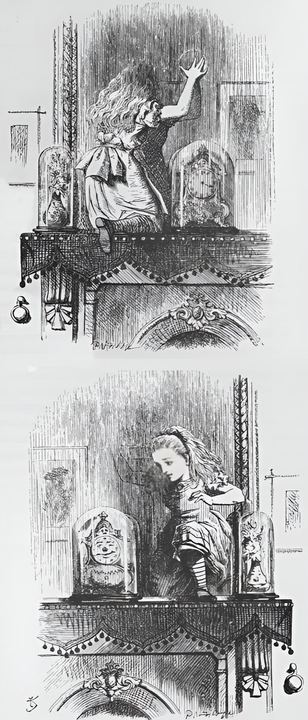
Through the Looking-Glass is the sequel to Alice's Adventures in Wonderland. On a snowy afternoon, the day before a bonfire she hopes to see, Alice sits by the fire scolding her black kitten, wonders what the room behind the drawing-room mirror is like, climbs onto the mantelpiece and passes through the glass. In Looking-Glass House the chessmen are alive: she lifts the White King and Queen onto the table, unseen and terrifying to them, and finds a book whose poem, Jabberwocky, she can read only by holding it to a mirror. Outside, every path leads her back to the house until she walks away from her goal. In the Garden of Live Flowers the Tiger-lily and the Rose talk rudely to her, and she meets the Red Queen, who shows her that the whole country is laid out like a great chessboard, divided by brooks and hedges. Alice is made the White Queen's Pawn, and if she reaches the Eighth Square she will be a queen. The Red Queen runs her breathlessly fast only to keep in the same place. As she crosses each brook Alice moves a square: she rides a train with a Gnat who tells her about Looking-Glass insects; walks through a wood where things have no names, arm in arm with a Fawn until it remembers it is a Fawn and she a human child; and meets the fat twins Tweedledum and Tweedledee, who recite The Walrus and the Carpenter, show her the snoring Red King, and tell her she is only a thing in his dream. The White Queen, who lives backwards, screams before she pricks her finger and tells Alice she can believe six impossible things before breakfast; she turns into a Sheep keeping a shop, and the shop becomes a rowing boat and then a shop again. Humpty Dumpty, sitting on a wall, explains that words mean what he chooses, interprets Jabberwocky, and falls with a crash. The Lion and the Unicorn fight for the crown, and Alice serves plum-cake the looking-glass way, handing it round first and cutting it afterwards. The gentle, inventive White Knight rescues her from the Red Knight, falls off his horse again and again, and sings her a song before she crosses the last brook and finds a golden crown on her head. As Queen Alice she is examined by the Red and White Queens and guests at her own feast, where the leg of mutton is introduced to her and the dishes and guests run wild. She seizes the Red Queen and shakes her, and the Queen turns into the black kitten. Awake, Alice wonders whether it was her dream or the Red King's. Macmillan published the book in December 1871 with title-page date 1872 and fifty illustrations by John Tenniel; it ends with an acrostic poem spelling Alice Pleasance Liddell.
Virtues in this work
- Fortitude: Alice keeps crossing brook after brook toward the Eighth Square despite rude flowers, bossy queens and a quarrelsome egg.
- Charity: Alice waits at the foot of the hill to wave her handkerchief to the White Knight so he will be encouraged as he rides away.
- Prudence: Alice keeps asking sensible questions of Humpty Dumpty and the White Queen instead of simply accepting their nonsense.
Plot or Argument
- Chapter I: Looking-Glass House
Alice passes through the mirror, finds the chessmen alive, alarms the White King by holding his pencil, and reads Jabberwocky in mirror-writing.
- Chapter II: The Garden of Live Flowers
Talking flowers mock Alice; the Red Queen explains the chessboard country, runs with her to stay in place, and gives her the Pawn's route to queenship.
- Chapter III: Looking-Glass Insects
A railway journey, the melancholy Gnat and its catalogue of insects, the wood where things have no names, and the Fawn.
- Chapter IV: Tweedledum and Tweedledee
The twins recite The Walrus and the Carpenter, show Alice the sleeping Red King, and arm for a battle over a rattle until a monstrous crow scares them off.
- Chapter V: Wool and Water
The White Queen explains living backwards and believing impossible things, then becomes a knitting Sheep whose shop turns into a boat on a stream.
- Chapter VI: Humpty Dumpty
Humpty Dumpty debates birthdays and un-birthdays, claims to be master of words, explains the hard words of Jabberwocky, and has his great fall.
- Chapter VII: The Lion and the Unicorn
The White King's messengers Haigha and Hatta bring news; the Lion and the Unicorn fight for the crown and Alice serves the looking-glass cake.
- Chapter VIII: It's my own Invention
The White Knight defeats the Red Knight, shows his inventions, keeps falling off, sings his song, and sees Alice to the last brook, where she is crowned.
- Chapter IX: Queen Alice
The two Queens quiz Alice, fall asleep on her shoulders, and attend her feast, where the pudding talks and the banquet collapses into chaos.
- Chapters X-XII: Shaking, Waking, Which Dreamed it?
Alice shakes the Red Queen, who becomes the black kitten; awake, she questions the kittens and wonders whose dream it was; a closing poem remembers the summer day of the first story.
Characters
- Alice, heroine
A thoughtful, polite and stubborn girl of seven and a half who plays her way across the chessboard from Pawn to Queen.
- The Red Queen, chess piece
A brisk, commanding governess figure who sets Alice's course and corrects her manners.
- The White Queen, chess piece
A kindly, untidy queen who lives backwards and remembers the future.
- The White King, chess piece
A fussy monarch who keeps a memorandum book and sends out all his horses and men.
- The White Knight, Alice's escort
A gentle, absent-minded inventor who keeps falling off his horse and sings Alice a song.
- Tweedledum and Tweedledee, twins
Quarrelsome brothers of nursery rhyme who recite The Walrus and the Carpenter.
- Humpty Dumpty, egg on a wall
A proud talker who insists words mean whatever he chooses and explains Jabberwocky.
- The Red King, sleeping chess piece
Snores under a tree throughout; the twins say Alice exists only in his dream.
- The Gnat, insect companion
A large, sighing insect that loves bad jokes and sighs itself away.
- The Lion and the Unicorn, rivals
Fighters for the White King's crown, who regard Alice as a fabulous monster.
- Dinah and the kittens, pets
Alice's cat and her black and white kittens, who seem to have been the Red and White Queens.
Lessons
Words keep their meanings
Humpty Dumpty says a word means just what he chooses, and that the question is which is to be master. Alice doubts that words can be made to mean so many things. The scene shows that conversation depends on words having shared meanings no single speaker owns.
- What happens to a conversation if one person decides what every word means?
- Why do you think Humpty Dumpty is so proud?
- What does the wood where things have no names show about why names matter?
Growing up, one square at a time
Alice begins as a Pawn and must cross square after square, meeting strange and difficult people, to become a Queen. When she is crowned she finds that being a Queen means taking charge, and at the feast she does. The journey is a gentle picture of growing up through steady patience.
- What does Alice have to do to move from Pawn to Queen?
- How does Alice behave differently after she is crowned?
Kindness in a contrary world
Most of the creatures Alice meets are rude, bossy or contrary, but the White Knight is kind and wants nothing but to see her safely on. Alice waves her handkerchief to him as he rides away. The book shows how one gentle person stands out among proud ones.
- Why does Alice wait to wave goodbye to the White Knight?
- Which characters are kind to Alice, and which are not?
- How does Alice stay polite when others are rude to her?
Is it a dream?
The twins tell Alice she is only a thing in the Red King's dream, and the last chapter asks which dreamed it. The book plays with a real puzzle about what is real and leaves it, smiling, for the reader.
- How does Alice answer Tweedledee when he says she is only in the King's dream?
- Whose dream do you think it was?
Context
Carroll wrote the sequel six years after Alice's Adventures in Wonderland had become a great success. The real Alice Liddell, daughter of the Dean of Christ Church, was by then a young woman, and the prefatory and closing poems look back with some sadness on the summer days of the first story. The book is built on a game of chess, described in a prefatory problem, and draws on nursery rhymes such as Humpty Dumpty, Tweedledum and Tweedledee, and The Lion and the Unicorn.
Composition
The first stanza of Jabberwocky had been written by Dodgson in 1855 as a mock Stanza of Anglo-Saxon Poetry in a family magazine. Macmillan published the book in December 1871, dated 1872, with illustrations by John Tenniel, who also drew Wonderland. At Tenniel's urging Carroll dropped an episode about a Wasp in a Wig; its galley proofs surfaced at auction in 1974 and it was published in 1977.
Reception
The book sold quickly and has been printed with Wonderland ever since. Many of its phrases passed into common English: Humpty Dumpty's theory of words has been cited by judges and philosophers of language, jam to-morrow became a byword for promises never kept, and biologists named the Red Queen hypothesis after the Queen's race to stay in the same place. Words from Jabberwocky such as chortle and galumph entered the dictionary.
Comparisons
- alices-adventures-in-wonderland
Wonderland is built on a pack of cards and falls into a rabbit hole; Looking-Glass is built on a chessboard and enters through a mirror, so its world is more orderly, more reversed and more wistful.
- the-phantom-tollbooth
Milo, like Alice, travels a land where words and numbers come alive and puns become places; both books make wordplay into adventure.
- the-princess-and-the-goblin
George MacDonald was Carroll's friend, and his children heard the first Alice story; MacDonald's fairy tale is openly Christian where Carroll's dream stays playful and unexplained.
- a-midsummer-nights-dream
Both works blur dream and waking, and end by asking the audience whether what they have seen was a dream.
- the-wonderful-wizard-of-oz
Dorothy and Alice both cross a strange land toward a goal, a wizard or a crown, meeting odd companions on the way; Dorothy wants to go home, Alice to grow up.
Quotes
Frequently cited
“’Twas brillig, and the slithy toves Did gyre and gimble in the wabe; All mimsy were the borogoves, And the mome raths outgrabe.”
Frequently cited
“If you want to get somewhere else, you must run at least twice as fast as that!”
Frequently cited
“‘The time has come,’ the Walrus said, ‘To talk of many things: Of shoes—and ships—and sealing-wax— Of cabbages—and kings— And why the sea is boiling hot— And whether pigs have wings.’”
Frequently cited
“The rule is, jam to-morrow and jam yesterday—but never jam to-day.”
Frequently cited
“Why, sometimes I’ve believed as many as six impossible things before breakfast.”
Frequently cited
“it means just what I choose it to mean—neither more nor less.”
“It’s a poor sort of memory that only works backwards”
“which is to be master—that’s all.”
“Life, what is it but a dream?”
For Students
A reading companion for classical Christian high school students. See the student guide.
Reading Guide
Watch for
- How everything is backwards in Looking-Glass House, from the mirror-writing of Jabberwocky to the cake that is handed round before it is cut.
- Each brook Alice jumps over, because each one moves her forward one square on the chessboard.
- The sleeping Red King in Chapter IV, and the question of who is dreaming whom.
- The kind White Knight in Chapter VIII, and how Alice says goodbye to him.
- Which kitten turns out to have been which Queen in the last chapters.
Key terms and names
- Looking-glass
- An old word for a mirror; Alice climbs through the one over her fireplace.
- Pawn
- The smallest chess piece; Alice starts as the White Queen's Pawn and becomes a Queen on reaching the eighth square.
- Jabberwocky
- A nonsense poem about a boy who slays a monster, full of made-up words that Humpty Dumpty explains.
- Portmanteau
- A traveling bag that opens into two parts; Humpty Dumpty uses the word for a made-up word packing two meanings into one, like slithy for lithe and slimy.
- Un-birthday present
- A present given on any of the days that are not your birthday, as Humpty Dumpty explains about his cravat.
- Living backwards
- The White Queen's way of life, in which she remembers the future and feels hurt before she is hurt.
Seminar Questions
- Comprehension How does Alice get into Looking-Glass House, and what does she find there first?
- Comprehension What does Alice have to do to become a Queen?
- Comprehension Why does the White Queen scream before she pricks her finger?
- Interpretation Humpty Dumpty says a word means just what he chooses. Do you agree with him or with Alice, and why?
- Interpretation Why do you think the White Knight is the one Alice remembers most kindly?
- Interpretation Is the Walrus kind or unkind to the Oysters? How can you tell?
- Big Question How can you tell the difference between a dream and being awake?
Faith Connections
- Genesis 2:19-20 (Scripture)
God brings the animals to Adam to see what he will call them. In the wood where things have no names, Alice and the Fawn forget who they are, which shows how much names help us know ourselves and each other.
- Matthew 5:37 (Scripture)
Jesus tells his followers to let their yes mean yes and their no mean no. Humpty Dumpty, who makes words mean whatever he likes, is the opposite of an honest speaker.
- Hebrews 11:1 (Scripture)
Faith is the substance of things hoped for and the evidence of things not seen. The White Queen practices believing impossible things for fun; Christian faith is trust in what God has truly promised.
- Augustine, Confessions XI (Church Fathers)
Augustine wonders what time is and how memory holds the past and expectation reaches to the future. The White Queen, whose memory works both ways, is a joke about the same mystery.
Logic and Rhetoric
Central argument: In a world where everything is reversed, Alice keeps her good sense, manners and purpose. She moves forward square by square, questions nonsense politely, and at the end takes charge as a Queen. Therefore steady patience and clear thinking can carry a child through even the most contrary world.
Rhetorical device: portmanteau word. In Chapter VI Humpty Dumpty explains that slithy in Jabberwocky packs lithe and slimy into one word, like two meanings packed into one bag.
Debate: Resolved: that Humpty Dumpty is right that a word means just what the speaker chooses.
Memory Work
’Twas brillig, and the slithy toves Did gyre and gimble in the wabe; All mimsy were the borogoves, And the mome raths outgrabe.
‘The time has come,’ the Walrus said, ‘To talk of many things: Of shoes—and ships—and sealing-wax— Of cabbages—and kings— And why the sea is boiling hot— And whether pigs have wings.’
Writing Prompts
Essay: Choose two characters Alice meets on her journey across the chessboard and explain what each one teaches her before she becomes a Queen.
Comparison with Alice's Adventures in Wonderland: Compare Wonderland and Looking-Glass Land. How is a world built on playing cards different from a world built on chess, and which would you rather visit?
Medical Lens
The book is a dream-fantasy without medical content as such, but its play with sleep, memory and sensation has interested writers on the mind. The Red King sleeps throughout and the twins insist Alice exists only in his dream; the last chapter asks which of them dreamed it. The White Queen remembers things that happen the week after next and screams in pain before pricking her finger, then is calm afterward, a comic reversal of cause, feeling and memory. In the wood where things have no names Alice briefly cannot remember her own name. These episodes are logical and literary games, and reading them as descriptions of a neurological disorder would go beyond the text.
- Chapter III
In the wood where things have no names, Alice forgets her own name and the Fawn forgets what it is.
- Chapter IV
Tweedledum and Tweedledee show Alice the snoring Red King and tell her she is only a sort of thing in his dream.
- Chapter V
The White Queen's memory works both ways; she bandages and screams over her finger before the brooch pricks it.
- Chapter XII
Awake, Alice asks the kitten which of them dreamed it, herself or the Red King.
Listen to the book
Public-domain audiobook from LibriVox, read by Craig Franklin. Recording: Through the Looking-Glass (Version 6) on LibriVox (Internet Archive).
LibriVox recordings are volunteer readings released into the public domain. The reading may follow a different edition from the text in this library.
Creative Prompts
- Poetry
Write a nonsense poem in the style of Jabberwocky with four invented words, then explain each word the way Humpty Dumpty does.
- Classroom
Set up a chessboard and move a white pawn along Alice's route square by square, telling which character she meets in each.
- Fiction
Climb through a looking-glass in your own house and write what is reversed on the other side.
- Dialogue
Write a conversation between Alice and the White Knight on the day after she becomes a Queen.
- Adaptation
Act out the scene of the Lion and the Unicorn and the looking-glass cake that must be handed round before it is cut.
Further Reading
- Alice's Adventures in Wonderland, Lewis Carroll
- The Hunting of the Snark, Lewis Carroll
- The Annotated Alice, Martin Gardner
Explains the chess problem, the nursery-rhyme sources and the jokes.
- Lewis Carroll: A Biography, Morton N. Cohen
Verification notes
Plot and chapter structure follow the attached Project Gutenberg text, which includes the prefatory chess problem, the opening and closing poems and Tenniel-style illustration markers. The Wasp in a Wig history (dropped at Tenniel's urging, proofs auctioned 1974, published 1977) was checked against the University of Maryland Libraries' Alice 150 exhibition page (https://exhibitions.lib.umd.edu/alice150/alice-in-wonderland/early-editions/wasp-in-a-wig). The 1855 origin of Jabberwocky's first stanza and the December 1871 publication with an 1872 title-page date are standard bibliographic facts. Quotes were checked against the attached text.
No verification flags recorded.