Work record
The Spirit of the Laws
1748 · 18th Century · Political Theory · French
Abstract
Background. A nobleman who had sat as a président of the Bordeaux Parlement, Montesquieu returned from Austria, Italy and a long English sojourn determined to explain why nations live under such different legal orders.
Thesis. Human laws are not arbitrary. Each must be fitted to the kind of state that enacts it and to the physical and moral circumstances of its people, and the web of those fittings is what the title calls the spirit.
Structure. Books I-VIII classify republics, monarchies and despotisms by their nature and their animating principle. IX-XIII address war, liberty and revenue; XIV-XIX climate, servitude, terrain and national character; XX-XXIII trade, currency and population; XXIV-XXVI religion and kinds of law; XXVII-XXXI Roman and Frankish legal history.
Key Concepts. Civic virtue, honour and fear move the three regimes. Freedom means security under law, and it survives only where authority is split among separate hands, as Book XI finds at Westminster. Bondage harms owner and owned alike. Exchange draws peoples into mutual need, though a merchant spirit may also price every kindness.
Significance. Condemned at Rome in 1751 yet read everywhere, the treatise shaped Blackstone's England and the debates of 1787-1788, when both supporters and critics of the federal plan appealed to it, and it later inspired comparative sociology.
Key figures
- Montesquieu: Bordeaux magistrate and baron writing as a comparative student of laws
- Lycurgus: Spartan lawgiver held up as a former of republican virtue
- Aristotle: Classifier of constitutions whose account of monarchy is questioned in Book XI
- Tacitus: Roman historian of the Germans, credited with describing the seed of English government
- Pierre Bayle: Sceptical philosopher whose view of Christian citizens Book XXIV disputes
- Charlemagne: Frankish ruler central to the last books on feudal law

Summary
Montesquieu's The Spirit of the Laws (De l'esprit des lois), published anonymously at Geneva in 1748 after many years of reading and travel, asks why the laws of different peoples differ and what makes them fit or unfit for those who live under them. His answer is that laws are relations: they must suit the form of government and also the climate and soil, the religion, commerce, manners and size of a nation. The library text is Thomas Nugent's English translation of 1750 as revised by J. V. Prichard for the 1914 Bell edition, with the preface and all thirty-one books. Book I defines laws in the widest sense as relations arising from the nature of things, so that God, the material world, the beasts and man each have their laws. Books II to VIII set out three kinds of government, each with a nature and a principle that moves it. The republic, democratic or aristocratic, needs virtue, meaning love of country and of equality; monarchy runs on honour and depends on intermediate powers such as nobility, clergy and parlements; despotism, where one man rules by will and caprice, is moved by fear. Montesquieu shows how education, sumptuary and criminal laws, and the place of women follow from each principle, and how each government decays when its principle is corrupted. Books IX to XIII turn to defence, conquest, political liberty and taxation. In Book XI liberty is the right to do what the laws permit, and it is found only in moderate governments where power is a check to power. Chapter 6, on the constitution of England, separates legislative, executive and judicial power and argues that liberty is lost when any two are joined. Book XII applies the idea to the citizen's security, warning against punishing thoughts or indiscreet words. Books XIV to XIX treat climate, soil and the general spirit of a nation. Heat and cold, Montesquieu argues, shape temperament, but good legislators resist the vices a climate encourages instead of yielding to them. Book XV calls slavery bad in its own nature and answers its defenders with sustained irony in chapter 5. Books XX to XXII describe commerce as a gentle force that makes trading nations depend on one another, and examine money and exchange. Book XXIII considers population; Books XXIV and XXV weigh religion by its civil effects, while praising the Christian religion as the friend of good laws; and Books XXVI to XXXI treat the order of laws, the art of composing them, and the history of Roman and Frankish feudal law. The Church placed the book on the Index in 1751 after Montesquieu had published a Defence of it in 1750. It was read across Europe and in America, where Madison, in Federalist 47, called Montesquieu the oracle always consulted on the separation of powers.
Virtues in this work
- Prudence: Book XIX counsels legislators to change by example and manners what cannot wisely be changed by law, fitting each measure to the people.
- Justice: Book XII demands that punishments follow the nature of each crime and that no one be punished for thoughts or indiscreet words.
- Temperance: Book XI's claim that even virtue needs limits makes moderation the condition of political liberty.
- Humility: Book XI begins from the admission that every holder of power is apt to abuse it, so no ruler should be trusted with all of it.
Plot or Argument
- Preface and Book I: laws as necessary relations
Montesquieu asks the reader to judge the whole book and not a few sentences. Laws in the most general sense are relations arising from the nature of things; God, matter, higher intelligences, beasts and men all have their laws. Man, a finite and fallible being, forgets God, himself and his fellows, so religion, morality and political and civil laws recall him to his duties. Positive laws should be suited to the people who live under them, to the government, the climate, the soil, the way of life, the religion and the manners of a nation; the relations among all these together form what he calls the spirit of the laws.
- Books II–VIII: three governments and the springs that move them
A republic places sovereign power in the whole people (democracy) or a part of it (aristocracy); a monarchy is the rule of one by fixed laws through intermediate powers; a despotism is the rule of one by his own will. Each has a principle: virtue in a republic, honour in a monarchy, fear in a despotism. Education, civil and criminal laws, sumptuary laws and the treatment of women must be fitted to the principle. Each government is corrupted when its principle decays, as when a democracy loses the spirit of equality or carries it to extremes.
- Books IX–X: defence and conquest
Small republics defend themselves by confederation; monarchies by fortified frontiers; despotisms by laying waste the land around them. Conquest gives a right that should be used to preserve the conquered people, and Montesquieu reviews Roman, Spanish and Persian examples of how conquerors have ruled, well or badly.
- Book XI: political liberty and the English constitution
Liberty is not doing whatever one pleases but the right of doing what the laws permit, and it exists only in moderate governments where power is not abused. Because every holder of power tends to push it as far as it will go, power must check power. Chapter 6 describes England, a nation whose constitution has political liberty for its direct object: the legislative power is divided between Lords and Commons, the executive belongs to the monarch, and the power of judging is given to juries drawn from the people. When any two of these are united, there can be no liberty. Chapters 7 to 20 compare monarchies of the ancient world and of Rome.
- Books XII–XIII: the security of the citizen and the burden of taxes
Political liberty in relation to the citizen consists in security, which depends above all on the goodness of criminal law. Punishments should follow the nature of each offence; heresy, magic and offences against nature require great caution; thoughts and indiscreet words should not be punished as treason. Taxes may be heavier where liberty is greater, and duties on goods are better suited to moderate governments than capitation, which suits servitude.
- Books XIV–XVIII: climate, servitude and soil
Cold climates make bodies vigorous and spirits bold; hot climates make them languid and timid. Bad legislators favour the vices of the climate and good ones oppose them. Book XIV discusses sobriety laws, laws against contagious distempers, and the English disposition to suicide. Book XV declares slavery bad in its own nature for master and slave alike and, in chapter 5, mocks the arguments used to defend the slave trade. Books XVI and XVII treat domestic servitude and political servitude, and Book XVIII ties the laws of a people to whether they hunt, herd, farm or trade.
- Book XIX: the general spirit of a nation
Climate, religion, laws, maxims of government, examples from the past, morals and customs together form a nation's general spirit. A wise legislator does not try to change by law what is better changed by example and manners. The book ends with a long portrait of the English, whose free constitution shapes their restless, independent and commercial character.
- Books XX–XXIII: commerce, money and population
Commerce cures destructive prejudices and inclines nations toward peace through mutual need, although it can also turn every human service into a matter of price. Montesquieu distinguishes the commerce of luxury from the commerce of economy, surveys the history of trade from the ancient world to the Portuguese and Spanish voyages, examines money, exchange, interest and public debt, and asks how laws affect the number of inhabitants.
- Books XXIV–XXVI: religion and the order of laws
Montesquieu writes as a political author weighing religion by its civil effects. He answers Pierre Bayle's claim that true Christians could not form a lasting state, praises the Christian religion as favourable to moderate government, and argues that a state should be cautious both in establishing new religions and in using penal laws about religion. Book XXVI separates divine, natural, ecclesiastical, civil and political law so that questions are judged by the right kind of law.
- Books XXVII–XXXI: Roman succession and the feudal laws of the Franks
The closing books are history. Book XXVII follows the Roman laws of inheritance; Book XXVIII the origin and revolutions of civil law among the French, including trial by combat; Book XXIX gives rules for the manner of composing laws; and Books XXX and XXXI reconstruct the feudal laws of the Franks and the changes of the French monarchy under the Merovingians and Carolingians.
Characters
- Lycurgus, exemplary legislator
The Spartan lawgiver, cited in Book IV as a founder whose laws formed citizens through education and the spirit of virtue.
- Aristotle, authority and foil
His classification of governments is discussed in Book XI, where Montesquieu judges that he did not clearly understand the distribution of powers in monarchy.
- Tacitus, historical source
His account of the ancient Germans is cited in Book XI for the claim that the English system of government was first found in the woods of Germany.
- Moses, legislator cited
His laws for separating the leprous are cited in Book XIV as a model that legislators might have followed against contagious disease.
- Pierre Bayle, opponent
Huguenot philosopher whose paradox, that a society of true Christians could not endure, Montesquieu answers in Book XXIV.
- Charlemagne, historical subject
The Carolingian emperor whose government and capitularies appear in the closing books on the feudal laws of the Franks.
Lessons
Laws must suit the nation that lives under them
Montesquieu does not write a single code for all mankind. He argues that a good law in one country may be a poor law in another, because laws are tied to a people's government, climate, religion, commerce and customs. Wise legislation begins with knowing the people well.
- Which of Montesquieu's factors (government, climate, soil, religion, commerce, manners) seems strongest to you, and why?
- If laws depend on circumstances, what remains fixed? How does Book I's account of natural and divine law answer that question?
- Why does Book XIX warn legislators against changing by law what should be changed by manners?
Every holder of power tends to push it further
Book XI starts from a realistic view of human nature: whoever holds power is tempted to abuse it. Montesquieu's answer is not to trust better rulers but to arrange institutions so that one power checks another, and to keep the power of judging apart from the powers of making and executing law.
- Why does Montesquieu say that even virtue has need of limits?
- What dangers does he foresee if the judge is also the legislator, or also the executive?
- How does his picture of England differ from a simple government of the majority?
Virtue, honour and fear as springs of government
Each form of government is moved by a passion that citizens must share: love of country and equality in a republic, desire for distinction in a monarchy, fear under a despot. A regime declines when its spring weakens, so laws of education and manners matter as much as constitutions.
- Why does a republic depend more on the character of its citizens than a monarchy does?
- Montesquieu says honour can produce good actions even from unworthy motives. Is that a strength or a weakness of monarchy?
- What signs of corruption in a democracy does Book VIII describe?
Climate is a condition, not a destiny
Montesquieu believed heat and cold affect the body and the temper of peoples, but Book XIV insists that good legislators work against the vices a climate encourages. Natural causes set the problem; law, education and religion can answer it.
- What does Montesquieu mean when he calls those bad legislators who favour the vices of the climate?
- How does Book XIV's treatment of contagious disease show the legislator caring for the health of citizens?
- Where does Montesquieu leave room for human choice in his account of climate?
Trade as a bond between peoples
Book XX presents commerce as a force that softens manners and makes nations depend on one another, so that peace becomes their interest. Montesquieu also notes that a purely commercial spirit can make people calculate every service, so he weighs commerce as a good with limits.
- Why does Montesquieu think two trading nations become reciprocally dependent?
- What does he say commerce does to hospitality and the other moral virtues?
- How does his view of commerce compare with his praise of virtue in republics?
Context
Montesquieu wrote in the France of Louis XV, an absolute monarchy in which the parlements, the nobility and the Church still claimed rights and functions of their own. As a judge of the Parlement of Bordeaux and a nobleman, he valued those intermediate bodies as barriers against despotism. His travels, especially his stay in England from 1729 to 1731, gave him a model of a nation that had made political liberty the object of its constitution. The book joins classical political science (Aristotle, Polybius, the Roman historians) to the comparative study of laws, climates and customs drawn from travel accounts of Asia, Africa and the Americas.
Composition
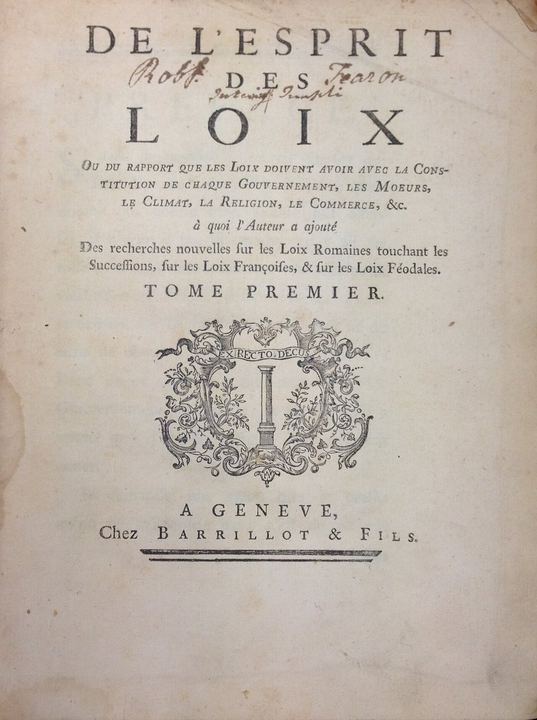
Montesquieu worked on the book for many years after his return from England, with help from secretaries as his eyesight failed. It was printed anonymously in two quarto volumes by Barrillot in Geneva in 1748. Thomas Nugent's English translation appeared in London in 1750; the library text follows J. V. Prichard's revision of Nugent, printed by G. Bell & Sons, here in the 1914 edition.
Reception
The book was widely read and quickly attacked. A Jansenist journal accused it of irreligion, and Montesquieu replied with his Defence of the Spirit of the Laws (1750); it was nevertheless placed on the Index of Prohibited Books in 1751. Blackstone drew on it for his account of the English constitution, and American readers cited it constantly in the 1780s. In Federalist 47 Madison calls Montesquieu the oracle always consulted and cited on the separation of powers, and Anti-Federalist writers invoked his argument that republics must be small. Later historians, among them Tocqueville and the founders of comparative sociology, treated him as a pioneer in studying laws in relation to society.
Comparisons
- persian-letters
Montesquieu's own epistolary novel of 1721, in which Usbek's harem in Isfahan collapses into disorder while he travels in Europe, dramatizes the despotism ruled by fear that Books II–VIII and XVI later analyse in treatise form.
- the-federalist-papers
Federalist 47 quotes Book XI, chapter 6 and argues that Montesquieu, rightly read, does not forbid all partial mixture of powers; Federalist 9 answers Anti-Federalist use of his claim that republics must be small by citing his own praise of confederate republics in Book IX.
- second-treatise-of-government
Locke distinguishes legislative, executive and federative power and makes the legislative supreme; Montesquieu treats judging as a separate power and makes liberty depend on balance among the three rather than on the supremacy of one.
- the-founding-documents
The Constitution's three articles for Congress, President and courts, and its checks such as the veto and impeachment, put into written form the distribution of powers that Book XI found in England.
- politics
Aristotle sorts constitutions by who rules and for whose good; Montesquieu sorts them by nature and principle and openly discusses Aristotle's classification of monarchies in Book XI, chapter 9.
- democracy-in-america
Tocqueville, who acknowledged Montesquieu as a master, follows his method of reading laws through manners, religion and physical circumstances, and his concern with intermediate bodies as protections of liberty.
Quotes
“Laws, in their most general signification, are the necessary relations arising from the nature of things.”
“As virtue is necessary in a republic, and in a monarchy honour, so fear is necessary in a despotic government”
“constant experience shows us that every man invested with power is apt to abuse it, and to carry his authority as far as it will go.”
“To prevent this abuse, it is necessary from the very nature of things that power should be a check to power.”
“When the legislative and executive powers are united in the same person, or in the same body of magistrates, there can be no liberty”
“As it is the business of legislators to watch over the health of the citizens, it would have been a wise part in them to have stopped this communication by laws made on the plan of those of Moses.”
“The state of slavery is in its own nature bad.”
“Peace is the natural effect of trade.”
For Students
A reading companion for classical Christian high school students. See the student guide.
Reading Guide
Watch for
- Book I's opening definition of laws as relations, and how it reaches from God and the material world down to the positive laws of nations.
- The pairing of each government with its principle in Book III (virtue, honour, fear), and how later books keep returning to it.
- Book XI, chapter 6 on the constitution of England, where legislative, executive and judicial power are separated and liberty is said to depend on keeping them apart.
- The irony of Book XV, chapter 5, where Montesquieu pretends to give the arguments for slavery in a form that exposes them.
- The way Book XIV moves from cold and warm air acting on the body to the duties of legislators toward health and sobriety.
Key terms and names
- Spirit of the laws
- Montesquieu's name for the whole set of relations that laws bear to a nation's government, climate, soil, religion, commerce and manners. Understanding it explains why laws differ.
- Principle of government
- The passion that makes a government act, distinguished from its nature (who holds power and how). The principles are virtue for republics, honour for monarchies and fear for despotisms.
- Political virtue
- In Book III and the Advertisement prefixed to the work, love of country and of equality, a civic virtue rather than Christian or moral virtue in general.
- Intermediate powers
- Bodies such as the nobility, clergy, towns and parlements that stand between a monarch and the people, channel his power through law and keep monarchy from sliding into despotism.
- Political liberty
- In Book XI, the right of doing what the laws permit, joined to a citizen's tranquillity of mind that comes from feeling secure. It is not independence from all law.
- Separation of powers
- The division of legislative, executive and judicial power among different hands so that each checks the others, which Book XI, chapter 6 finds in the English constitution.
- General spirit
- In Book XIX, the character of a nation formed by climate, religion, laws, maxims of government, past examples, morals and customs together.
Seminar Questions
- Comprehension What are the three kinds of government in Book II, and what principle belongs to each according to Book III?
- Comprehension How does Book XI, chapter 3 define liberty, and why does Montesquieu distinguish liberty from independence?
- Comprehension In Book XI, chapter 6, what happens to liberty when the power of judging is joined to the legislative power, and when it is joined to the executive?
- Interpretation Montesquieu says even virtue has need of limits. What does he mean, and how does that idea shape his argument for checks on power?
- Interpretation Book XIV says climate shapes temperament, yet good legislators oppose the vices of the climate. How does Montesquieu hold these two claims together?
- Interpretation In Book XV, chapter 5 Montesquieu lists reasons for enslaving Africans in a mocking voice. How can a reader tell that he is being ironic, and why might irony persuade better than direct argument?
- Big Question Can a republic survive if its citizens lose the virtue Montesquieu calls love of country and equality, even if its institutions are well balanced?
- Big Question Is liberty better protected by good laws and divided powers or by good people? Can either work without the other?
Faith Connections
- Leviticus 13:45-46 (Scripture)
The law that the leper shall dwell alone outside the camp is the Mosaic law Montesquieu has in view in Book XIV, chapter 11, when he praises laws made on the plan of those of Moses for guarding the health of a people.
- Jeremiah 17:9 (Scripture)
The prophet's word that the heart is deceitful above all things fits Montesquieu's starting point in Book XI that every holder of power tends to abuse it, though he argues from experience rather than from Scripture.
- Augustine, City of God XIX (Great Conversation)
Augustine weighs earthly peace and the justice of commonwealths against the heavenly city. Montesquieu, in Book XXIV, says he writes as a political author about religion's civil effects, and argues against Bayle that Christian citizens would make an excellent and lasting state; reading the two together shows how differently a theologian and a jurist frame the same question.
- Thomas Aquinas, Summa Theologiae I-II, qq. 90-97 (Great Conversation)
Aquinas's treatise on law moves from eternal and natural law to human laws that must be adapted to the condition of those who obey them. Montesquieu's Book I begins with a similar ladder of laws, and his whole book develops the idea that human laws must fit times and places.
Logic and Rhetoric
Central argument: Laws are relations that must suit a nation's government, physical circumstances, religion, commerce and manners. Every holder of power tends to abuse it. Political liberty, the right to do what the laws permit with security, can therefore exist only in a moderate government where power checks power. The English constitution shows that such a government is possible when legislative, executive and judicial power are placed in different hands. Therefore legislators who wish to preserve liberty must divide power and fit their laws to the character of their people.
Rhetorical device: irony. In Book XV, chapter 5, Montesquieu writes as if he were a defender of the slave trade, offering arguments about sugar, skin colour and gold so absurd that the reader turns against them. The method is the same one he used in Persian Letters, where a foreign voice makes familiar customs look strange.
Debate: Resolved: That the separation of powers protects liberty better than the virtue of citizens.
Memory Work
To prevent this abuse, it is necessary from the very nature of things that power should be a check to power.
As virtue is necessary in a republic, and in a monarchy honour, so fear is necessary in a despotic government
Writing Prompts
Essay: Montesquieu says republics need virtue, monarchies honour, and despotisms fear. Using Books III and VIII, explain what each principle is, how each is corrupted, and argue which form of government Montesquieu seems to think most durable.
Comparison with The Federalist Papers: In Federalist 47 Madison defends the proposed Constitution against the charge that it violates Montesquieu's maxim. Compare Book XI, chapter 6 with Madison's reading of it, and argue whether Madison interprets Montesquieu fairly.
Medical Lens
Book XIV is a document in the eighteenth-century medicine of climates. Drawing on the iatromechanical physiology of his day, Montesquieu explains that cold air contracts and strengthens the body's fibres while heat relaxes them, and he links these changes to courage, sensibility and indolence; he even reports observing a sheep's tongue under a microscope as the cold contracted its papillae. Readers can place this alongside the Hippocratic Airs, Waters, Places tradition and John Arbuthnot's Essay Concerning the Effects of Air on Human Bodies (1733), without treating it as modern physiology. Chapter 11 is an early argument that legislators have a duty to protect health: it recalls the Mosaic separation of lepers, describes the arrival of the disease from the New World (generally read as syphilis), and praises the cordon of troops used against plague. Chapter 12 contrasts Roman suicide, a matter of education and principle, with an English disposition to suicide that he attributes to a bodily distemper, an example of the eighteenth-century idea of the English malady. Chapter 10 ties sobriety laws to climate. These are period theories; any modern reading of them should be offered as interpretation.
- Book XIV, ch. 2
Cold and warm air act on the external fibres of the body, with the experiment on a sheep's tongue, and Montesquieu's inferences about vigour and sensibility.
- Book XIV, ch. 10
Laws about drinking and sobriety explained by the needs of hot and cold climates.
- Book XIV, ch. 11
Laws in relation to the distempers of the climate: leprosy and the laws of Moses, the disease brought from America, and the military cordon against plague.
- Book XIV, ch. 12
Roman and English suicide compared; the English case attributed to a distemper of the body rather than to education.
Creative Prompts
- Classroom
Divide the class into three governments from Books II–VIII. Each group drafts one law about education that fits its principle (virtue, honour or fear) and explains how the law would decay if the principle were corrupted.
- Dialogue
Write a conversation in 1788 between a Federalist and an Anti-Federalist who both appeal to Montesquieu, one to Book XI on separated powers and the other to his teaching that republics must be small.
- Essay
Book XIX says a legislator should not change by law what ought to be changed by manners. Choose an example from history and test the rule against it.
Further Reading
- The Spirit of the Laws (trans. Anne M. Cohler, Basia Carolyn Miller and Harold Samuel Stone), Montesquieu
The Cambridge translation of 1989, with an introduction and notes.
- Montesquieu: A Critical Biography, Robert Shackleton
The standard English life, with a detailed account of the book's composition.
- Montesquieu, Judith N. Shklar
A short introduction to his thought.
- Montesquieu's Philosophy of Liberalism, Thomas L. Pangle
- Persian Letters, Montesquieu
The earlier fiction in which many of the treatise's themes first appear.
Verification notes
Structure, dates and publication history are standard. All eight quotations were found by search in the stored Nugent/Prichard text (content/texts/the-spirit-of-the-laws.txt) and copied exactly; book and chapter numbers follow that text's headings. The microscope experiment on a sheep's tongue, the Defence of 1750 and the Index decree of 1751 are well documented in the biographical literature. The identification of the New World disease in Book XIV, ch. 11 with syphilis is the usual reading; Montesquieu does not name it in this text.
- The years of Montesquieu's English stay (usually given as late 1729 to spring 1731).
- The claim that the Jansenist Nouvelles ecclésiastiques published the attack that prompted the Defence of 1750.