Work record
Elegy Written in a Country Churchyard
1751 · 18th Century · Poetry · English
Abstract
Background. Gray, a reclusive Cambridge scholar, worked on the poem across several years and finished it in 1750. To forestall an unauthorized magazine printing, Dodsley rushed out an anonymous quarto the following February, under the title An Elegy Wrote in a Country Church Yard.
Content. At dusk a lone figure surveys the burial ground and pictures the labourers resting beneath it, their family hearths and fieldwork. He warns the powerful against contempt, since rank and riches meet one end. Speculating that genius lay buried here undeveloped, he also notes that humble station prevented tyranny and bloodshed. Finally he foresees his own funeral as narrated by an aged villager, and the poem closes on the inscription over his tomb.
Form. The alternately rhymed pentameter quatrain gives the poem a slow, processional pace, and stanza after stanza closes on a self-contained, quotable line. Personified abstractions such as Ambition, Penury and Memory carry much of the reasoning.
Themes. Mortality as the great leveller, the dignity of anonymous labour, unrealized human capacity, the uses of commemoration, and a temperament of scholarly sadness resolved in religious hope.
Significance. Reprinted repeatedly in its first year and widely translated, it became the defining English poem of its century. Johnson admired its universality, and Hardy borrowed a novel's title from it.
Main characters
- The speaker: Lone observer among the graves at nightfall
- The rude Forefathers of the Hamlet: Unnamed farming generations buried in the churchyard
- The hoary-headed swain: Old countryman who later recounts the speaker's last days
- The Youth: Melancholy young man commemorated by the closing Epitaph

Summary
Gray's Elegy is a meditation spoken at dusk in a village churchyard. In the opening stanzas the curfew bell rings, the cattle wind home, the ploughman plods away, and the speaker is left alone with the darkening fields, an owl complaining from the ivied tower, and the grassy mounds where the rude forefathers of the hamlet sleep. The poem then imagines the lives those villagers lived: the hearth, the wife at her evening work, the children climbing for a kiss, the harvest and the ploughing. From there the speaker turns on the proud. Ambition and Grandeur should not mock the short and simple annals of the poor, because heraldry, power, beauty and wealth all come to the same hour, and the paths of glory lead but to the grave. Marble monuments and church anthems cannot call back the breath. Perhaps some heart lies here that might have ruled an empire or written great poetry, but poverty and lack of learning held it back. Gray's images of the gem in the ocean's caves and the flower born to blush unseen give that thought its most quoted form. A village Hampden, a mute inglorious Milton or a Cromwell guiltless of his country's blood may rest here. Obscurity limited their virtues but also kept them from the crimes of the great, and they kept the noiseless tenor of their way far from the madding crowd. The poem then turns to its own maker. The speaker imagines a hoary-headed swain describing to some future inquirer a melancholy young man who wandered these fields at dawn and noon until one morning he was missed and then carried to the churchyard. The poem closes with the epitaph carved on his stone, which commends the youth, marked by Melancholy and unknown to fame, to the bosom of his Father and his God. Written in heroic quatrains of iambic pentameter rhyming abab, the Elegy was an instant success in 1751 and has been among the most quoted poems in English ever since.
Virtues in this work
- Humility: The poem tells the Proud that heraldry, power and wealth meet the same inevitable hour as the poor.
- Industry: Gray honours the villagers' harvests, furrows and sturdy strokes of the axe as useful toil not to be mocked.
- Temperance: The villagers' sober wishes never learned to stray, and they kept the noiseless tenor of their way.
- Hope: The Epitaph places the youth's merits and frailties in trembling hope with his Father and his God.
- Charity: The youth of the Epitaph gave to misery all he had, a tear, and his bounty was large.
Plot or Argument
- Stanzas 1-3: evening in the churchyard
The curfew tolls, herd and ploughman go home, and the landscape fades. Only the beetle's flight, the distant sheep-bells and an owl in the ivy-mantled tower break the stillness around the solitary speaker.
- Stanzas 4-7: the sleeping villagers
Under the elms and yew lie the forefathers of the hamlet. No morning sounds will wake them, no hearth will burn for them, and no children will run to greet them; the speaker recalls their harvests, furrows and woodcutting.
- Stanzas 8-11: the proud rebuked
Ambition and Grandeur are told not to scorn the annals of the poor. Heraldry, power, beauty and wealth all await the same hour, the paths of glory lead to the grave, and neither monuments nor flattery can rouse the dead.
- Stanzas 12-19: buried potential
Perhaps this neglected ground holds hearts capable of empire or poetry, held back by poverty and ignorance like an unseen gem or flower. Their lot confined their virtues but also their crimes, and they kept the quiet course of their lives far from the strife of the crowd.
- Stanzas 20-23: the claim of memory
Even these bones have a frail memorial with rough rhymes and holy texts that teach the rustic how to die. No one leaves life without a longing look behind, and every dying soul seeks a loving breast and a tear.
- Stanzas 24-29 and the Epitaph: the poet's own grave
The speaker imagines a hoary-headed swain telling of a wandering, melancholy youth who was one day missed and then carried to burial. The closing Epitaph describes that youth, generous and sincere, and leaves his merits and frailties to rest in trembling hope with his Father and his God.
Characters
- The speaker, Narrator
A solitary observer who lingers in the churchyard at nightfall and reflects on the villagers buried there; later revealed as the subject of the Epitaph.
- The rude Forefathers of the Hamlet, The village dead
Generations of farmers and labourers buried under the turf, whose plain lives the poem honours.
- The hoary-headed swain, Imagined witness
An old countryman who, in the future, describes the speaker's wanderings and burial to a stranger and points to his grave.
- The Youth, Subject of the Epitaph
A young man unknown to fortune and fame, marked by Melancholy, generous to misery, whose epitaph closes the poem.
Lessons
Glory and the common grave
The ninth stanza sets all the goods the world prizes, birth, power, beauty and wealth, before the same inevitable hour. Gray does not despise them; he denies them the right to scorn the poor, since the grave makes every life equal. The lesson is humility before death and respect for the obscure.
- Why does Gray personify Ambition and Grandeur and address the Proud directly?
- What do storied urns and animated busts try to do, and why do they fail?
- Does equality in death make differences in life less important, or more?
The gem unseen and the mute Milton
The Elegy asks how much human greatness has gone unrealized for want of learning and opportunity. Its images of the hidden gem and the unseen flower make waste a source of pathos, but Gray adds that obscurity also spared the villagers from wading through slaughter to a throne. Talent and temptation grow together.
- What kept the villagers' gifts from flowering, according to stanza 13?
- Why does Gray pair a mute Milton with a Cromwell guiltless of blood?
- Is a hidden life wasted if no one ever sees its worth?
A quiet life well kept
Far from the madding crowd, the villagers kept the noiseless tenor of their way. Gray praises sober wishes, steady work and family affection as a form of goodness that needs no audience. The poem gives dignity to ordinary faithfulness.
- What details of daily village life does Gray choose in stanzas 6-7?
- What does the phrase noiseless tenor suggest about how these people lived?
- What would it take to choose such a life today rather than merely fall into it?
Hope at the end
The Epitaph does not rest the youth's worth on fame. It names his bounty and sincerity, gives his frailties to God, and places both merits and faults in trembling hope in the bosom of his Father. The poem ends not in melancholy but in Christian hope held with reverent fear.
- Why does the Epitaph tell the reader to seek no farther into the youth's merits or frailties?
- What does it mean to repose in trembling hope?
- How does the Epitaph answer the poem's earlier question about what memorials can do?
Context
The Elegy belongs to the mid-eighteenth-century turn toward melancholy reflection, rural settings and graveyards, alongside Edward Young's Night Thoughts and Robert Blair's The Grave. It is also deeply classical in its personifications and its echoes of Latin and English poets. Its praise of the poor and its naming of Hampden, Milton and Cromwell, figures of the seventeenth-century conflicts, give it a quietly political edge. The churchyard has traditionally been identified with St Giles, Stoke Poges, in Buckinghamshire, where Gray's mother lived and where he is buried, though the poem names no place.
Composition
Gray may have begun the poem as early as 1742, the year his close friend Richard West died, and completed it in 1750, when he sent it to Horace Walpole. An earlier draft preserved in the Eton College manuscript ends differently, without the hoary-headed swain and the Epitaph. When a magazine prepared to print it without permission, Gray asked Walpole to arrange publication, and Robert Dodsley issued it anonymously as a quarto pamphlet in February 1751 under the title An Elegy Wrote in a Country Church Yard. Later editions in 1753 and 1768 made small verbal changes.
Reception
The poem went through many editions within months and was soon translated into Latin and modern languages. Samuel Johnson, otherwise cool toward Gray, praised the churchyard stanzas in his Lives of the Poets for images that find a mirror in every mind. Phrases from it became proverbial, and Thomas Hardy took the title Far from the Madding Crowd (1874) from stanza 19. It remains one of the most anthologized poems in the language.
Comparisons
- ozymandias
Shelley's broken statue illustrates what Gray states outright in stanza 9: the paths of glory lead but to the grave. Gray mourns the obscure; Shelley mocks the mighty.
- tintern-abbey
Both are meditations spoken in a particular English landscape and moving from scene to reflection. Wordsworth finds renewal in nature and memory; Gray finds in the churchyard a lesson about death and the worth of plain lives.
- because-i-could-not-stop-for-death
Dickinson's speaker rides past the fields toward a grave that looks like a swelling of the ground, much like Gray's mouldering heaps; but where Gray stands among the dead as a living observer, Dickinson speaks from beyond death.
- paradise-lost
Gray's mute inglorious Milton imagines a village poet who never wrote; the real Milton's epic of fall and providence shows what such a gift could do when it found its voice.
Quotes
Frequently cited
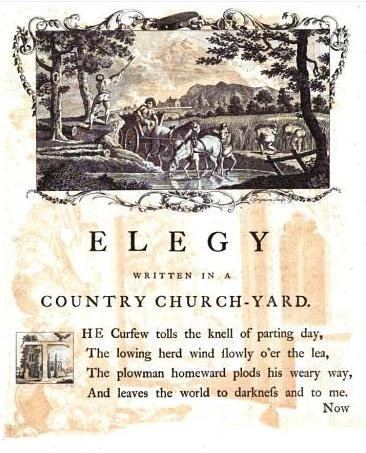
“The Curfeu tolls the Knell of parting Day, The lowing Herd winds slowly o'er the Lea, The Plow-man homeward plods his weary Way, And leaves the World to Darkness, and to me.”
Frequently cited
“The short and simple Annals of the Poor.”
Frequently cited
“The Boast of Heraldry, the Pomp of Pow'r, And all that Beauty, all that Wealth e'er gave, Awaits alike th' inevitable Hour. The Paths of Glory lead but to the Grave.”
Frequently cited
“Full many a Gem of purest Ray serene, The dark unfathom'd Caves of Ocean bear: Full many a Flower is born to blush unseen, And waste its Sweetness on the desart Air.”
Frequently cited
“Far from the madding Crowd's ignoble Strife, Their sober Wishes never learn'd to stray; Along the cool sequester'd Vale of Life They kept the noiseless Tenor of their Way.”
“Some mute inglorious Milton here may rest, Some Cromwell guiltless of his Country's Blood.”
“Fair Science frown'd not on his humble Birth, And Melancholy mark'd him for her own.”
“(There they alike in trembling Hope repose) The Bosom of his Father and his God.”
For Students
A reading companion for classical Christian high school students. See the student guide.
Reading Guide
Watch for
- The sounds of the first three stanzas, the curfew bell, lowing herd, droning beetle, tinkling folds and complaining owl, and how each fades into stillness.
- The direct address to Ambition, Grandeur and the Proud in stanzas 8-10, where the poem turns from description to argument.
- The paired images of the hidden gem and the unseen flower in stanza 14, and the three named figures Hampden, Milton and Cromwell in stanza 15.
- The sudden shift to For thee in stanza 24, where the speaker begins imagining his own death through the swain's eyes.
- The Epitaph's final quatrain, which sets merits and frailties together in trembling hope.
Key terms and names
- Curfeu
- The evening bell (curfew), originally a signal to cover fires for the night. In Gray's first line it rings out the end of the working day.
- elegy
- A poem of mourning or solemn reflection on death. Gray's mourns no single person until the Epitaph, reflecting instead on a whole village's dead.
- heroic quatrain
- A four-line stanza of iambic pentameter rhyming abab, sometimes called the elegiac stanza because of this poem. Every stanza of the Elegy uses it.
- storied Urn or animated Bust
- A funeral urn carved with scenes or an inscription, and a lifelike sculpted head on a tomb. Stanza 11 asks whether such monuments can call back the dead.
- Village-Hampden
- John Hampden (1594-1643) resisted Charles I's ship-money tax. A village Hampden stands up to a local petty tyrant over his fields.
- madding
- Frenzied or wildly acting. The madding crowd of stanza 19 is the restless, ambitious world the villagers never entered.
- Swain
- A country labourer or shepherd. The hoary-headed swain is the white-haired old man who tells the speaker's story after his death.
- Science
- In Gray's usage, learning or knowledge in general. Fair Science frowning not on the youth means he was educated despite his humble birth.
Seminar Questions
- Comprehension What time of day is it at the opening, and who leaves the World to Darkness and to the speaker?
- Comprehension Which ordinary activities of the villagers does Gray recall in stanzas 6-7?
- Comprehension According to the swain, what was the youth seen doing before the morning he was missed?
- Interpretation Why does Gray say that obscurity confined the villagers' crimes as well as their virtues? Is this consolation, warning, or both?
- Interpretation Who is the thee of stanza 24, and why does the poem end with the speaker's own imagined grave rather than the villagers'?
- Interpretation The poem first asks whether memorials can call back the dead, then honours a frail memorial with holy texts. How do the two attitudes fit together?
- Big Question Is a life of quiet faithfulness, unknown beyond its village, as worthy as a life of public greatness?
- Big Question What, if anything, rightly earns a person remembrance after death?
Faith Connections
- Psalm 103:15-17 (Scripture)
Man's days are as grass and the flower of the field, gone when the wind passes over, but the mercy of the Lord is from everlasting. Gray's flower born to blush unseen and his closing hope in God follow the same movement from frailty to mercy.
- Ecclesiastes 2:14-16 (Scripture)
The Preacher observes that one event happens to the wise and the fool, and that neither is long remembered. Stanza 9's inevitable hour that awaits beauty, wealth and power alike restates that observation.
- Philippians 2:12 (Scripture)
Paul tells believers to work out their salvation with fear and trembling. The Epitaph's trembling Hope captures that mixture of confidence and reverent fear before God's judgment.
- Samuel Johnson, Life of Gray (Lives of the Poets) (Great Conversation)
Johnson, a devout Anglican and severe critic, judged that the churchyard stanzas contain images that find a mirror in every mind, praising the Elegy for expressing what all readers feel before death.
Logic and Rhetoric
Central argument: All human distinctions end in the same grave (stanza 9). Monuments and praise cannot restore the dead (stanza 11). The poor buried here may have had gifts equal to the great, but poverty kept those gifts, and also their capacity for great crimes, from growing (stanzas 12-17). Therefore the proud have no ground to scorn the obscure, and a quiet life faithfully lived, commended to God in hope, is as fit an object of honour as any famous one.
Rhetorical device: personification and apostrophe. In stanzas 8-10 Gray turns abstract qualities into figures, Ambition, Grandeur, Memory, Honour, Flattery, and addresses the Proud directly, so that the argument against scorning the poor becomes a scene of rebuke.
Debate: Resolved: that the obscurity of the villagers in Gray's Elegy was more a protection than a loss.
Memory Work
The Boast of Heraldry, the Pomp of Pow'r, And all that Beauty, all that Wealth e'er gave, Awaits alike th' inevitable Hour. The Paths of Glory lead but to the Grave.
The Curfeu tolls the Knell of parting Day, The lowing Herd winds slowly o'er the Lea, The Plow-man homeward plods his weary Way, And leaves the World to Darkness, and to me.
Writing Prompts
Essay: Gray names Hampden, Milton and Cromwell in stanza 15. Explain what each name stands for and argue how the stanza balances the loss of hidden greatness against the dangers of power.
Comparison with Ozymandias: Gray and Shelley both show that the paths of glory lead to the grave, one in an English churchyard and one in an empty desert. Compare how each poem uses a monument, and what each suggests is worth remembering.
Medical Lens
The Elegy is a landmark of the eighteenth-century cult of melancholy, in which a contemplative, solitary sadness was treated as the temperament of the scholar and poet rather than as a disease. The swain's picture of the youth, drooping, wan, muttering wayward fancies and crazed with care, and the Epitaph's Melancholy marking him for her own, use the period's language of the melancholic disposition still loosely tied to humoral theory. Stanzas 22-23 also give a compact eighteenth-century picture of the good death: the dying soul relying on a fond breast and asking for pious tears. Any link to Gray's own low spirits, documented in his letters, is biographical and should be stated cautiously.
- Stanzas 26-27
The hoary-headed swain describes the youth stretching listlessly by the brook at noon and roving the wood drooping, wan and crazed with care or hopeless love.
- Stanzas 22-23
Reflection on the dying: no one leaves life without a lingering look behind, and the parting soul relies on a loving breast and the tears of those at the bedside.
- The Epitaph, lines 117-120
The epitaph names Melancholy as the defining mark of the young man's character, alongside his learning and humble birth.
Creative Prompts
- Poetry
Visit a local cemetery or read the names on a war memorial, then write four heroic quatrains (abab, iambic pentameter) on the ordinary lives behind the names, in the manner of Gray's stanzas 6-7.
- Classroom
Divide the class into groups, give each one section of the poem (scene, villagers, the proud, lost potential, memorials, the swain and Epitaph), and have each group report in one sentence what its section adds to the argument.
- Essay
Gray's stanza 17 says obscurity confined the villagers' crimes as well as their virtues. Write an essay on whether limited opportunity can be a protection as well as a loss, using the Elegy and one life you know of.
Further Reading
- The Poems of Thomas Gray, William Collins, Oliver Goldsmith, ed. Roger Lonsdale
Longman Annotated English Poets edition with full notes on sources and drafts.
- Thomas Gray: A Biography, R. W. Ketton-Cremer
- The Well Wrought Urn, Cleanth Brooks
Includes a chapter on the Elegy, Gray's Storied Urn.
- Lives of the Poets, Samuel Johnson
The Life of Gray contains Johnson's famous praise of the Elegy.
Verification notes
Publication by Dodsley in February 1751, the Walpole connection, the Eton manuscript and Hardy's borrowed title are well established. The 1742 starting date is a common scholarly suggestion, not a certainty, and the identification with Stoke Poges is traditional. The attached text is the 1751 first edition with its original spelling and capitals, including printer's forms such as Isle for aisle, born for borne and a doubled they in stanza 7; quotations reproduce it exactly and avoid the doubled word. Line numbers assume 116 lines of the body plus a 12-line Epitaph. The often-told story that General Wolfe recited the poem before taking Quebec in 1759 is an anecdote and is not used here.
No verification flags recorded.