Work record
Alice's Adventures in Wonderland
1865 · 19th Century · Novel · English
Abstract
Background. An Oxford mathematics don improvised the tale for Dean Liddell's three daughters during a rowing excursion, then wrote and illustrated a shorter version as a gift before enlarging it for Macmillan with Tenniel's drawings.
Plot. Chasing a waistcoated rabbit, Alice tumbles into an underground country where food and drink make her swell or dwindle. She meets a debating Dodo, a pipe-smoking Caterpillar, a squalling baby that becomes a piglet, and a disappearing cat, sits through a riddling tea, and plays croquet using live birds as mallets. A courtroom inquiry into stolen tarts collapses when she, regaining her proper height, rejects the proceedings, and she wakes beside her sister.
Form. Episodes are loosely chained rather than plotted, each built on a logical or verbal joke, and Carroll scatters comic versions of hymns and schoolroom rhymes that Victorian children knew by heart.
Themes. Unstable identity in a growing body, the pleasures of logic pushed to absurdity, the slipperiness of language, arbitrary authority and justice turned upside down, and the gap between nursery lessons and real experience.
Significance. Often credited with freeing English children's books from heavy-handed instruction, it spawned the 1871 sequel, countless translations and adaptations, and phrases now proverbial; physicians even borrowed Alice's name for a perceptual disorder.
Main characters
- Alice: Inquisitive young girl who follows a rabbit underground
- White Rabbit: Fretful courtier forever checking his pocket-watch
- Caterpillar: Laconic interrogator perched on a size-changing mushroom
- Cheshire Cat: Vanishing feline whose grin outlasts the rest of him
- Hatter: Host of an endless six o'clock tea with the March Hare and Dormouse
- Duchess: Pepper-loving aristocrat who later finds morals everywhere
- Queen of Hearts: Card monarch who demands beheadings for every offence
- Mock Turtle: Weeping creature who recalls his undersea schooling

Watch the summary
Alice's Adventures in Wonderland in 88 seconds · 1:28
Summary
On a hot summer afternoon Alice, bored beside her sister on a riverbank, sees a White Rabbit in a waistcoat take a watch out of its pocket and hurry down a rabbit-hole. She follows, falls slowly down a long well past cupboards and bookshelves, and lands in a hall of locked doors. A tiny golden key opens a door onto a lovely garden, but she is too large to pass. A bottle labelled DRINK ME shrinks her and a cake marked EAT ME makes her enormous, and her tears as a giant form a pool in which, shrunk again, she nearly drowns. The animals who swim out with her dry off by a Caucus-race organized by the Dodo, in which everyone wins, and the Mouse tells a long tale printed on the page in the shape of a tail. Sent by the Rabbit to fetch his gloves, Alice grows so large in his house that she fills it, and kicks Bill the Lizard up the chimney. In the wood she meets a hookah-smoking Caterpillar on a mushroom, who asks her who she is and tells her that one side of the mushroom will make her grow and the other shrink. At the Duchess's house the cook flings pepper and saucepans, the Duchess sings a lullaby about beating a sneezing boy, and the baby Alice carries off turns into a pig. The grinning Cheshire Cat tells her that everyone here is mad and fades away until only the grin remains. At the Mad Tea-Party the Hatter, the March Hare and the sleepy Dormouse sit at a long table where it is always six o'clock and pose a riddle with no answer. Alice at last reaches the garden, where gardeners paint white roses red, the Queen of Hearts orders beheadings for every offence, and croquet is played with flamingos and hedgehogs. The Gryphon takes her to the weeping Mock Turtle, who recounts his schooling in Reeling and Writhing, and the two dance the Lobster Quadrille. Finally the Knave of Hearts is tried for stealing the tarts before the King, while Alice keeps growing. Called as a witness, she protests against the Queen's demand for sentence before verdict, declares that the court is nothing but a pack of cards, and wakes on the bank with leaves fluttering onto her face. Her sister, musing on the dream, imagines the grown Alice keeping her childlike heart and telling such tales to children of her own. Carroll first told the story on a boat trip up the Thames on 4 July 1862 to Alice, Lorina and Edith Liddell, wrote it out as Alice's Adventures Under Ground, and expanded it for publication by Macmillan in 1865 with illustrations by John Tenniel.
Virtues in this work
- Fortitude: At the trial in Chapter XII Alice refuses to hold her tongue when the Queen orders her beheaded, and calls the court a pack of cards.
- Justice: Alice protests the Queen's demand for sentence before verdict as plain nonsense.
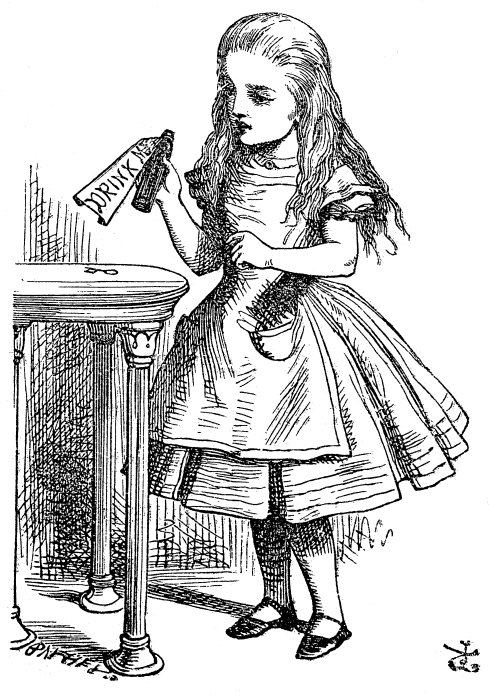
- Prudence: Before drinking from the DRINK ME bottle in Chapter I, Alice checks whether it is marked poison, remembering the rules she has been taught.
Plot or Argument
- Chapters I–II: Down the Rabbit-Hole and The Pool of Tears
Alice follows the White Rabbit, falls into the hall of doors, shrinks and grows by bottle and cake, weeps a pool, and wonders whether she has been changed into another child.
- Chapters III–IV: The Caucus-Race and the Rabbit's house
The Dodo's race in which all win prizes, the Mouse's long tale, and Alice's swelling to fill the White Rabbit's house, ending with Bill the Lizard shot out of the chimney.
- Chapter V: Advice from a Caterpillar
The Caterpillar questions Alice's identity, she recites a garbled 'You are old, Father William', and she learns to regulate her size with the two sides of the mushroom.
- Chapters VI–VII: Pig and Pepper and A Mad Tea-Party
The Duchess's peppery kitchen, the baby who becomes a pig, the Cheshire Cat's directions to the mad, and the endless tea with the Hatter, March Hare and Dormouse.
- Chapter VIII: The Queen's Croquet-Ground
Painted roses, a croquet game with flamingo mallets and hedgehog balls, the Queen's cry for heads, and the dispute over beheading the bodiless Cheshire Cat.
- Chapters IX–X: The Mock Turtle's Story and The Lobster Quadrille
The moralizing Duchess, the Gryphon and the Mock Turtle's sea-school lessons, their dance and songs, and parodies of familiar moral verses.
- Chapters XI–XII: Who Stole the Tarts? and Alice's Evidence
The trial of the Knave of Hearts, absurd witnesses, a nonsense letter read as evidence, Alice's defiance of the Queen, her waking, and her sister's closing reverie.
Characters
- Alice, protagonist
Curious, polite and argumentative young girl who keeps trying to apply lessons and good manners to a world that ignores them.
- The White Rabbit, guide and herald
Anxious, gloved rabbit always late for the Duchess or the Queen; he leads Alice into Wonderland and reads the evidence at the trial.
- The Caterpillar, questioner
Languid, hookah-smoking creature on a mushroom who asks Alice who she is.
- The Duchess, noblewoman
Ugly, peppery mother of the pig-baby who later finds a moral in everything.
- The Cheshire Cat, philosopher
The Duchess's grinning cat, who appears and vanishes at will and declares everyone mad.
- The Hatter, host of the tea-party
Rude riddler stuck at six o'clock since quarrelling with Time; later a nervous witness at the trial.
- The March Hare, tea-party companion
The Hatter's partner in nonsense, who offers wine that is not there.
- The Dormouse, tea-party guest
Perpetually sleepy creature who tells the tale of three sisters living in a treacle-well.
- The Queen of Hearts, tyrant
Furious ruler who orders beheadings that are never carried out.
- The King of Hearts, judge
Timid husband of the Queen who presides over the trial.
- The Gryphon and the Mock Turtle, companions
A brisk mythical beast and a sobbing creature who recount sea-school lessons and dance the Lobster Quadrille.
- Alice's sister, frame figure
The older sister on the riverbank who hears the dream and imagines Alice grown up.
Lessons
Holding on to who you are
Alice's body keeps changing size, and the Caterpillar's question about who she is leaves her unsure. Yet she keeps her manners, her curiosity and her sense of fairness, and those, more than her height, prove to be what makes her Alice.
- In Chapter II Alice wonders if she has turned into Mabel. How does she test whether she is still herself?
- What stays the same about Alice from the first chapter to the last, even when her size changes?
- Why do you think the Caterpillar's question bothers her so much?
Words mean something
Wonderland's creatures twist puns, take idioms literally and argue that saying what you mean is not the same as meaning what you say. The jokes work only because words normally carry fixed meanings, so the book quietly trains readers to listen closely to language.
- At the tea-party, the March Hare tells Alice to say what she means. Is meaning what you say the same thing? Why not?
- Which pun in the Mock Turtle's school lessons made you laugh, and what real school subject does it play on?
- Why might a mathematician who taught logic enjoy writing nonsense?
Courage to call nonsense by its name
At the trial the Queen wants the sentence before the verdict, and everyone is afraid of her. Alice, grown to full size, says plainly that the idea is nonsense and that the court is only a pack of cards. Seeing clearly and speaking truthfully ends the bad dream.
- Why does no one in the court stand up to the Queen except Alice?
- What is wrong with deciding the punishment before deciding whether someone is guilty?
- Can you think of a time when it took courage to say that something unfair was wrong?
Rules that make sense and rules that do not
Alice remembers sensible rules, such as not drinking from a bottle marked poison, and she tries to be polite. Wonderland is full of rules that serve no purpose, like the Caucus-race where everyone wins or the King's Rule Forty-two. The contrast helps children see why good rules exist.
- Before drinking from the bottle in Chapter I, what rule does Alice remember?
- Is a race where everyone wins a prize really a race? Why or why not?
Context
Victorian children's books were often openly instructive, full of moral verses such as Isaac Watts's 'How doth the little busy bee' and Robert Southey's 'The Old Man's Comforts'. Carroll parodies these poems ('How doth the little crocodile', 'You are old, Father William') and lets his heroine wander without a lesson attached, which made the book a landmark in writing for children's delight.
Composition
On 4 July 1862 Dodgson and his friend Robinson Duckworth rowed the three daughters of Henry Liddell, Dean of Christ Church, up the Thames toward Godstow, and Dodgson told the story to amuse them. At Alice Liddell's request he wrote it down as Alice's Adventures Under Ground, with his own drawings, and gave her the manuscript in November 1864. Encouraged by friends including the family of George MacDonald, he expanded it for Macmillan, with 42 illustrations by John Tenniel. The first printing of 1865 was withdrawn because Tenniel disliked the printing of the pictures; a new printing appeared in late 1865 dated 1866, and the earlier sheets were sold to Appleton for an American issue.
Reception
The book sold steadily and soon widely, and Carroll followed it with Through the Looking-Glass, and What Alice Found There (dated 1872). It has been translated into a great many languages, adapted for stage and screen, and its phrases (mad as a hatter, the Cheshire cat's grin, down the rabbit-hole) entered common English.
Comparisons
- peter-pan
Both are Victorian or Edwardian dream-journeys of a girl into a land of childish logic, but Alice wakes and is imagined growing up with her heart unchanged, while Barrie's book dwells on the boy who will not grow up.
- on-fairy-stories
Tolkien set the Alice books aside from true fairy-stories because their dream frame explains the marvels away; reading the essay alongside the book's final chapter sharpens the question of what a dream ending does.
- the-princess-and-the-goblin
George MacDonald, whose family read Carroll's manuscript and urged him to publish it, wrote fantasy for children with an openly Christian moral seriousness that contrasts with Carroll's playful nonsense.
- gullivers-travels
Gulliver among the Lilliputians and Brobdingnagians and Alice growing and shrinking both use changes of scale to make familiar manners look absurd, though Swift's satire is sharper and aimed at adults.
- the-phantom-tollbooth
Juster's Milo, like Alice, travels through a land built from puns and literal idioms, and both books turn wordplay into a lesson in thinking clearly.
- the-wind-in-the-willows
Another Oxford-rooted riverside fantasy with talking animals; Grahame's world is gentle and homely where Carroll's is argumentative and dreamlike.
Quotes
“Curiouser and curiouser!”
“But if I’m not the same, the next question is, Who in the world am I?”
“we’re all mad here. I’m mad. You’re mad.”
“Then you should say what you mean,”
“Everything’s got a moral, if only you can find it.”
“it’s no use going back to yesterday, because I was a different person then.”
“Begin at the beginning,” the King said gravely, “and go on till you come to the end: then stop.”
“Sentence first—verdict afterwards.”
“You’re nothing but a pack of cards!”
For Students
A reading companion for classical Christian high school students. See the student guide.
Reading Guide
Watch for
- Every time Alice eats or drinks something and changes size, from the DRINK ME bottle in Chapter I to the mushroom in Chapter V, and whether she is the right size for what she wants.
- The poems Alice tries to recite, such as 'How doth the little crocodile' and 'You are old, Father William', which come out wrong and funny.
- How the Cheshire Cat appears and disappears, leaving his grin behind in Chapter VI and turning up again at the croquet-ground in Chapter VIII.
- The trial in Chapters XI and XII, where Alice keeps growing until she is brave enough to speak up.
- The last pages, where Alice's sister imagines Alice grown up and still telling stories.
Key terms and names
- Rabbit-hole
- The hole beside the riverbank that Alice falls down after the White Rabbit. Her fall is so slow that she has time to take a jar of orange marmalade off a shelf.
- Caucus-race
- The Dodo's race in Chapter III, run in a circle with no set start or finish, after which everybody wins and Alice must hand out comfits as prizes.
- Hookah
- The long smoking pipe the blue Caterpillar puffs while he questions Alice from the top of his mushroom in Chapter V.
- Cheshire Cat
- The Duchess's cat, who grins from ear to ear, gives Alice directions, and can vanish until only the grin is left.
- Mad Tea-Party
- The never-ending tea in Chapter VII. The Hatter says Time stopped at six o'clock, so it is always tea-time and they just move round the table.
- Mock Turtle
- A sad creature in Chapter IX who tells of his school under the sea, where the lessons were Reeling and Writhing and different branches of Arithmetic.
- Knave of Hearts
- The playing-card servant accused of stealing the Queen's tarts, whose trial fills the last two chapters.
Seminar Questions
- Comprehension What does Alice see that makes her follow the White Rabbit down the rabbit-hole?
- Comprehension How does Alice finally learn to make herself bigger or smaller whenever she wants?
- Comprehension What happens to the baby that Alice carries out of the Duchess's kitchen?
- Interpretation Alice tries hard to be polite, but the creatures are often rude to her. Why do you think she keeps trying to be polite anyway?
- Interpretation When the Caterpillar asks Alice who she is, she cannot answer. Why is that question so hard for her on this strange day?
- Interpretation The Queen shouts for heads to be cut off all the time, but the Gryphon says nobody is ever executed. What does that tell you about the Queen?
- Big Question At the end Alice says the court is nothing but a pack of cards, and the dream ends. Why does telling the truth sometimes make a frightening thing lose its power?
Faith Connections
- Proverbs 18:13 (Scripture)
Solomon says that whoever answers a matter before hearing it is foolish and shamed. The Queen's demand for the sentence before the verdict in Chapter XII is exactly that folly, and Alice is right to call it nonsense.
- Matthew 18:3 (Scripture)
Jesus says that unless we turn and become like little children we will not enter the kingdom of heaven. The book's last page hopes the grown Alice will keep the simple and loving heart of her childhood.
- Psalm 139:13-14 (Scripture)
The psalmist knows he is fearfully and wonderfully made by God, who knit him together. When Alice, changed in size, wonders who in the world she is, children can talk about where a person's true identity comes from.
- Isaac Watts, Divine Songs for Children (1715), 'Against Idleness and Mischief' (Great Conversation)
Carroll's 'How doth the little crocodile' in Chapter II parodies Watts's well-known hymn for children about the busy bee. Comparing the two shows both Watts's earnest teaching and Carroll's affectionate fun with it.
Logic and Rhetoric
Central argument: Wonderland's creatures speak confidently but reason badly: they confuse words with things, decide before they judge, and make rules that serve no purpose. Alice, though small and often puzzled, keeps her common sense, memory and manners. When she finally trusts that sense and names the court for what it is, a pack of cards, the nonsense loses its power and she wakes. So the book suggests that clear thinking and honest speech are a child's best defense against bluster.
Rhetorical device: parody. Alice's recitations in Chapters II and V turn familiar moral poems into nonsense, and the Duchess's habit in Chapter IX of declaring that everything has a moral pokes fun at books that force a lesson onto every story.
Debate: Resolved: Alice is braver at the end of the story than at the beginning.
Memory Work
Begin at the beginning,” the King said gravely, “and go on till you come to the end: then stop.
Curiouser and curiouser!
Writing Prompts
Essay: Choose three moments when Alice changes size and explain how each change gets her into trouble or out of it. What does she learn by the time she meets the Caterpillar?
Comparison with The Phantom Tollbooth: Alice and Milo both travel through lands where words act strangely. Compare one scene of wordplay from each book and explain which traveler learns more from the journey.
Medical Lens
The book is a children's dream fantasy, not a medical text, but several of its images have entered clinical and popular medical vocabulary. In 1955 the psychiatrist John Todd used the name 'Alice in Wonderland syndrome' for distortions of body image and of perceived size (micropsia, macropsia) reported especially with migraine and some infections; links to Carroll's own migraines are sometimes proposed, and should be treated as speculation. The phrase 'mad as a hatter' predates the book, and the association of hatters with mercury exposure from felting is often attached to Carroll's Hatter, though there is no evidence Carroll meant it. The bottle and cake that change Alice's body, the Caterpillar's hookah and mushroom, and Alice's careful recollection that drinking from a bottle marked poison is likely to disagree with you invite a light historical note on Victorian nursery medicines and poison labelling. The Cheshire Cat's 'we're all mad here' is playful logic, not a portrait of mental illness.
- Chapter I
Alice checks whether the DRINK ME bottle is marked poison before tasting it, then shrinks to ten inches high.
- Chapter II
Alice grows to over nine feet, weeps a pool, and doubts her own identity, testing her memory with multiplication and geography.
- Chapter V
The Caterpillar with his hookah gives Alice the mushroom whose two sides make her grow or shrink; her neck stretches above the trees.
- Chapters VI–VII
The Cheshire Cat's argument that everyone in Wonderland is mad, and the Mad Tea-Party with the Hatter, March Hare and ever-sleeping Dormouse.
- Chapter XII
Alice wakes on the bank and her sister half-dreams the same scenes, explaining the adventures as a dream.
Listen to the book
Public-domain audiobook from LibriVox, read by Vin Cramer. Recording: Alice's Adventures in Wonderland (Version 8) on LibriVox (Internet Archive).
LibriVox recordings are volunteer readings released into the public domain. The reading may follow a different edition from the text in this library.
Creative Prompts
- Classroom
Make a size chart of Alice's changes through the book: what she ate or drank, how tall she became, and what trouble it caused.
- Fiction
Write a new chapter in which Alice attends one more Wonderland gathering, with a guest who takes every idiom literally.
- Poetry
Choose a short moral poem you know well and write a Carroll-style parody of it, as he did with 'How doth the little busy bee'.
- Dialogue
Script the conversation between the King, the Queen and the executioner about whether a cat with no body can be beheaded.
Further Reading
- Through the Looking-Glass, and What Alice Found There, Lewis Carroll
The 1871 sequel, with Tweedledum and Tweedledee, Humpty Dumpty and the chess-board country.
- The Annotated Alice, Martin Gardner
Explains Carroll's parodies, puns, Oxford jokes and logic puzzles.
- Lewis Carroll: A Biography, Morton N. Cohen
- The Hunting of the Snark, Lewis Carroll
Verification notes
All nine quotations were found verbatim (with curly apostrophes and dashes as in the file) in content/texts/alices-adventures-in-wonderland.txt, Project Gutenberg #11; chapter locators come from the chapter headings in that file. The 4 July 1862 boat trip, the Under Ground manuscript of 1864, Tenniel's illustrations and the withdrawn first printing are standard publication history. John Todd's 1955 naming of the syndrome is well documented; the mercury and hatter link is presented as a popular association only.
- Count of 42 Tenniel illustrations in the first edition.
- That the withdrawn 1865 sheets were sold to D. Appleton for the first American issue (usually dated 1866).
- Role of the George MacDonald family in encouraging publication (based on Carroll's diaries as usually reported).