Work record
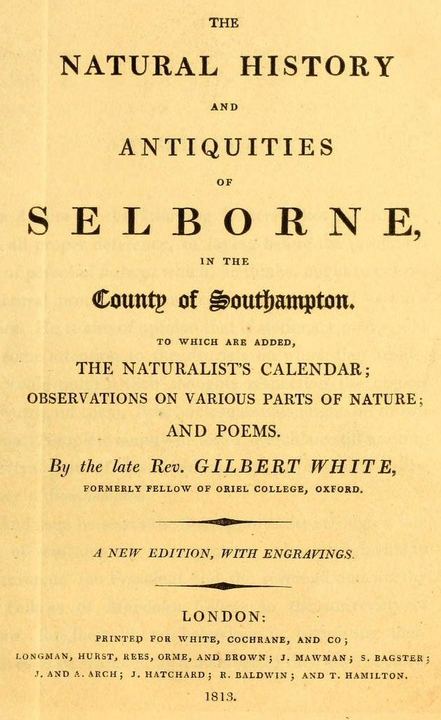
The Natural History of Selborne
1789 · 18th Century · Essays · English
Abstract
Background. Gilbert White, curate in the Hampshire village where he was born, exchanged letters for some twenty years with Thomas Pennant and Daines Barrington. At Barrington's urging he revised them for print, adding opening letters that were never actually posted.
Scope. The subject is one parish: its beech hanger on the chalk, hollow lanes, springs, sandy heaths and the dwindling deer of Wolmer Forest, together with whatever creatures and villagers White could observe on foot.
Content. To Pennant he reports seasonal arrivals, the separation of three willow-wrens by their songs, the tiny harvest mouse and a large bat unrecorded in England. The Barrington series includes close studies of swallow, house-martin, sand-martin and swift, the old tortoise read as a living barometer, earthworms, rushlights, a bee-catching boy, hard winters and the haze of summer 1783.
Method. White dates, weighs and measures, and on whether swallows migrate or lie torpid through winter he gathers testimony and suspends judgment. He reads the order of animal instinct as evidence of Providence, and he prefers a careful account of one district to broad systems built at a distance.
Significance. In print without interruption since 1789, the book helped found English field natural history. Charles Darwin read it as a boy, and White's house at Selborne is now a museum.
Key figures
- Gilbert White: Curate and naturalist of Selborne, the letter-writer
- Thomas Pennant: Welsh zoologist, author of British Zoology, addressee of the first series
- Daines Barrington: Lawyer and Fellow of the Royal Society, addressee of the second series
- Benjamin White: The author's brother, a London bookseller who published the book

Summary
The Natural History of Selborne is a book of letters about one Hampshire parish, written by its curate over about twenty years to two learned correspondents: the zoologist Thomas Pennant and the lawyer and antiquary Daines Barrington. White opens with the place itself: its position among the chalk downs and sandy heaths of east Hampshire, its soils, springs and beech hanger, the deep hollow lanes worn into the rock, the forest of Wolmer and its decayed deer. He then turns to what he can watch from his own garden and walks. Season after season he records birds, insects, reptiles and mammals with dates, weights and measurements: when the first swallow appears, how the swift differs in its habits from the swallow and house-martin, how the fern-owl or nightjar takes beetles on the wing, how rooks, owls and cuckoos behave. Some observations were new to English science. He distinguished three species of willow-wren, today's chiffchaff, willow warbler and wood warbler, chiefly by their songs; described the harvest mouse, which he weighed against a halfpenny as the smallest quadruped in the island; and described a great bat then unnamed in England, now known as the noctule. A recurring question is what becomes of swallows in winter: White collects reports of birds found torpid, notes late broods, and keeps both migration and winter hiding open, judging carefully by evidence. Later letters range more widely: the old tortoise that he inherited and watched for years as a weather-glass, the echo near the village, the use of rushes dipped in fat as candles by cottagers, a boy who spent his summers catching bees, a hare reared by a cat, earthworms as great promoters of vegetation, great frosts, the hail storm and the summer haze of 1783. Throughout, White writes as a Christian observer who sees Providence in the order of creatures, and as a patient scientist who prefers a careful local account to sweeping theory. His closing note commends the study of one place well examined, since all nature is so full that the district most examined yields the greatest variety. The book has been reprinted continuously since 1789.
Virtues in this work
- Prudence: White weighs every report on swallows in winter and refuses to accept claims no one actually witnessed.
- Industry: He kept dated records of weather and creatures at Selborne for over forty years.
- Humility: White confines himself to one parish and admits plainly what he has not yet been able to learn.
- Piety: He reads the creatures of Selborne as works of Providence and applies Scripture to them with reverence and humor.
Plot or Argument
- The parish described (To Pennant, Letters I-IX)
Letters prepared as an introduction describe Selborne's situation, soils, hanger, hollow lanes, springs and the forest of Wolmer.
- Birds and their seasons (To Pennant, Letters X-XLIV)
White reports arrivals and departures, the three willow-wrens, the harvest mouse, local rarities, and the puzzle of swallows in winter, often answering Pennant's questions.
- The hirundines (To Barrington)
Monographs on the house-martin, swallow, sand-martin and swift set out nesting, feeding, flight and dates of arrival and departure in exact detail.
- Animal behavior and instinct (To Barrington)
Letters discuss the songs of birds, the instincts of animals, the tortoise, the fern-owl, rooks, a cat that nursed a leveret and the importance of earthworms.
- Village life and weather (To Barrington, later letters)
Rushlights, the echo, the bee-catching boy, great frosts, the hail storm and the haze of 1783 show White's interest in people and climate as well as animals.
Characters
- Gilbert White, author and observer
Curate and naturalist who records Selborne's creatures with patience, humor and piety.
- Thomas Pennant, correspondent
Welsh zoologist and author of British Zoology, to whom the first group of letters is addressed.
- Daines Barrington, correspondent
Lawyer and Fellow of the Royal Society, to whom the second and longer group of letters is addressed.
- The old tortoise, observed creature
A land-tortoise kept for many years in Sussex and later at Selborne, studied as a sleeper and a weather-glass.
Lessons
Attention as a discipline
White teaches by example that knowledge comes from long, careful attention to one place. He dates, weighs, measures and returns to the same creatures season after season.
- Why does White weigh the harvest mice against a halfpenny?
- How does he tell the three willow-wrens apart?
- What does he mean by saying the district most examined produces the greatest variety?
Evidence before conclusions
On the winter fate of swallows White gathers reports, tests them and keeps an open mind. He prefers to say he does not yet know rather than accept a story he cannot verify.
- Why is White disappointed when the schoolboy admits he did not see the swallows himself?
- What evidence leads him to think some swallows might hide in winter?
Small creatures matter
White argues that earthworms, though they seem a despicable link in the chain of nature, would leave a lamentable chasm if lost. The book trains readers to honor the humble parts of creation.
- What does White say earthworms do for the soil?
- Why do gardeners and farmers dislike them?
Creation and Providence
White sees the creatures as works of a wise Creator, even when, as with the sleeping tortoise, their design puzzles him. His piety and his science sit comfortably together.
- How does White apply Isaiah 1:3 to the tortoise?
- What puzzles him about the tortoise's long life?
Context
White wrote in the age of Linnaeus, when naturalists across Europe were naming and classifying species and English gentlemen and clergy kept diaries of weather and natural events. Pennant and Barrington were active members of the Royal Society. White's parish-based method, joining natural history to local history, drew on a tradition of county histories but gave it a new intimacy and precision.
Composition
White's letters to Pennant began in 1767 and to Barrington in 1769. Encouraged by Barrington, he revised them for print, adding introductory letters never actually sent, and his brother Benjamin White published the book in London at the end of 1788, dated 1789, together with The Antiquities of Selborne. This text gives the natural-history letters.
Reception
Little noticed at first, the book became steadily more popular in the nineteenth century and is reckoned among the most often reprinted books in English. Charles Darwin read it as a boy, and generations of naturalists, poets and essayists have praised it. White's house at Selborne is now a museum.
Comparisons
- the-voyage-of-the-beagle
Darwin, who read White as a boy, takes the same habits of exact observation on a voyage around the world.
- the-burgess-bird-book-for-children
Burgess teaches children bird habits through stories of one meadow; White does the same for adults by letters from one parish.
- natural-history-a-selection
Pliny compiles reports from the whole known world, often uncritically; White examines one parish and tests every report.
- on-the-origin-of-species
Darwin's theory rests on the kind of patient field observation White modeled, though White himself explains design by Providence.
Quotes
Frequently cited
“all nature is so full, that that district produces the greatest variety which is the most examined”
Frequently cited
“Earth-worms, though in appearance a small and despicable link in the chain of nature, yet, if lost, would make a lamentable chasm”
Frequently cited
“it is a matter of wonder to find that Providence should bestow such a profusion of days, such a seeming waste of longevity, on a reptile that appears to relish it so little as to squander more than two-thirds of its existence in a joyless stupor”
“The parish of Selborne lies in the extreme eastern corner of the county of Hampshire, bordering on the county of Sussex, and not far from the county of Surrey”
“I suppose they are the smallest quadrupeds in this island”
“Thus not only ‘the ox knoweth his owner, and the ass has master’s crib,’* but the most abject reptile and torpid of beings distinguishes the hand that feeds it, and is touched with the feelings of gratitude”
“No two birds can differ more in their notes, and that constancy, than those two that I am acquainted with; for the one has a joyous, easy, laughing note; the other a harsh loud chirp”
For Students
A reading companion for classical Christian high school students. See the student guide.
Reading Guide
Watch for
- How the first letters move from the parish's position to its soils, lanes and waters before reaching any animal.
- Every place where White weighs, measures or dates something, and why he does it.
- His reasoning about whether swallows hide or migrate in winter, and how he treats secondhand reports.
- The letters on the old tortoise, which mix science, humor and Scripture.
- The passage on earthworms and its argument for the value of small creatures.
Key terms and names
- Parochial history
- The history of one parish; White argues it should include natural productions as well as antiquities.
- Hirundines
- The swallow family; White studies swallows, house-martins, sand-martins and swifts closely.
- Hanger
- A wood on the side of a steep hill; Selborne Hanger is a beech wood above the village.
- Torpid
- Sluggish or dormant; White asks whether swallows lie torpid in winter as the tortoise does.
- Willow-wren
- White's name for small warblers; he showed there were three species distinguished by song.
- Naturalist's journal
- A dated record of weather and natural events, which White kept for decades.
Seminar Questions
- Comprehension To whom are the letters written, and what did each correspondent study?
- Comprehension How does White prove that the harvest mouse is so small?
- Comprehension What does White say earthworms do for soil and plants?
- Interpretation White was mistaken in thinking some swallows might hide in winter. Does his reasoning still deserve respect? Why?
- Interpretation Why does White, a clergyman, so often mention Providence while describing animals? Does it help or hinder his science?
- Interpretation White says the district most examined yields the greatest variety. What does this suggest about how to learn anything well?
- Big Question Is it better to know one place deeply or many places broadly?
Faith Connections
- Psalm 104:24 (Scripture)
"O Lord, how manifold are thy works! in wisdom hast thou made them all." White's patient catalog of creatures is an extended meditation on the variety this psalm praises.
- Isaiah 1:3 (Scripture)
White quotes Isaiah's ox that knows its owner when the tortoise recognizes the woman who feeds it.
- Job 12:7-9 (Scripture)
"Ask now the beasts, and they shall teach thee." White learns about the world's order by asking the beasts of his own parish.
Logic and Rhetoric
Central argument: Nature is so full that any district carefully examined will reveal great variety. White examines his own parish for decades, recording exact dates, weights and behaviors, and tests every report against evidence. His findings include new species distinctions and new questions. Therefore the book argues that patient, local, evidence-based observation is the surest path to natural knowledge, and that such knowledge deepens wonder at the Creator's work.
Rhetorical device: the familiar letter. White addresses Pennant and Barrington directly, answers their questions and apologizes for testing their patience, so that scientific reports read as friendly conversation.
Debate: Resolved: that White was right to keep an open mind about swallows hiding in winter.
Memory Work
all nature is so full, that that district produces the greatest variety which is the most examined
Earth-worms, though in appearance a small and despicable link in the chain of nature, yet, if lost, would make a lamentable chasm
Writing Prompts
Essay: Choose one creature White studies, such as the swift, the tortoise or the harvest mouse, and explain his methods of observation and what he concludes. Evaluate how well his method supports his conclusions.
Comparison with The Voyage of the Beagle: White observes one parish for forty years; Darwin observes the world for five. Compare one passage from each and argue which method yields deeper understanding.
Medical Lens
The book is natural history, but it touches daily health and village life: White notes that Selborne's damp, wooded situation is nonetheless free of agues, describes the harvest-bug whose bites raise intolerably itching tumours, records how cottagers make rushlights, and describes with sympathy a boy of very limited understanding who lived for catching bees. His weather records, including the haze and heat of 1783, are an early form of the environmental observation later used in public health.
- To Pennant, Letter V
White notes that the village, though surrounded by trees and damp, is healthy and free from agues.
- To Pennant, Letter XXXIV
The harvest-bug's bites raise tumours that itch intolerably on those who walk in the grass in summer.
- To Barrington, Letter XXVII
A village boy of very limited understanding spent summers catching bees and sucking their honey-bags, torpid by the fire in winter.
- To Barrington, Letter LXV
White records the strange haze, heat and storms of the summer of 1783 and their effects in the parish.
Listen to the book
Public-domain audiobook from LibriVox, read by Peter Yearsley. Recording: Natural History of Selborne on LibriVox (Internet Archive).
LibriVox recordings are volunteer readings released into the public domain. The reading may follow a different edition from the text in this library.
Creative Prompts
- Classroom
Keep a two-week naturalist's journal of one yard, park or schoolground in White's manner: date, weather, creatures seen, and one measurement each day.
- Essay
Explain how White investigates the winter fate of swallows and evaluate his reasoning in light of what is now known about migration.
- Poetry
Write a short poem from the point of view of White's tortoise waking in spring.
- Classroom
Listen to recordings of the chiffchaff, willow warbler and wood warbler and see whether students can tell them apart as White did.
Further Reading
- The Voyage of the Beagle, Charles Darwin
- The Formation of Vegetable Mould through the Action of Worms, Charles Darwin
Darwin's 1881 book on the earthworms White praised.
- Walden, Henry David Thoreau
- Gilbert White: A Biography of the Author of The Natural History of Selborne, Richard Mabey
Verification notes
Biographical and publication facts are standard. Letter locators follow the attached Gutenberg edition's numbering in the two series. The modern identifications of White's willow-wrens and his early record of the harvest mouse and noctule are standard in histories of British natural history. Quotes are verified against the attached Gutenberg text.
No verification flags recorded.