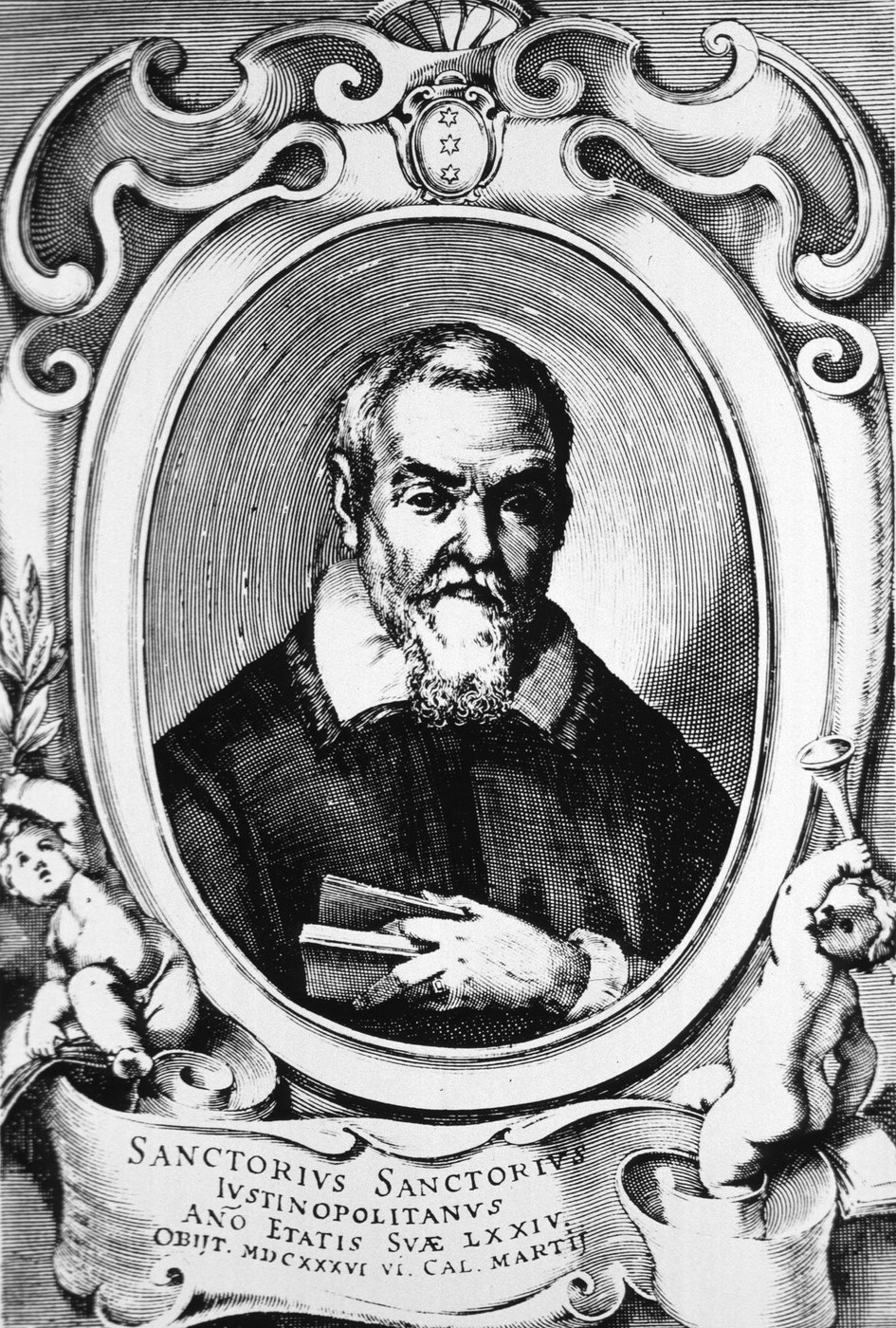
Santorio Santorio (1561-1636) · CatalogSantorio SantorioSantorio Santorio (1561-1636) · CatalogItalian physician of Capodistria and Padua who measured insensible perspiration and wrote De Statica Medicina (1614)
Author
Santorio Santorio
1561-1636 · Italian physician of Capodistria and Padua who measured insensible perspiration and wrote De Statica Medicina (1614)
Santorio Santorio, line engraving by Giacomo Piccini, 1609. Source · Public domain
About Santorio Santorio
Santorio Santorio (1561–1636) was a physician born at Capodistria (now Koper) who studied and later taught at Padua. He is remembered for the weighing chair in which he recorded intake and excretions in order to measure insensible perspiration, and for related instruments including a thermoscope and a pulsilogium. His Latin De Statica Medicina appeared in 1614. The English text here is John Quincy’s translation, first published in 1712 and prepared from the 1723 third edition.
“If there daily be an Addition of what is wanting, and a Substraction of what abounds, in due Quantity and Quality, lost Health may be restor'd, and the present preserved”
“If a Physician who has the Care of another's Health, is acquainted only with the sensible Supplies and Evacuations, and knows nothing of the Waste that is daily made by insensible Perspiration, he will only deceive his Patient, and never cure him”
“Amongst the Affections of the Mind, those of Anger and Joy, make Persons lighter; those of Fear and Sorrow more heavy; and the other Affections operate in Proportion to their Participation of these”
“Anger and Hope remove Fear, and Joy takes away Sorrow: For a Passion of the Mind is not to be conquered by Medicine, but by some contrary Passion, for Contraries are under the same Genus”
Santorio Santorio’s De Statica Medicina, first printed in Latin in 1614, is a short book of medical aphorisms built on a simple and then startling claim: a great part of what the body takes in leaves it not by the visible evacuations the physician already watched, but by an invisible loss Santorio called insensible perspiration. He tried to weigh that loss.