Work record
Medicina Statica
Santorio SantorioMedicina Statica by Santorio Santorio (1614)Santorio Santorio’s De Statica Medicina, first printed in Latin in 1614, is a short book of medical aphorisms built on a simple and then startling claim: a great part of what the body takes in leaves it not by the visible evacuations the physician…1614 · Renaissance Early Modern · Essays · Latin
Abstract
The work. De Statica Medicina (1614) is a book of medical aphorisms arguing that a large part of the body’s daily loss is invisible perspiration, which the physician must measure if he is to restore or preserve health. Santorio reached that claim after years of recording intake and evacuations in a weighing chair.
The method. He compared the weight of food and drink with visible evacuations, treated the difference as insensible perspiration, and then applied the same balance to air, bathing, diet, sleep, exercise, and the affections of the mind, still under the older heads of regimen called the non-naturals.
This edition. The hosted English is John Quincy’s translation, first published in 1712 and prepared from the 1723 third edition, with Quincy’s spelling kept and long s converted. Only the aphorisms are included; Quincy’s explanations and Keill’s related tract are not. A 1723 numbering gap in Section I is marked rather than filled by invention.
For students. Read in grades 11–12 as history of medicine, beside Harvey and Celsus. Section VI is in the full text because Quincy printed it, but it is not used for featured quotations. Featured lines were checked on 1723 page images; some other aphorism bodies may still show OCR roughness.
Key figures
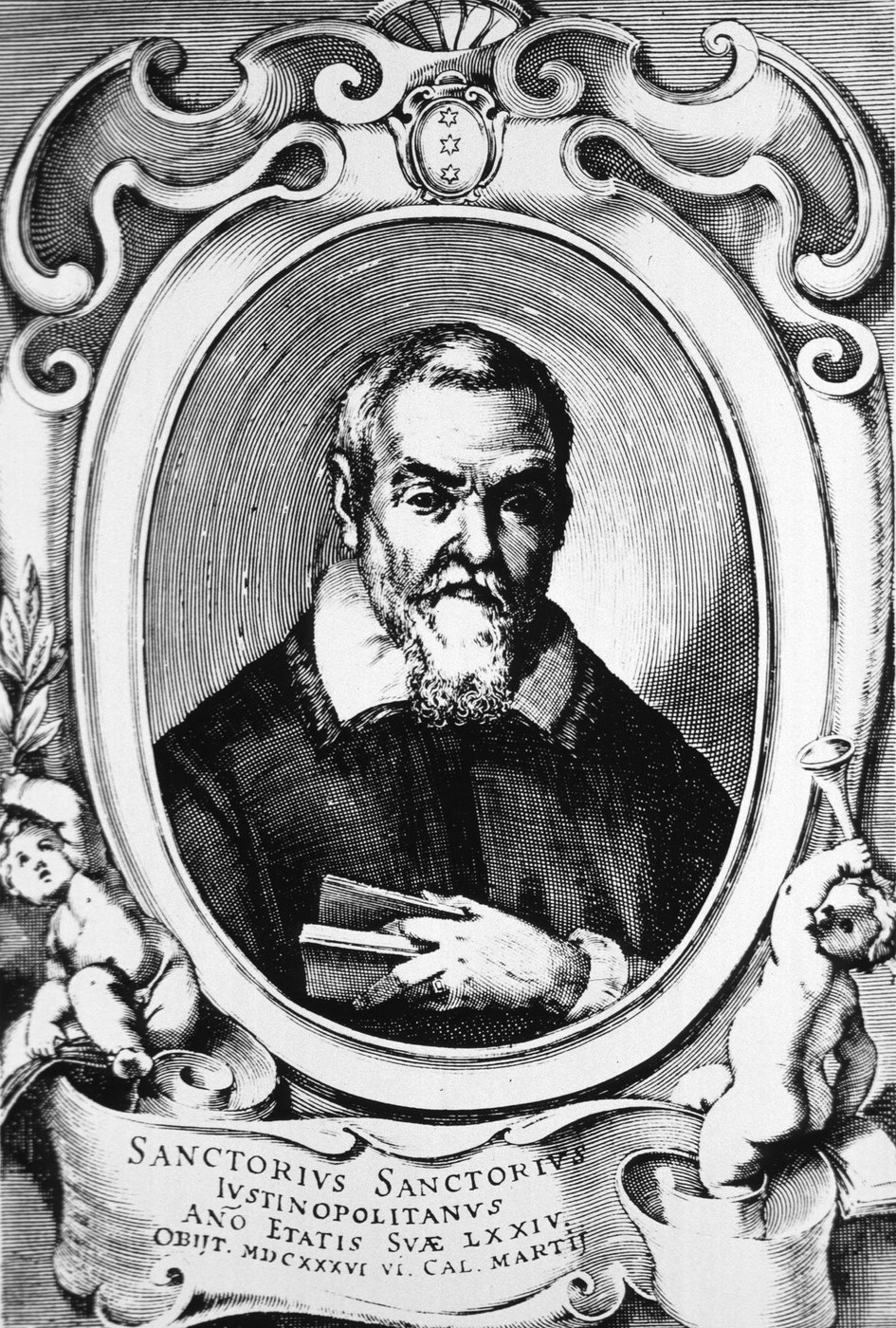
- Santorio Santorio: Physician of Capodistria and Padua who weighed insensible perspiration in a chair-balance
- John Quincy: English translator of the aphorisms; first edition 1712, this text from 1723

Summary
Santorio Santorio’s De Statica Medicina, first printed in Latin in 1614, is a short book of medical aphorisms built on a simple and then startling claim: a great part of what the body takes in leaves it not by the visible evacuations the physician already watched, but by an invisible loss Santorio called insensible perspiration. He tried to weigh that loss. For years he sat, ate, slept, and worked in a specially built chair-balance, recording the weight of food and drink against the weight of what left the body, and treating the difference as perspiration that escaped notice. The first aphorisms state the practical moral. If there is daily an addition of what is wanting and a “Substraction” of what abounds, in due quantity and quality, lost health may be restored and present health preserved; a physician who knows only the sensible supplies and evacuations, and nothing of the daily waste by insensible perspiration, will deceive his patient and never cure him. Later sections apply the same method to air and bathing, eating and drinking, sleep, exercise, and the affections of the mind, in the inherited language of the non-naturals. The English text hosted here is John Quincy’s translation, Medicina Statica: Being the Aphorisms of Sanctorius, first published in 1712. The transcription was prepared from the 1723 third edition printed at London for W. and J. Newton, E. Bell, W. Taylor, and J. Osborn (title page: “The Third Edition,” MDCCXXIII; Wellcome and Internet Archive copies of this edition). Quincy’s wording and spelling are kept, including forms such as Substraction, restor’d, and physick; long s has been converted to s. Only the aphorisms are hosted. Quincy’s own explanations, James Keill’s Medicina Statica Britannica, and the medico-physical essays printed with some English editions are excluded. Section VI is included because Quincy kept it in the 1723 text; it is not used for featured quotations, and the reading-level note flags it for teachers of grades 11–12. The 1723 edition prints no Aphorism I.132 and prints the heading APH. CXXXIII twice; the gap is marked in the text rather than filled by invention, and the aphorism printed as APH. XL immediately after CXXXIX is hosted as I.140, with its printed wording. A few unrepaired optical-character-recognition roughnesses may remain in aphorisms that were not used as quotations; no wording has been invented, and nothing has been silently rewritten in modern English. Read with Harvey’s quantitative turn in physiology, and with the older regimen tradition in Celsus, the book shows an early-modern physician trying to make diet, air, sleep, and even anger and joy answer to the balance. The weighing chair, the thermoscope, and the pulsilogium belong to the same program: to count, weigh, and measure what earlier medicine had often only named.
Virtues in this work
- Prudence: The first aphorisms require the physician to judge what must be added or taken away, and not to treat from visible evacuations alone.
- Industry: The weighing-chair program depends on long, repeated daily measurement of intake and loss rather than on a single observation.
- Temperance: Health is described as a due quantity and quality in what is added and what is subtracted, not as excess of food, air, or passion.
Plot or Argument
- Insensible perspiration and the first aphorisms
The opening section states the book’s method. Health depends on a daily addition of what is wanting and a removal of what abounds; insensible perspiration is a large part of that balance, and a physician who ignores it will not cure. Santorio gives measured examples, including the claim that of eight pounds taken in a day, about five ordinarily leave by invisible perspiration.
- The weighing chair and a quantitative regimen
The program is inseparable from the chair-balance in which Santorio weighed himself, his meals, and his evacuations. The same habit of measurement runs through later remarks on air and bathing, diet, sleep, and exercise, and it belongs with his thermoscope and pulsilogium as an early-modern attempt to number what older regimen literature had described in qualitative terms.
- Air, diet, sleep, exercise, and the non-naturals
Sections after the first apply the balance to the traditional non-naturals. Cold air and cold bathing, for example, are said to warm and lighten strong constitutions but to cool and weigh down the weak. The point is not a modern nutrition table; it is a 1614 effort to make familiar heads of regimen answer to the scale.
- Affections of the mind
The last section treats anger, joy, fear, and sorrow as they change the body’s weight and breathing. Anger and joy make a person lighter; fear and sorrow make one heavier; a passion, Quincy’s Santorio says, is not to be conquered by medicine but by a contrary passion. These aphorisms are medical observations, not a treatise of moral philosophy, but they show how closely he tied the mind to the measurable body.
- This English edition: what is included and what is not
The hosted text is Quincy’s English, first published in 1712 and here prepared from the 1723 third edition. Only the aphorisms are given. Quincy’s explanations, Keill’s Medicina Statica Britannica, and the accompanying essays are omitted. Section VI is present because Quincy printed it, but it is not used for featured quotations. The 1723 numbering oddities in the first section are described in the text, not repaired by invented aphorisms.
Lessons
Measure what the eye does not see
Santorio’s first lesson is methodological: a large part of the body’s economy is invisible, and the physician who attends only to what can be seen will err. Students can ask how far a balance can take a medical art that still uses the older language of the non-naturals.
- What, according to the first aphorisms, does a physician fail to do if he ignores insensible perspiration?
- How does the weighing chair change the kind of evidence a regimen can claim?
Regimen still governs the aphorisms
Despite the new instruments, the book is organized by air, food, sleep, exercise, and the passions—the inherited non-naturals. Quantification here serves an older medical structure rather than replacing it outright.
- Where do you still hear the older heads of regimen in a quantitative aphorism?
- Is Santorio overturning traditional dietetics, or giving it a new kind of proof?
The mind is part of the balance
Section VII treats anger, joy, fear, and sorrow as they lighten or weigh down the body and as they yield to contrary passions rather than to a drug. The moral life and the medical life meet in a claim that can be tested only if one takes both the scale and the passions seriously.
- Why would fear and sorrow be said to make a person heavier?
- What follows, for treatment, if a passion is conquered only by a contrary passion?
Context
Santorio lived in the Venetian and Paduan world of late Renaissance medicine, a generation after Vesalius’s anatomy and in the lifetime of Harvey’s work on the circulation. Physicians still spoke the language of the non-naturals, but some were beginning to weigh, time, and count. De Statica Medicina (1614) made that turn memorable by tying health to a daily balance of intake and insensible loss.
Composition
The Latin aphorisms were first published in 1614. John Quincy’s English translation, Medicina Statica: Being the Aphorisms of Sanctorius, first appeared in 1712; the second edition is dated 1720, and the present text is prepared from the 1723 third edition printed at London for W. and J. Newton, E. Bell, W. Taylor, and J. Osborn.
Reception
English and Latin reprints kept the aphorisms in circulation through the eighteenth century, often with Quincy’s commentary and sometimes with Keill’s related experiments. Later histories of physiology remember the weighing chair as an emblem of quantitative medicine, even where they question particular numerical claims.
Comparisons
- On the Motion of the Heart and Blood in Animals (De Motu Cordis)
Harvey’s treatise on the circulation, near in time to Santorio, also asks the reader to think of the living body in measured, mechanical terms, though Harvey’s subject is the motion of the blood rather than insensible loss.
- On Medicine
Celsus’s De Medicina, in Greive’s 1756 English, gives the older regimen and surgical art against which Santorio’s quantitative aphorisms can be read: diet, drugs, and manual operation without a weighing chair.
Quotes
Frequently cited
“If there daily be an Addition of what is wanting, and a Substraction of what abounds, in due Quantity and Quality, lost Health may be restor'd, and the present preserved”
Frequently cited
“If a Physician who has the Care of another's Health, is acquainted only with the sensible Supplies and Evacuations, and knows nothing of the Waste that is daily made by insensible Perspiration, he will only deceive his Patient, and never cure him”
Frequently cited
“If eight Pounds of Meat and drink are taken in one Day, the Quantity that usually goes off by insensible Perspiration in that Time, is five Pounds”
Frequently cited
“Amongst the Affections of the Mind, those of Anger and Joy, make Persons lighter; those of Fear and Sorrow more heavy; and the other Affections operate in Proportion to their Participation of these”
Frequently cited
“Anger and Hope remove Fear, and Joy takes away Sorrow: For a Passion of the Mind is not to be conquered by Medicine, but by some contrary Passion, for Contraries are under the same Genus”
“Cold Air and cold Bathing, give a greater Warmth to strong Constitutions, and by removing what is superfluous, render them lighter; but they cool weak Persons by overcoming their natural Heat, and thereby also render them heavier”
“Nothing more contributes to a free Respiration than Comfort and Satisfaction of Mind”
For Students
A reading companion for classical Christian high school students. See the student guide.
Reading Guide
Watch for
- How the first aphorisms define health as a daily balance, not only as the absence of a named disease.
- Where numbers appear, and whether they are offered as usual quantities or as strict laws.
- How air, diet, sleep, exercise, and the passions still follow the older heads of regimen.
- The difference between the hosted aphorisms and Quincy’s excluded explanations.
Key terms and names
- Insensible perspiration
- The invisible daily loss of weight Santorio tried to measure with the chair-balance, as distinct from visible evacuations.
- Non-naturals
- Traditional heads of regimen such as air, food and drink, sleep, exercise, and the passions, which still organize the later sections.
- Weighing chair
- Santorio’s balance-seat, in which he recorded the weight of what he took in and what left the body.
- Substraction
- Quincy’s spelling, kept as printed, for the removal of what abounds in the opening aphorism’s account of health.
- Contrary passion
- The claim in Section VII that a passion of the mind is conquered not by a medicine but by an opposing passion.
Seminar Questions
- Comprehension According to Aphorism I.1, what must happen daily if lost health is to be restored and present health preserved?
- Comprehension What quantity of insensible perspiration does Aphorism I.6 give for a day in which eight pounds are taken in?
- Interpretation Why does Santorio think a physician who knows only sensible supplies and evacuations will deceive his patient?
- Interpretation How do the aphorisms on anger, joy, fear, and sorrow extend the idea of a bodily balance into the life of the mind?
- Big Question Can a medical art still organized by the non-naturals become quantitative without changing what it means by health?
- Big Question What are the limits of a chair-balance as evidence, and what can it never weigh?
Faith Connections
- Wisdom 11:20 (KJV numbering; Vulgate Wisdom 11:21) (Scripture)
The 1723 English title page prints the motto Pondere, Mensurâ, & Numero Deus omnia fecit, echoing the scriptural claim that God has ordered all things in measure, number, and weight.
- Measure, number, and weight in early-modern natural philosophy (Great Conversation)
Santorio’s chair-balance belongs to a wider early-modern effort to treat nature, and the living body, as things that can be numbered, without ceasing to speak of providence and of a created order.
Logic and Rhetoric
Central argument: A large part of the body’s daily economy is invisible, and only by measuring intake against all losses, including insensible perspiration, can the physician restore or preserve health.
Rhetorical device: aphorism. The book proceeds by numbered, self-contained maxims rather than by a continuous narrative experiment, so that a claim such as the five pounds of daily perspiration can be cited, tested, or denied on its own.
Debate: Resolved: That a physician who does not measure insensible perspiration cannot honestly claim to govern a patient’s daily regimen.
Memory Work
If there daily be an Addition of what is wanting, and a Substraction of what abounds, in due Quantity and Quality, lost Health may be restor'd, and the present preserved
Anger and Hope remove Fear, and Joy takes away Sorrow: For a Passion of the Mind is not to be conquered by Medicine, but by some contrary Passion, for Contraries are under the same Genus
Writing Prompts
Essay: Explain, with two or more verified aphorisms, how Santorio uses the idea of a daily balance to connect diet, insensible perspiration, and the passions.
Comparison with On the Motion of the Heart and Blood in Animals (De Motu Cordis): Compare Santorio’s use of weight and daily measure with Harvey’s use of quantity and motion in the circulation: what does each think a measurement can prove?
Medical Lens
A foundational text in the history of quantitative physiology and in the older art of regimen: Santorio tries to weigh insensible perspiration and to bring air, diet, sleep, exercise, and the passions under a daily balance.
- Section I, Aphorisms I–VIII
Defines insensible perspiration and the physician’s need to measure the daily invisible loss, including the example of five pounds in a day.
- Section II, Aphorism I
Applies the balance to cold air and cold bathing in strong and weak constitutions.
- Section VII, Aphorisms I, VI, XII
Treats anger, joy, fear, and sorrow as they change weight and breathing, and as they yield to contrary passions.
Creative Prompts
- Essay
Using only the hosted aphorisms, explain what Santorio means by insensible perspiration and why he thinks a physician who ignores it will fail.
- Classroom
Have students describe the weighing chair from the 1723 frontispiece and list what Santorio would have to weigh in a single day in order to test Aphorism I.6.
- Dialogue
Write a short dialogue in which a physician trained on Celsus’s regimen questions Santorio about the chair-balance, staying faithful to what each writer actually says.
Further Reading
- Medicina Statica: Being the Aphorisms of Sanctorius, John Quincy
The English translation first published in 1712; this library text follows the 1723 third edition and hosts the aphorisms only.
- On the Motion of the Heart and Blood in Animals, William Harvey
Near-contemporary quantitative physiology, useful to read beside the weighing-chair program.
- On Medicine (De Medicina), Aulus Cornelius Celsus; trans. James Greive (1756)
The older Latin art of diet, drugs, and surgery, against which Santorio’s aphorisms can be placed.
- Santorio Santori and the Emergence of Quantified Medicine, 1614–1790, Fabrizio Bigotti
A modern scholarly study of Santorio and the later fortune of static medicine; still in copyright.
Verification notes
Featured quotations were transcribed from 1723 page images and match the hosted text exactly, including Quincy’s spelling (Substraction, restor'd). The full aphorism file has numbered slots for every aphorism in the 1723 edition and no [illegible] placeholders; I.132 is marked as absent from the 1723 edition, and I.140 is the aphorism printed as APH. XL after CXXXIX. Some non-quoted aphorism bodies still carry OCR roughness and were not rewritten. A full collation against the 1712 first edition was not completed because surviving 1712 OCR is very poor. Quincy’s commentary and Keill are excluded by design. No text has been invented.
- A complete word-for-word collation of the hosted aphorisms against the 1712 first edition remains to be done.
- Some non-quoted aphorism bodies still need image-checked cleanup of residual OCR errors.