Great Churches & Monasteries · Africa
Lalibela
Eleven churches cut down into red rock, still used for worship every day.
Still standing. The churches still stand and are still used for worship. Each is cut downward from the living rock, and large roofs have been raised over several of them in recent decades to keep the rain off.
Debre Damo, another early Ethiopian monastery
What it is
Lalibela is a town in the highlands of northern Ethiopia, and its churches are not built up from the ground but carved down into it. Workers cut trenches around a block of volcanic rock, then hollowed out the block into a church with doors, windows, columns, and a roof, all in one piece. Tradition names the churches after a king of the Zagwe dynasty, Lalibela, who ruled around 1200 and is remembered as a saint in the Ethiopian Orthodox Tewahedo Church. Tradition adds that he wished to make a new Jerusalem in the mountains, and some local names, such as the Yordanos stream, recall the Holy Land. Historians cannot say how many years the work took or exactly who directed it.
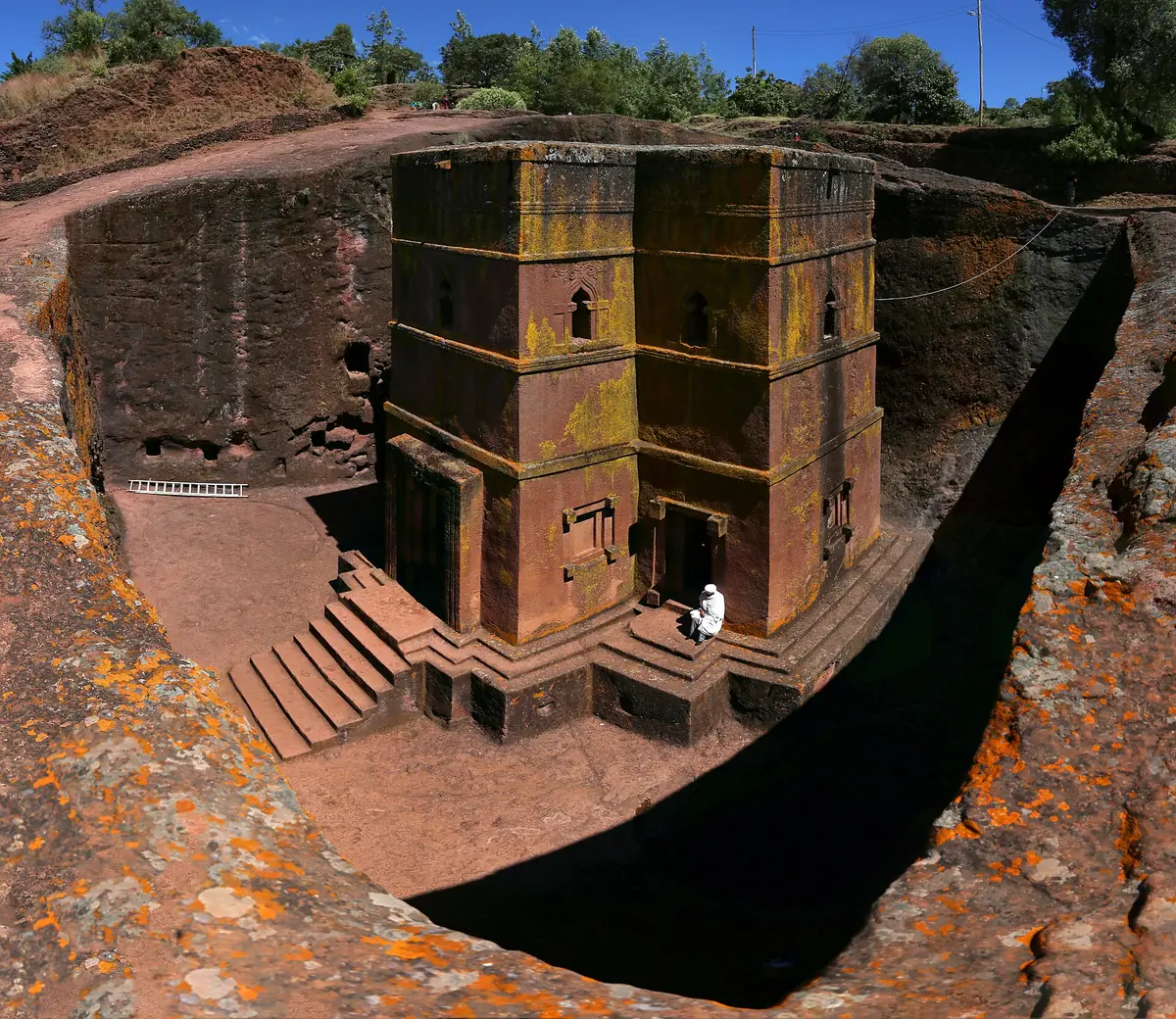
Bete Giyorgis, the Church of St George, is the best known. It is shaped like a Greek cross and sits alone at the bottom of a deep square pit, so that a visitor first sees only its flat roof. The other churches are in two clusters joined by narrow tunnels and trenches. Ethiopia is one of the oldest Christian lands. In the fourth century a Syrian-born teacher named Frumentius brought the faith to the Aksumite king Ezana, and he was consecrated the first bishop of Aksum by Athanasius of Alexandria. The Bible also tells of an Ethiopian official baptized by Philip on the road to Gaza. Lalibela belongs to that long Christian history, and it remains a place of pilgrimage at Christmas (Genna) and Epiphany (Timkat).
“Ethiopia shall soon stretch out her hands unto God.”
Why it matters for a classical Christian student
For a classical Christian student, Lalibela is a plain answer to the idea that the Christian faith belongs only to Europe. These churches were made by men with chisels and hammers, in a land far from Rome, who gave years of labor to make a house for God. The virtue to notice is patient, costly skill. A stone church cut from one rock cannot be corrected once an error is made. The place is also a reminder that the church is one body across the world and that many Christians in Africa have worshiped in the same faith since the age of the Fathers.
Read alongside
- The Bible: The Ethiopian official in Acts 8 and Psalm 68:31 speak of Ethiopia and God.
Great Lives connected here
- Athanasius of Alexandria, in Great Lives: Athanasius of Alexandria consecrated Frumentius as the first bishop of Aksum in the fourth century, a founding event of the Ethiopian church.
- Gebre Meskel Lalibela, in Great Lives: Tradition credits King Lalibela, who ruled about 1181 to 1221, with commissioning the rock-hewn churches that bear his name.
- Ezana of Aksum, in Great Lives: Ezana made Christianity the faith of the Aksumite kingdom in the fourth century, centuries before the Lalibela churches were cut.
Look closely
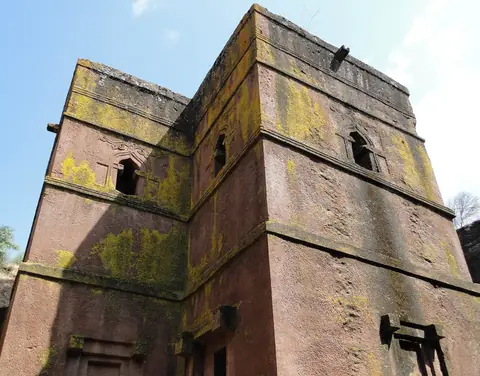
Image: Wikimedia Commons · Public domain Bet Giyorgis, the Church of St George
Look closely. The church is carved down into the red rock as a single block, with its roof level with the ground around it. Notice the tiers of windows, the carved door frames and the deep trench that separates the church from the living rock.
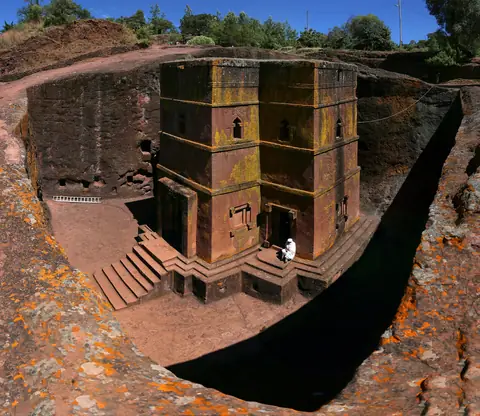
Image: Wikimedia Commons · CC BY 3.0 · Photo: Sailko Looking down into the pit
Look closely. From above you can see how the church stands free in a pit cut from the rock. The builders worked from the top downward, so a mistake could not be undone. Notice the steps that lead down to the doorway.
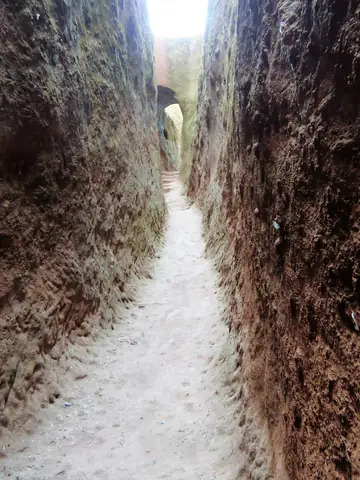
Image: Wikimedia Commons · CC BY 2.0 · Photo: Chuck Moravec A passage between the churches
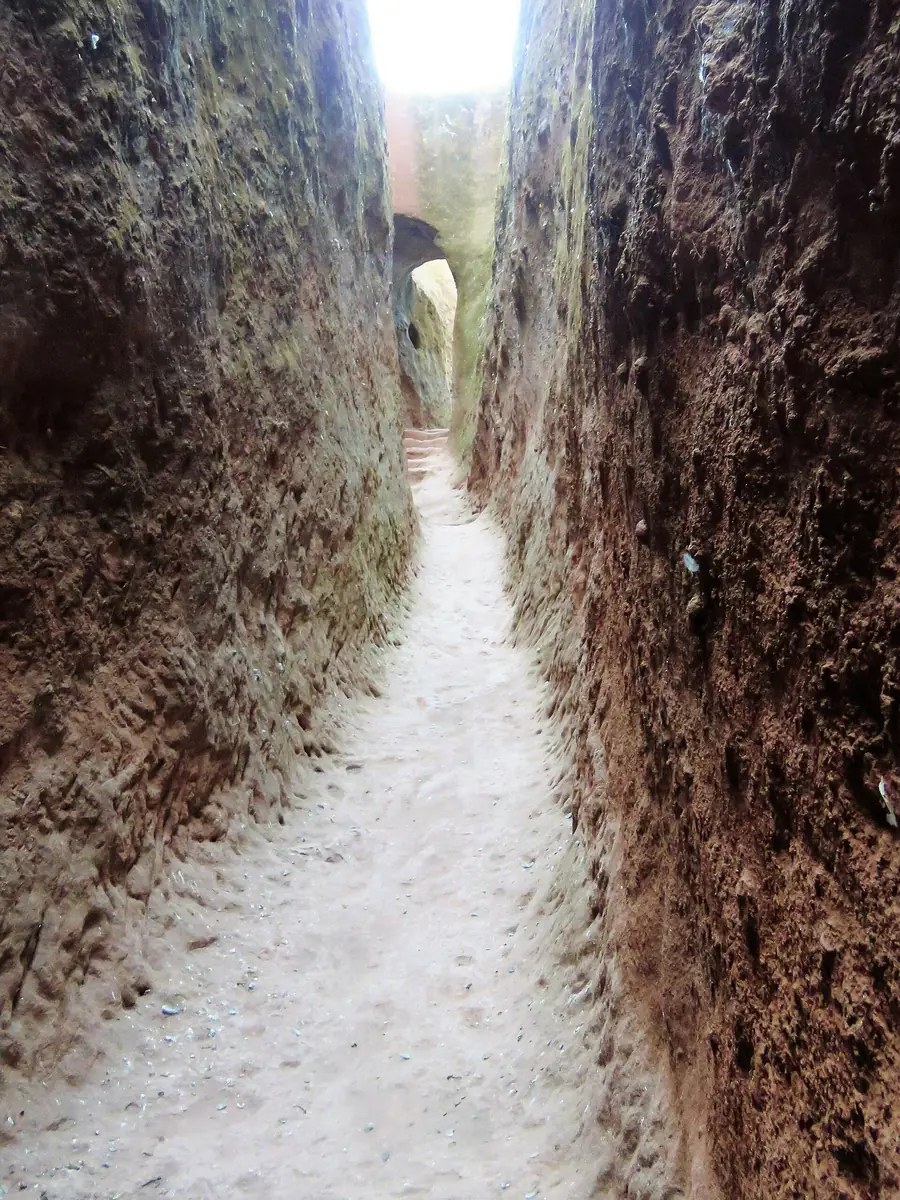
Look closely. Narrow trenches and passages cut from the rock join the churches to one another. Pilgrims walk these passages, and the walls rise on both sides above them.
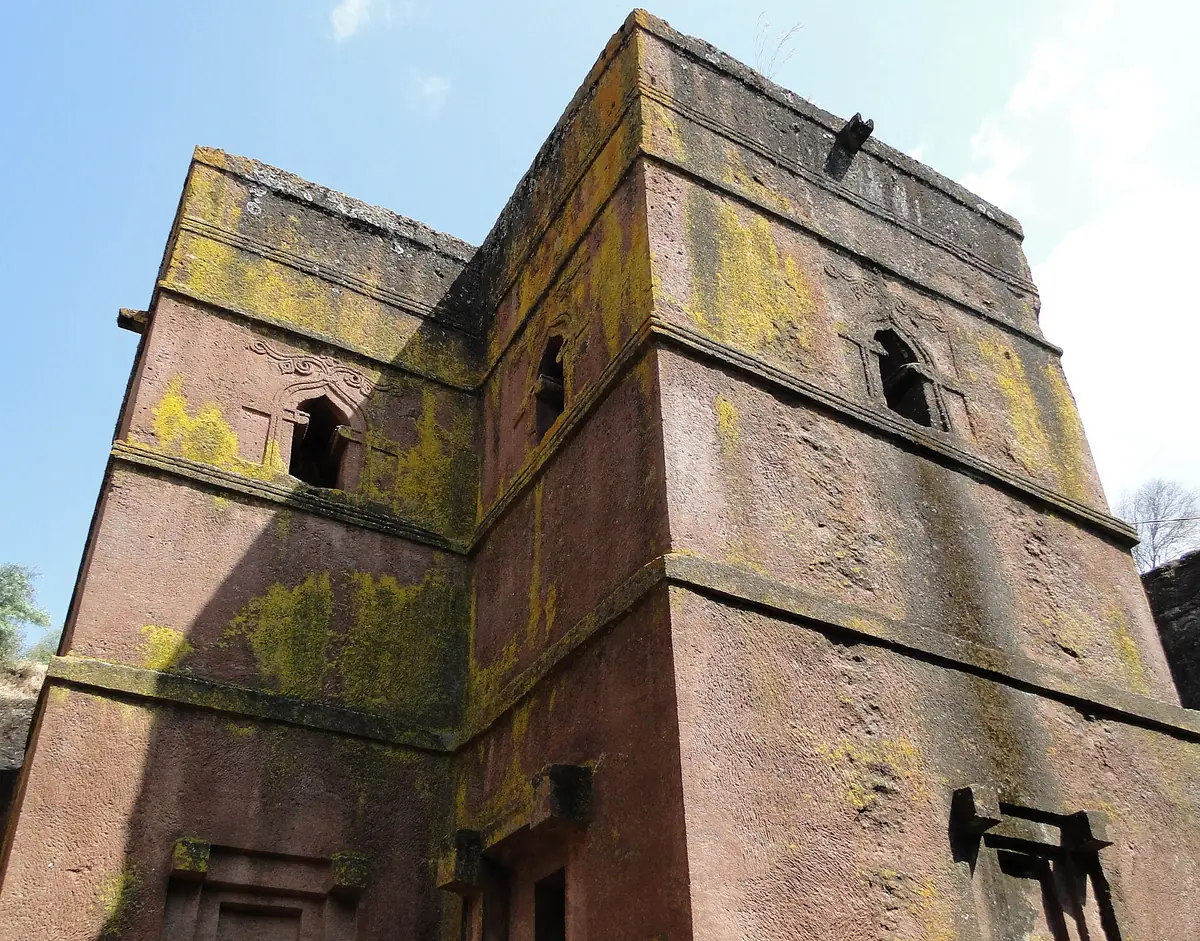


What to watch for
Look slowly- Carved, not built. Look for the trenches and the lack of mortar. Every wall is part of the rock itself.
- The cross plan of Bete Giyorgis. The roof of the church is cut into the shape of a cross. Think about how a visitor was meant to find it from above.
- Living worship. These are working churches, with priests, deacons, and pilgrims. They are not museums.
- Tradition and history. The stories about King Lalibela and a new Jerusalem are traditions. The dating of each church is still studied.
Sources
Dates follow standard historical references and, where we quote a book, the wording of the edition hosted in this library. Where a tradition is not certain history, the page says so. Photographs and pictures are used only when the image itself is Public domain, CC0, or CC BY with a named credit. Each picture links to its source page with full licence details. Pictures taken before a site was damaged are labelled with their date.