Great Churches & Monasteries · Africa
Debre Damo
A monastery on a mountaintop in Tigray that can be reached only by climbing a rope.
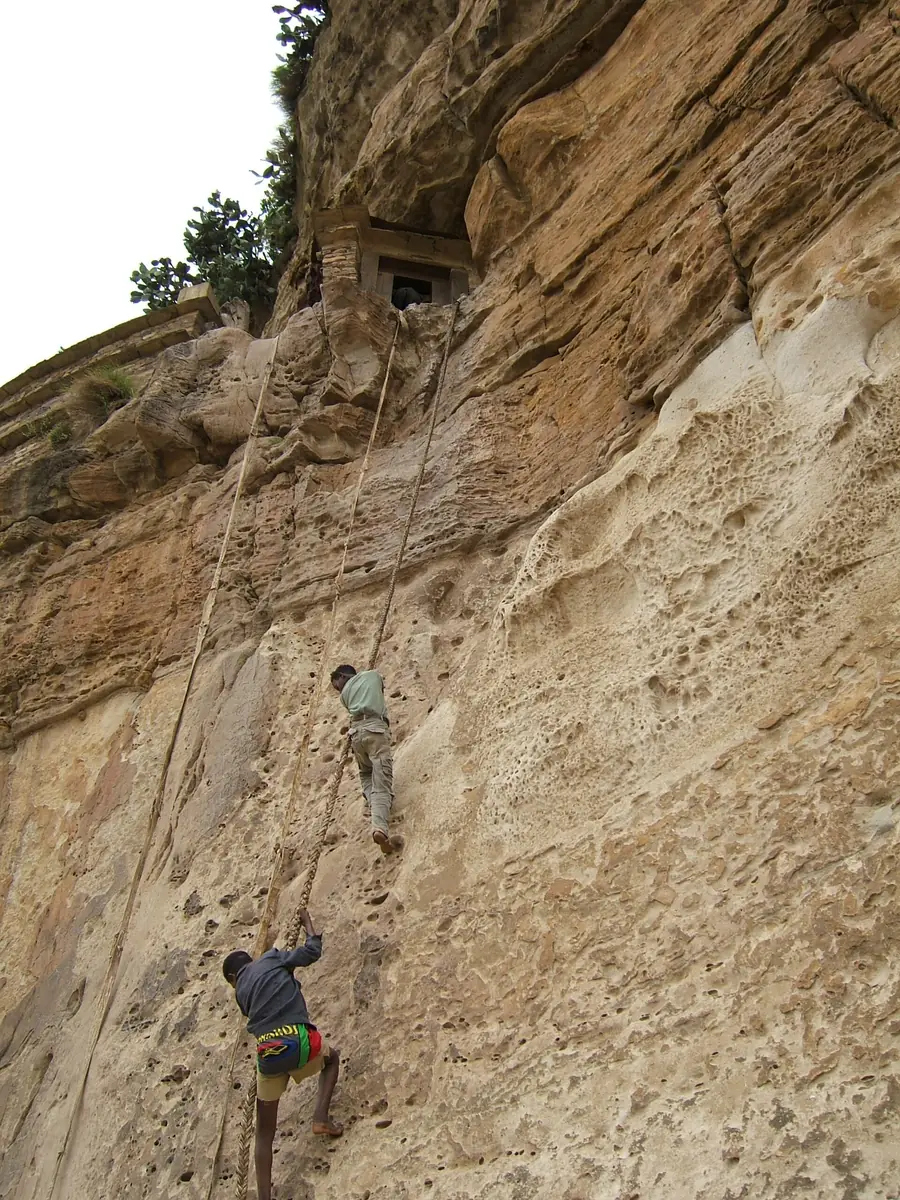
Still standing. The monastery is still an active community of monks, reached by climbing a rope up a cliff. Women are not admitted.
Lalibela, the rock-hewn churches
What it is
Debre Damo is a flat-topped mountain, an amba, in the north of Ethiopia, with cliffs on every side. The one way up is a leather rope that hangs down the cliff, and visitors climb it, with a monk's help, to reach the top. Tradition says the monastery was founded in the sixth century by Abuna Aregawi, one of the Nine Saints who came to Ethiopia, according to the church's tradition, from the Byzantine world and strengthened the young Ethiopian church. The mountain-top gave monks isolation and safety, and the monastery has kept books, relics, and a great church for centuries.
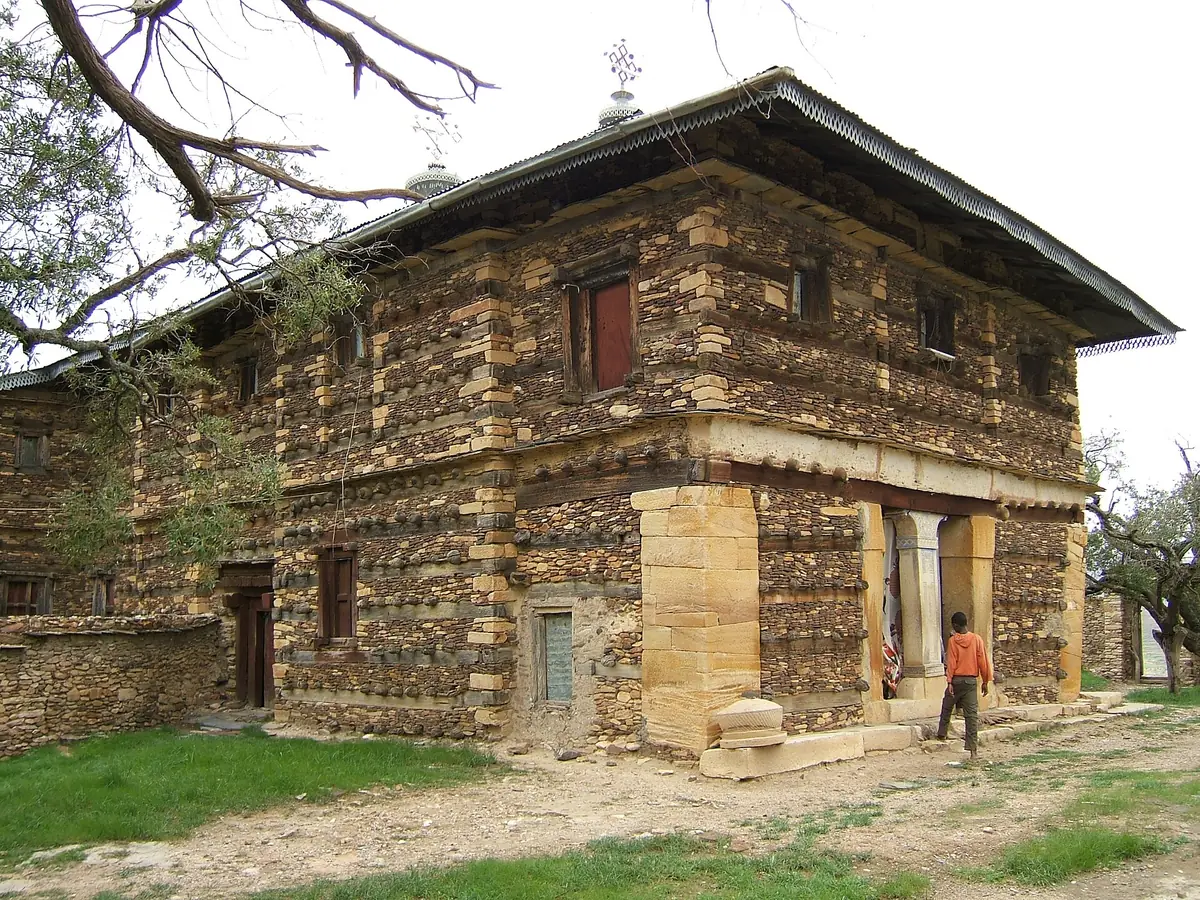
The church of Abuna Aregawi is built in the old Aksumite manner, in which layers of stone alternate with projecting wooden beam ends. The roof inside is a carved wooden ceiling with animals and patterns. The age of the church is debated, and some scholars place it centuries after the saint. The monks live by prayer, farming on the plateau, and the long Ethiopian church year of fasts and feasts. The monastery is a men's community, and women and female animals are not admitted, a rule it shares with a few other Orthodox places such as Mount Athos.
“I will lift up mine eyes unto the hills, from whence cometh my help.”
Why it matters for a classical Christian student
Debre Damo shows a form of Christian devotion that Western students may not know: a monastery that is a fortress in the sky. The virtue is perseverance in a hard and quiet place. Monks climb the rope for supplies and live by a rule that has been handed down for generations. A classical student can set it beside the desert fathers of Egypt and the monks of Mount Athos, and ask why believers in many lands have chosen solitude and prayer.
Read alongside
- The Bible: Psalm 121 is a song of pilgrims who look to the hills for help.
Great Lives connected here
- Athanasius of Alexandria, in Great Lives: Athanasius of Alexandria consecrated Frumentius, the first bishop of Aksum, and so linked the Ethiopian church to the church of Egypt.
Look closely
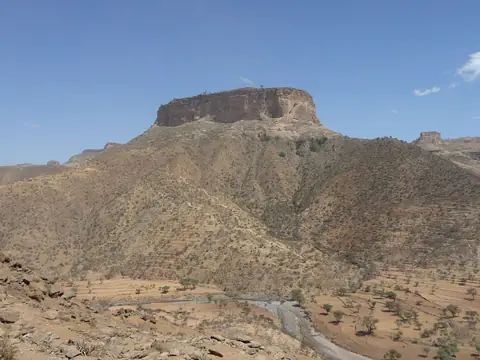
Image: Wikimedia Commons · CC BY 2.5 · Photo: Ondřej Žváček The flat-topped mountain
Look closely. The monastery stands on the flat top of an amba, a steep-sided mountain in Tigray. The cliffs are its defence and its seclusion. Compare this with the churches cut down into rock at Lalibela.
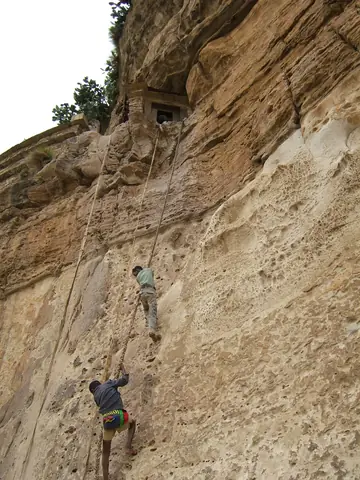
Image: Wikimedia Commons · CC BY 2.0 · Photo: Giustino (via Flickr) The climb
Look closely. The usual way up is a climb up a cliff face with the help of a rope. Notice the two climbers on the rock. By long custom the monastery is open to men only.
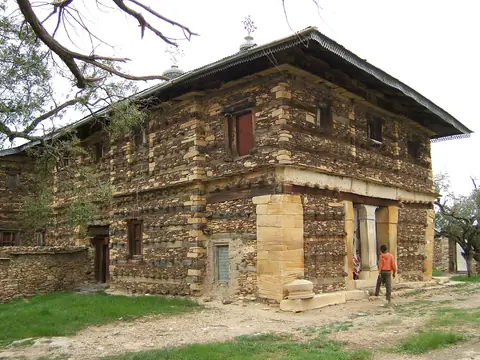
Image: Wikimedia Commons · CC BY 2.0 · Photo: Giustino (via Flickr) The church of Abuna Aregawi
Look closely. The walls are built in alternating courses of stone and timber, with the ends of the beams projecting from the wall. This is a style associated with the Aksumite kingdom. Tradition ties the church to the sixth century.
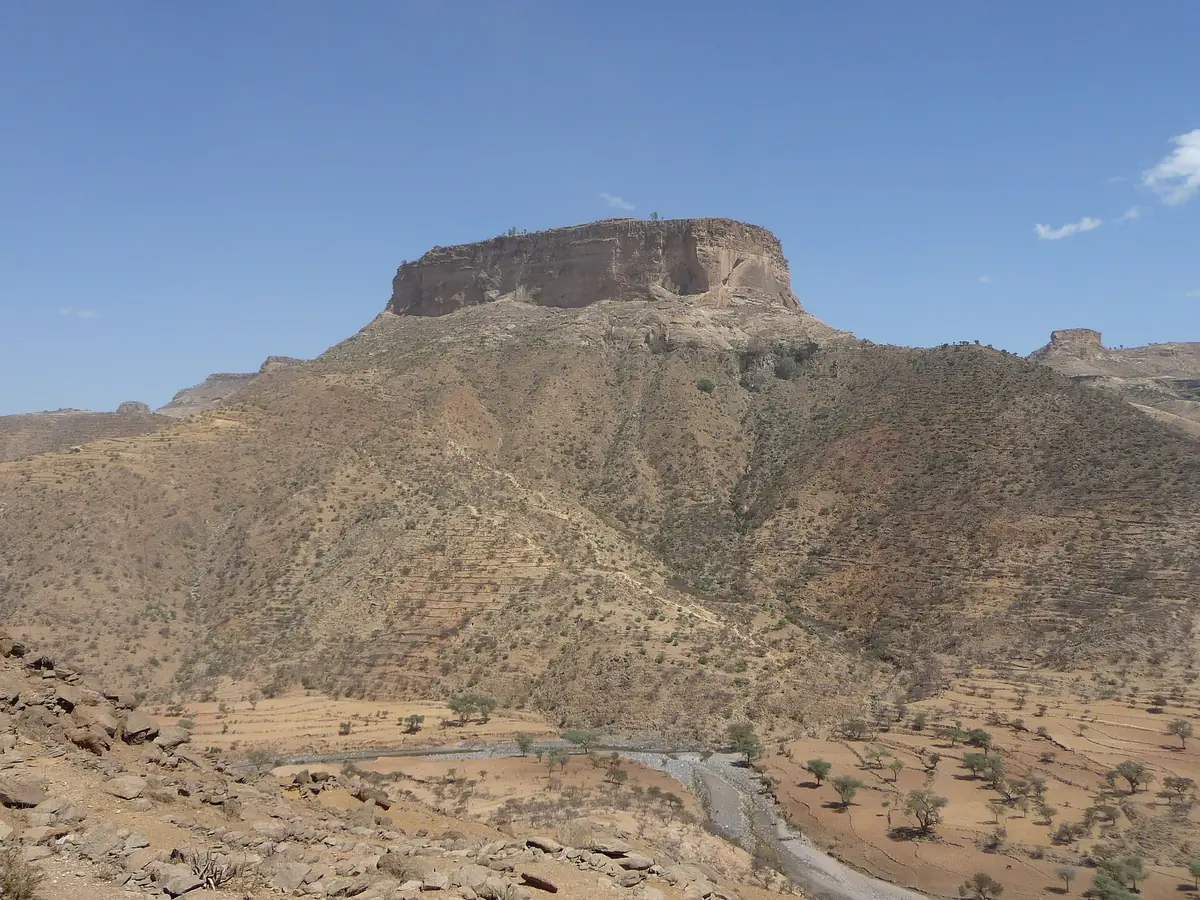


What to watch for
Look slowly- The rope. Notice how an ordinary leather rope is the only door to the monastery. Think about what that means for supplies, safety, and welcome.
- The church's timber and stone. The alternating courses are a mark of Aksumite building.
- The ceiling. The carved animals and patterns are among the oldest Ethiopian church art.
- An enclosed community. The monastery keeps its own customs, and some are strict. Learn them as the monks' own rule.
Sources
Dates follow standard historical references and, where we quote a book, the wording of the edition hosted in this library. Where a tradition is not certain history, the page says so. Photographs and pictures are used only when the image itself is Public domain, CC0, or CC BY with a named credit. Each picture links to its source page with full licence details. Pictures taken before a site was damaged are labelled with their date.