Great Art · Late Gothic
Tilman Riemenschneider
The Franconian carver of limewood altarpieces and of bishops who still seem to be thinking as they stand in Würzburg Cathedral.
His life
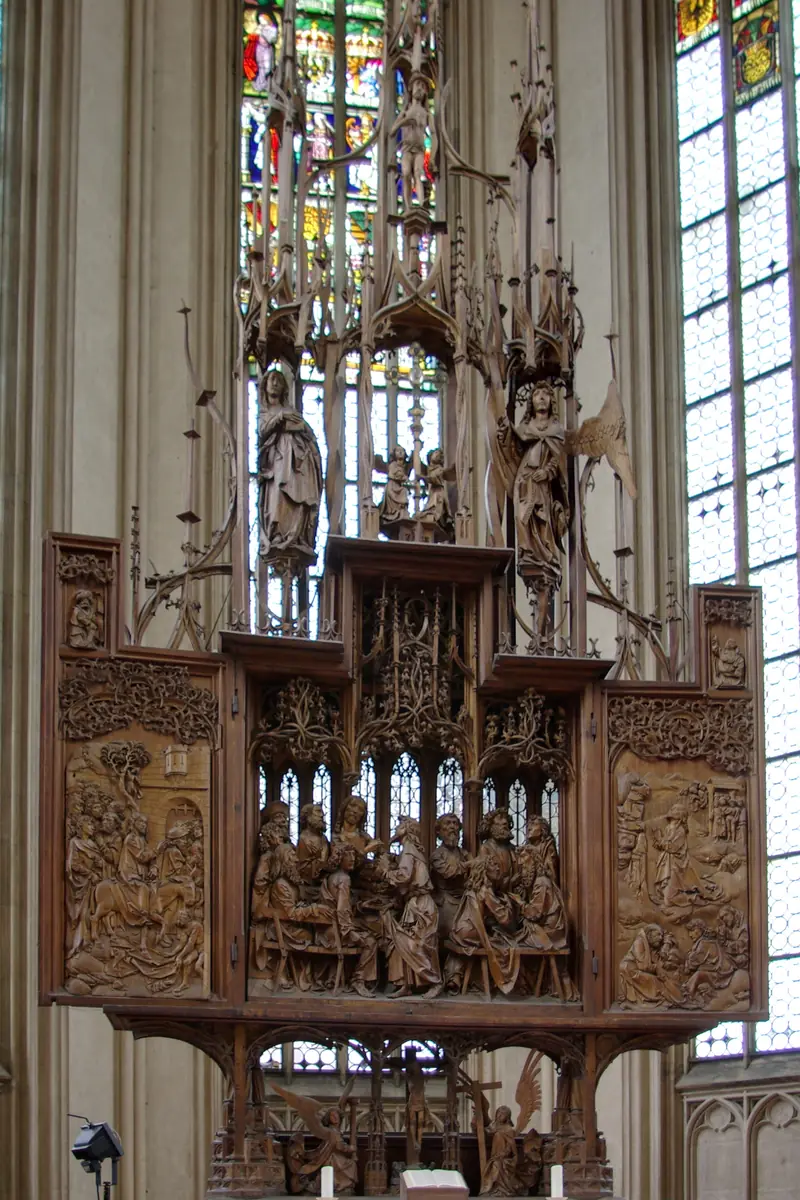
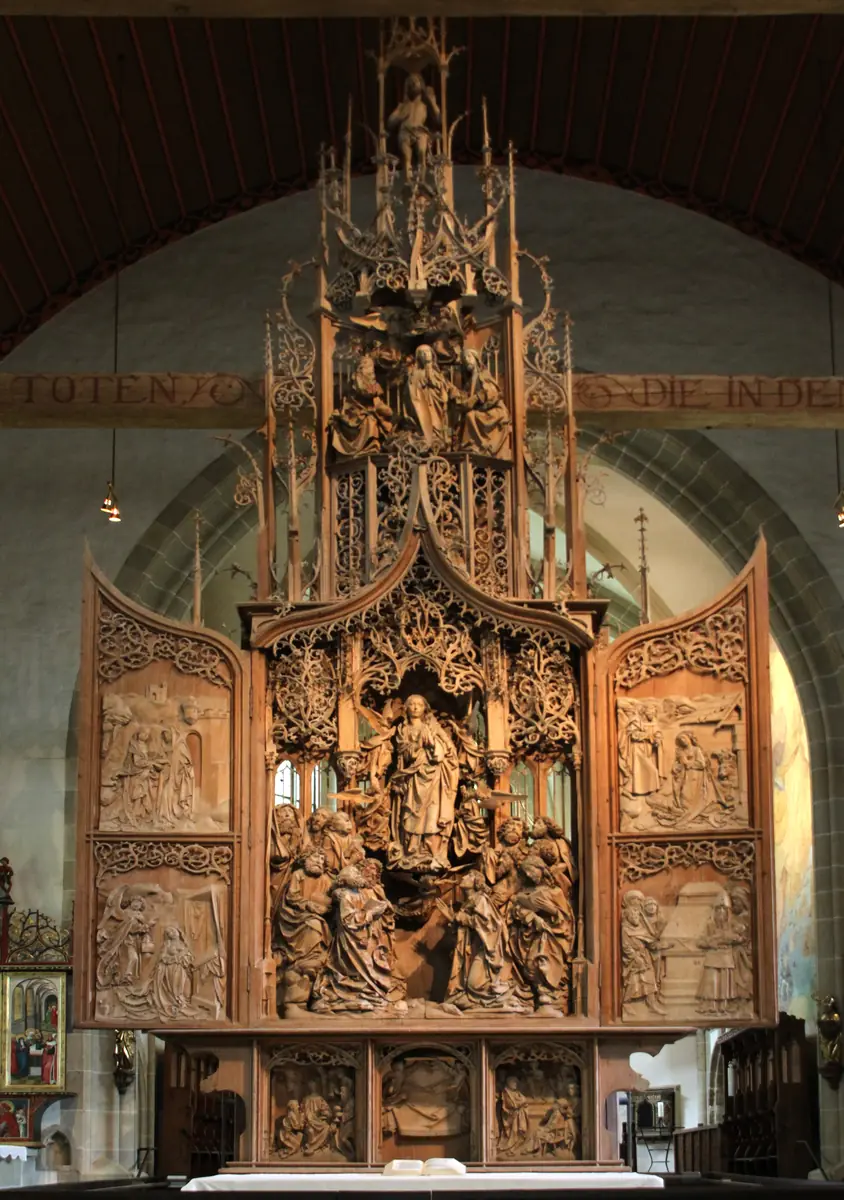
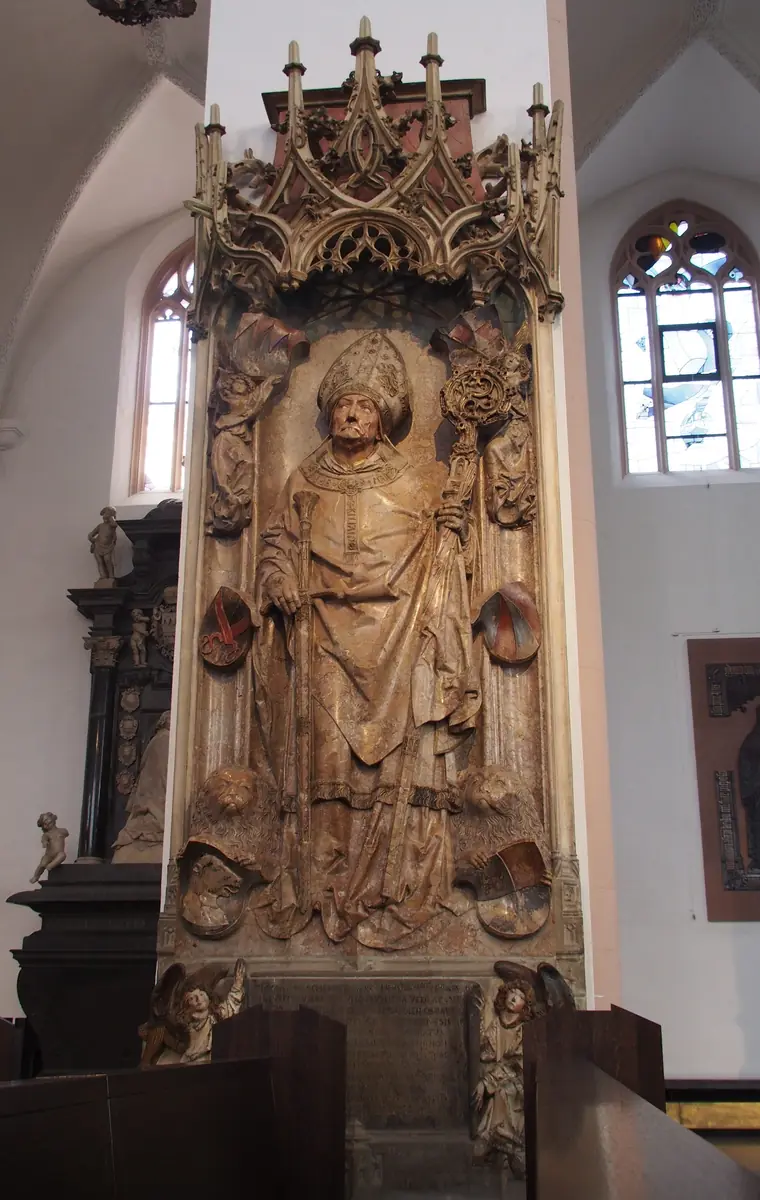
Riemenschneider was the great limewood sculptor of late medieval Franconia. He kept a busy workshop in Würzburg, served the city as councilman and burgomaster, and filled the region's churches with altarpieces and tombs whose faces are as carefully seen as their drapery. The Holy Blood Altar in St. Jakob at Rothenburg still stands over the west gallery, with the Last Supper in the center shrine; the altar of the Virgin in the Herrgottskirche at Creglingen lifts Mary among the apostles in a single soaring piece of wood. In Würzburg Cathedral he cut the tomb of Prince-Bishop Rudolf von Scherenberg, an old man in vestments who looks as if he had just raised his eyes.
The gift is attention in wood. He could make a bishop's mouth and a saint's veil from the same limewood, and leave the surface unpainted so that the grain and the knife-work would carry the light. Late in life he was caught in the Peasants' War, imprisoned, and largely silenced as a public man. The work already made did not go silent with him.
Key sculptures
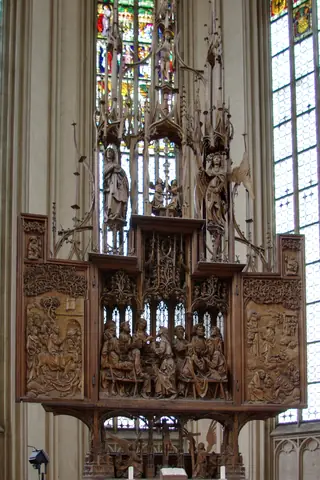
Image: Wikimedia Commons · Public domain The Holy Blood Altar
Look closely. The limewood altarpiece on the west gallery of St. Jakob, seen as a whole: the Last Supper in the center shrine, narrative scenes on the open wings, and a tall crown of tracery against the windows. Look at how the apostles sit and turn around the table, and at how the shrine rises into open work rather than stopping at a box of figures.
In the library: The Bible (KJV) · Jesus Christ
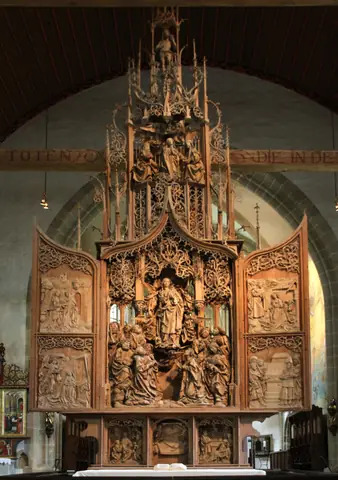
Image: Wikimedia Commons · CC BY 4.0 · Photo: Gerd Eichmann Altar of the Virgin, Creglingen
Look closely. The whole altarpiece in the Herrgottskirche, wings open: Mary assumed in the center shrine, the apostles gathered below and around her, smaller scenes on the wings and predella, and a high crown of tracery. Look at how the central group is carved almost in the round, so that Mary seems to stand free of the wood behind her.
In the library: The Bible (KJV) · Mary, mother of Jesus
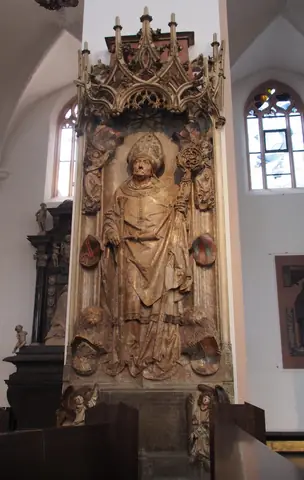
Image: Wikimedia Commons · CC BY 3.0 · Photo: Hajotthu Tomb of Prince-Bishop Rudolf von Scherenberg
Look closely. The monument on a pier of Würzburg Cathedral: the prince-bishop stands in full vestments, mitre on his head, crozier in one hand, a staff in the other, under a tall Gothic canopy, with coats of arms and smaller figures around the slab. Look at the face, which is an old man closely seen, not a type, and at how the vestments hang in heavy, believable folds.
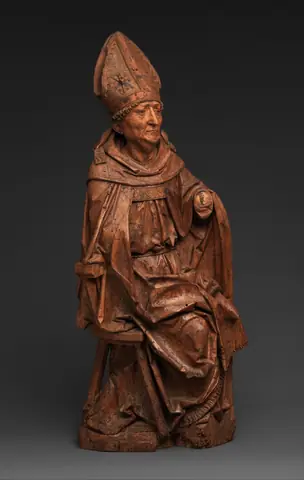
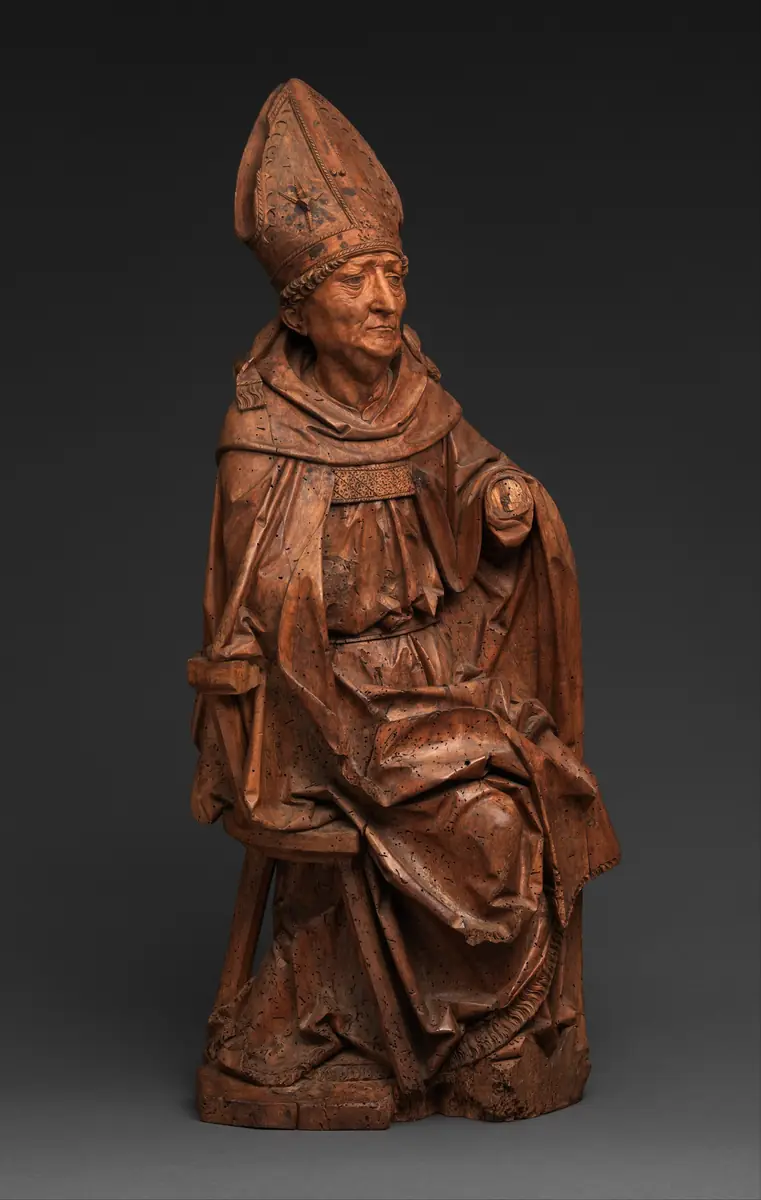
Image: Wikimedia Commons · CC0 (public domain) Seated Bishop
Look closely. A limewood bishop seated, in mitre, cope, and alb, one hand closed as if it once held a staff, the other at his knee. Look at the quiet weight of the sitting pose, the worn seriousness of the face, and the way the vestments break over the seat and the knees.
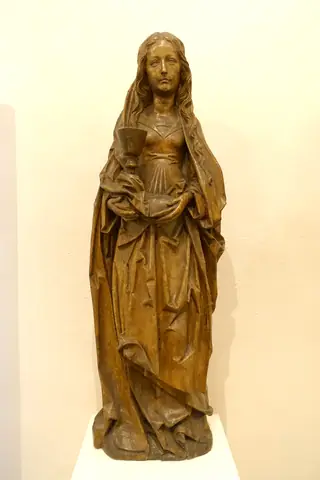
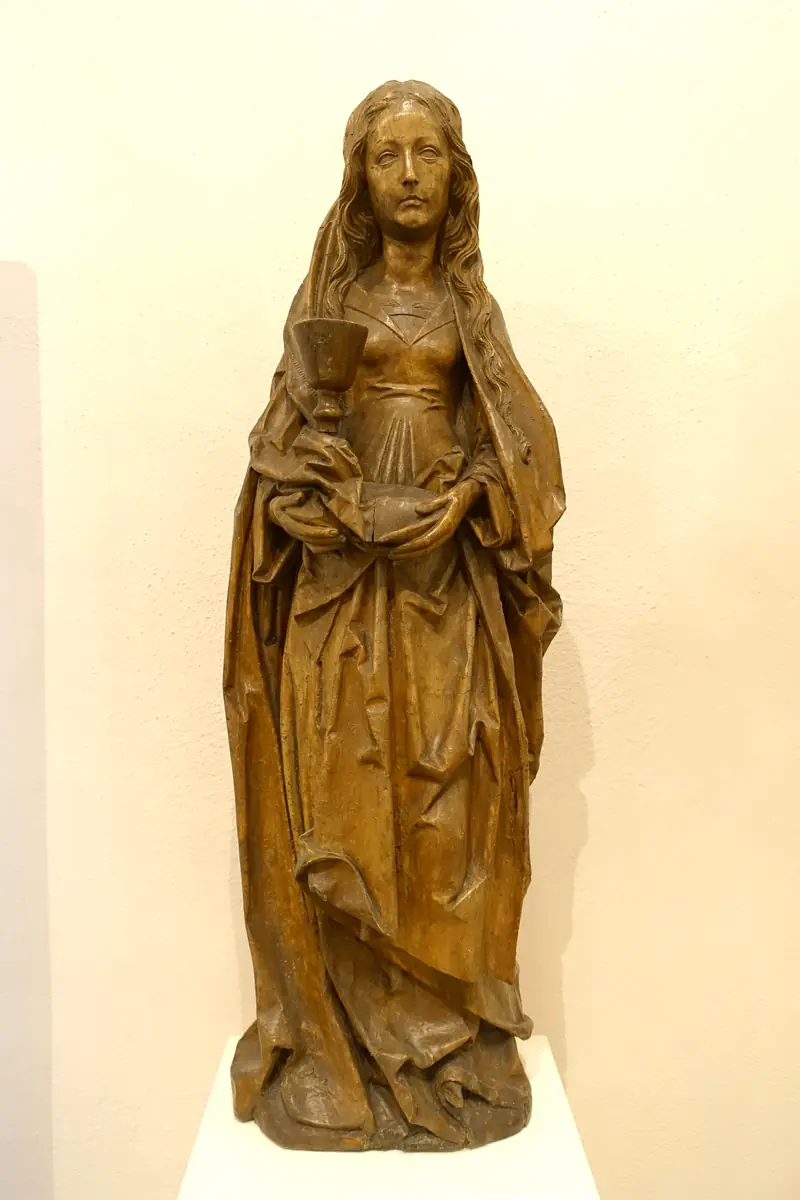
Image: Wikimedia Commons · Public domain Saint Barbara
Look closely. A standing limewood figure of the saint, a chalice in her right hand and a book in her left, her veil and gown falling in long, broken folds. Look at the still face and at how the cloth is carved so that it seems to have been worn, not merely arranged for the block.
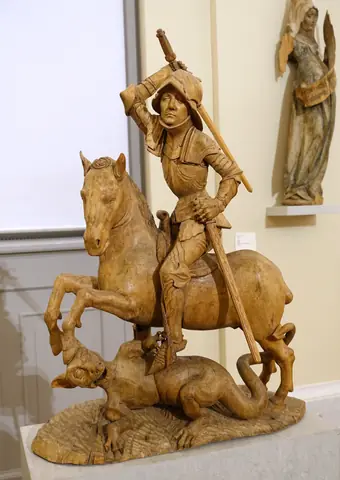
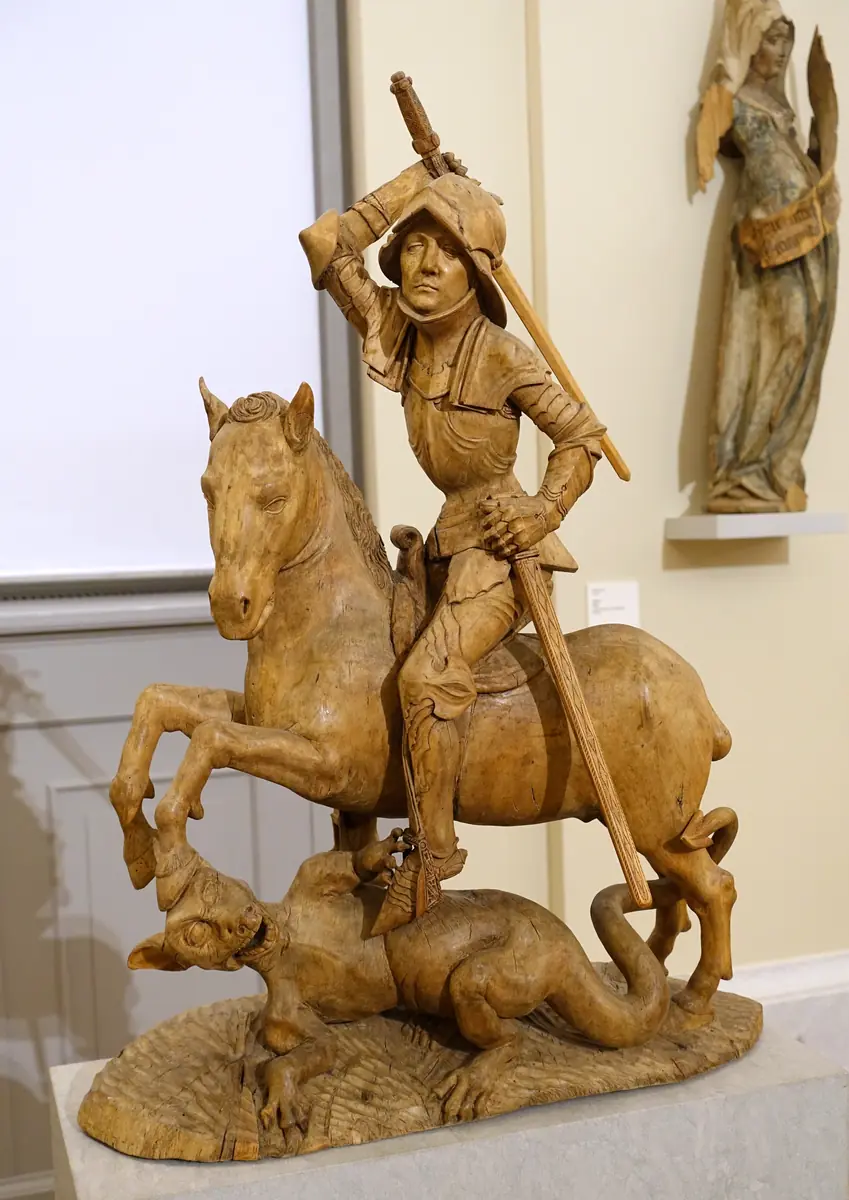
Image: Wikimedia Commons · Public domain Saint George and the Dragon
Look closely. The mounted saint in armor, his sword raised, the horse rising over the dragon on the ground. Look at the compact group — rider, horse, and beast in one block of limewood — and at the calm of George's face against the violence of the pose.


What to watch for in Tilman Riemenschneider
Look slowly- A Last Supper that is also a room of faces. On the Holy Blood Altar, look at the apostles around the table, each one distinct, under a shrine that rises into open tracery.
- Mary lifted, not merely placed. At Creglingen she stands among the apostles as if the wood itself were rising with her.
- An old bishop who is still a person. Scherenberg's cheeks, mouth, and mitre are observed, not generalized.
- Drapery that has weight. Saint Barbara's veil and gown fall as cloth falls, not as a pattern drawn on the surface.
- A rider and a dragon in one motion. Saint George's horse, armor, and down-thrust sword belong to a single instant.
For older students
These famous works include nudity, so they are named here but not shown. Teachers and parents can decide when to look at them together.
- Adam and Eve (portal figures), c. 1491–1493, Originally the south portal of the Marienkapelle, Würzburg; now the Museum für Franken, Würzburg. The famous life-size figures of Adam and Eve, unclothed, made for the chapel portal. They are named here but not shown.
Dates and collections follow the holding museums and Wikidata. Images of paintings are photographs of public-domain pictures from Wikimedia Commons or museum open-access releases; photographs of sculpture are used only when the photograph itself is Public domain, CC0, or CC BY with a named credit. Each picture links to its source page with full licence details.