Great Art · Late Gothic
Veit Stoss
The carver of the great altar at St. Mary's in Kraków and of the Annunciation that still hangs in mid-air at St. Lorenz in Nuremberg.
His life
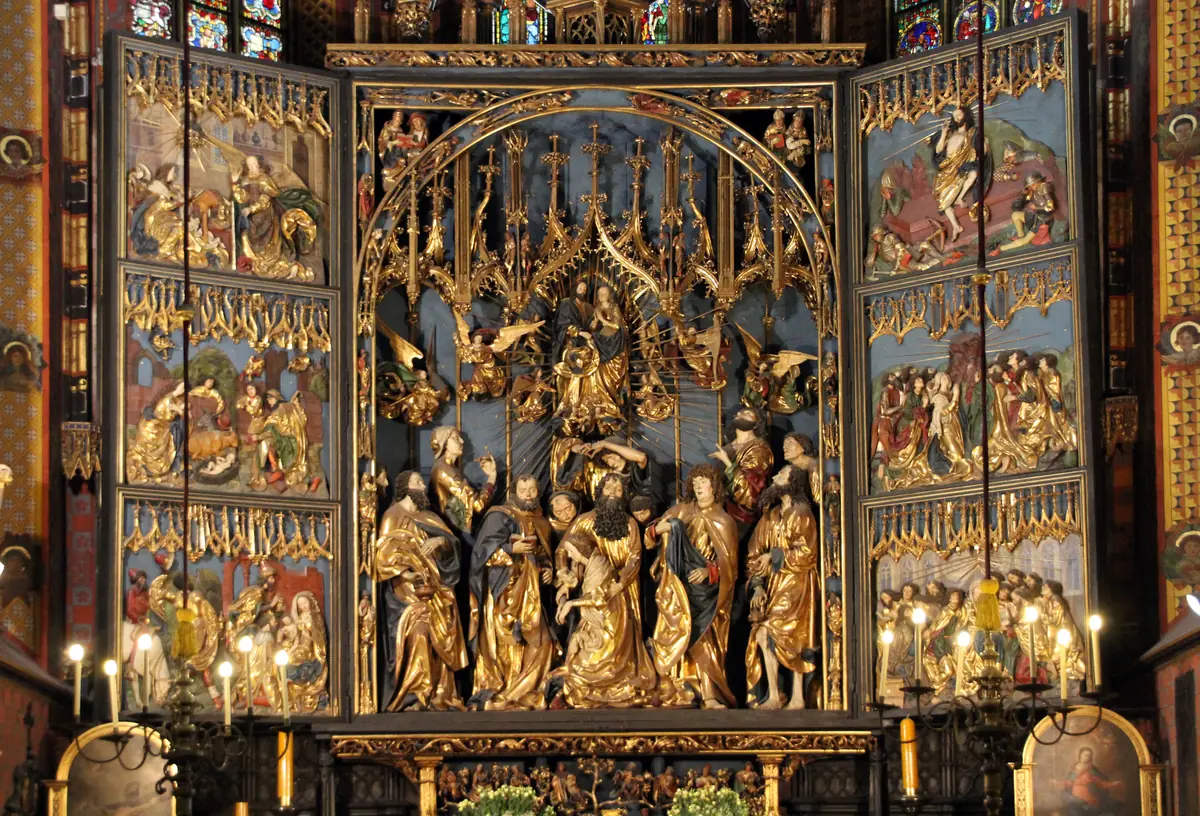
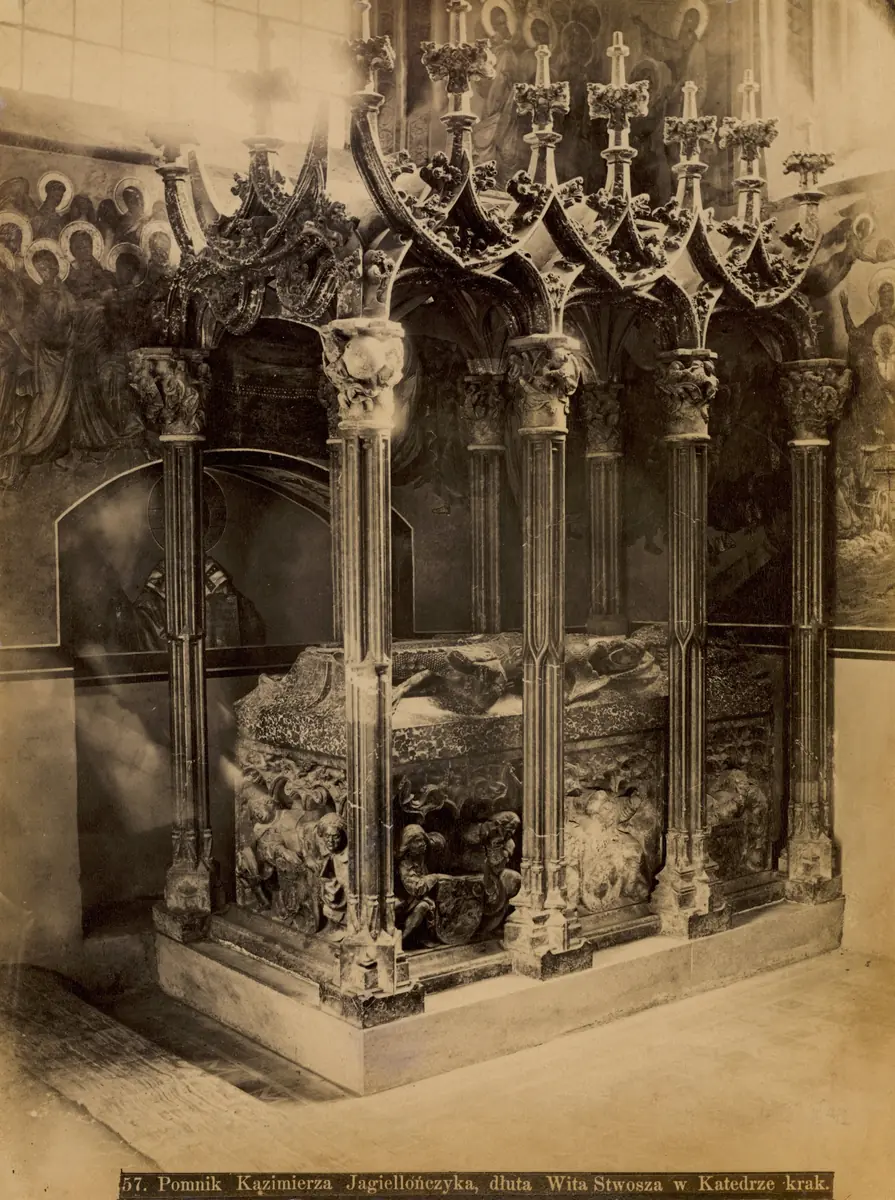
Stoss was a Nuremberg sculptor who spent years in Kraków and made, for St. Mary's Church there, the largest Gothic altarpiece in Europe still in its original place: a towering painted and gilded shrine of the death and assumption of the Virgin, with the apostles standing like a living crowd at her feet. He also cut the red-marble tomb of King Casimir IV in Wawel Cathedral, a recumbent king under a stone canopy. Back in Nuremberg he hung the Annunciation in St. Lorenz — Mary and the angel Gabriel inside a great wreath of roses, suspended in the choir — and later carved the wooden altar now in Bamberg Cathedral.
The gift is scale joined to tenderness. He could fill a church with gold and still keep a face close: an apostle's grief, Mary's stillness, a king's rest. He knew trouble in his own civic life, including a forgery charge and public punishment in Nuremberg, and he went on working into old age. The work is more faithful than the record of the man is easy.
Key sculptures
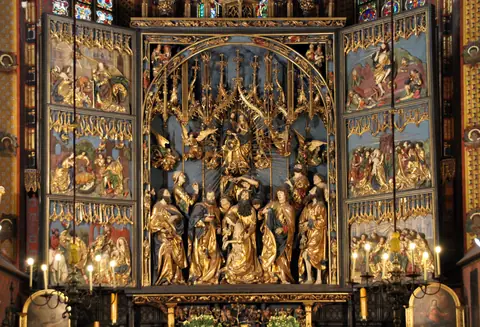
Image: Wikimedia Commons · CC BY 4.0 · Photo: Gerd Eichmann The High Altar of St. Mary's, Kraków
Look closely. The open festive side of the great altarpiece: the death of the Virgin in the center shrine, the apostles in a standing crowd around her, God the Father in the upper tracery, and painted relief scenes on the wings. Look at the scale of the central figures, at the gold against the deep blue ground, and at how the whole shrine is a single, crowded act of attention.
In the library: The Bible (KJV) · Mary, mother of Jesus · Jesus Christ
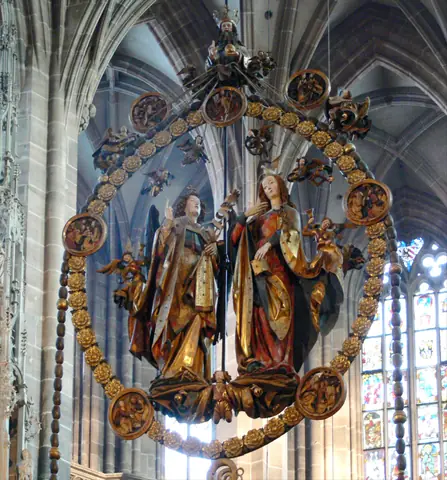
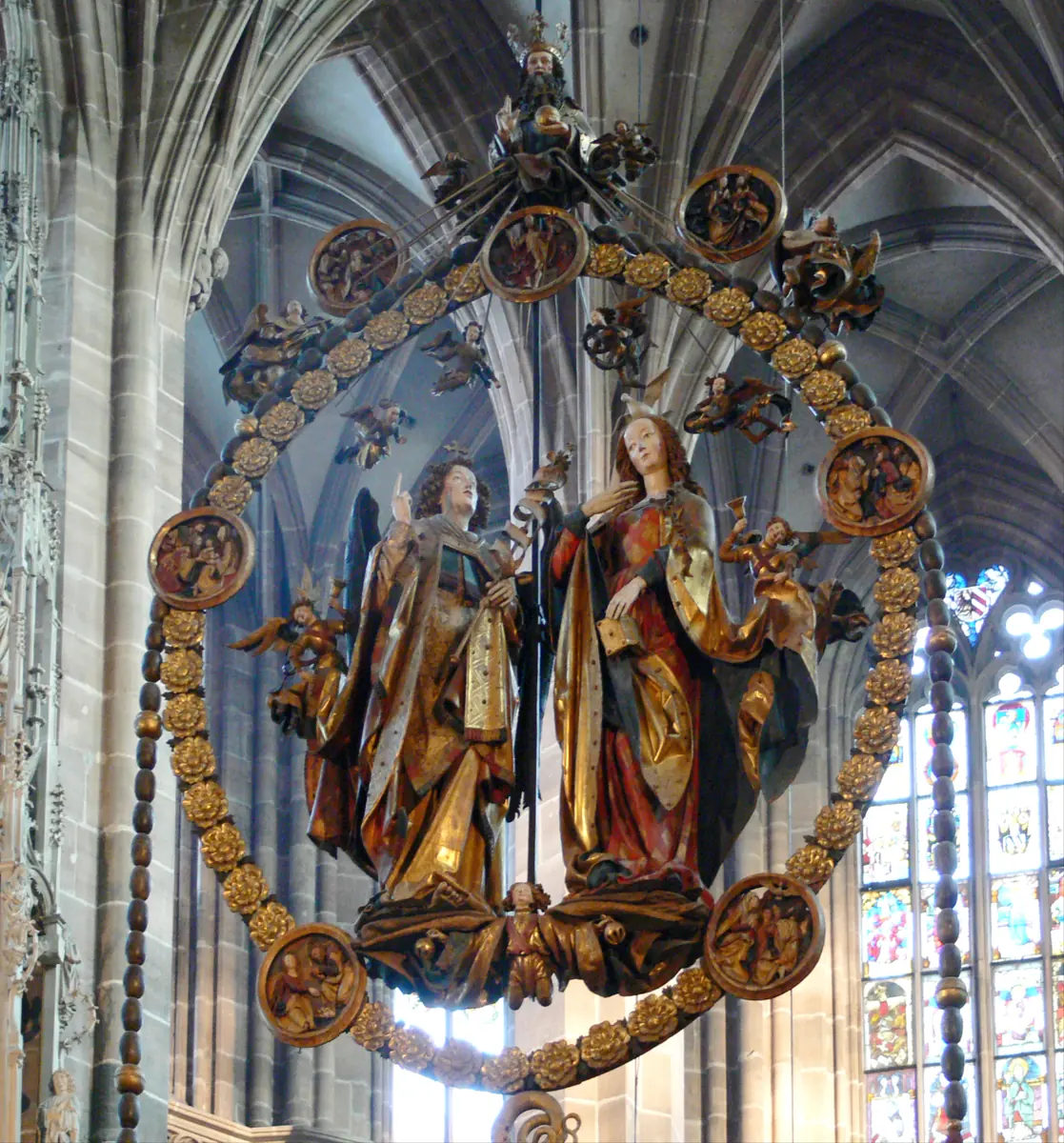
Image: Wikimedia Commons · Public domain The Annunciation (Engelsgruß)
Look closely. The hanging sculpture in the choir of St. Lorenz: Mary and the angel Gabriel stand inside a great rosary wreath, God the Father at the top, small medallions around the ring. Look at how the group is suspended in the air of the church, not set on a predella, and at the turning of the two figures toward one another.
In the library: The Bible (KJV) · Mary, mother of Jesus · Jesus Christ
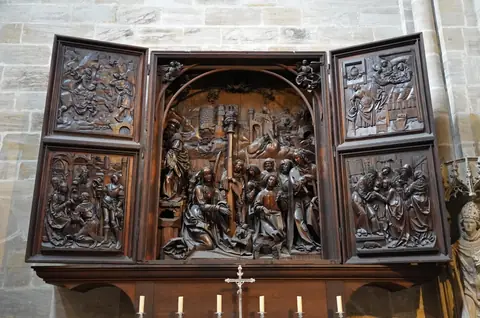
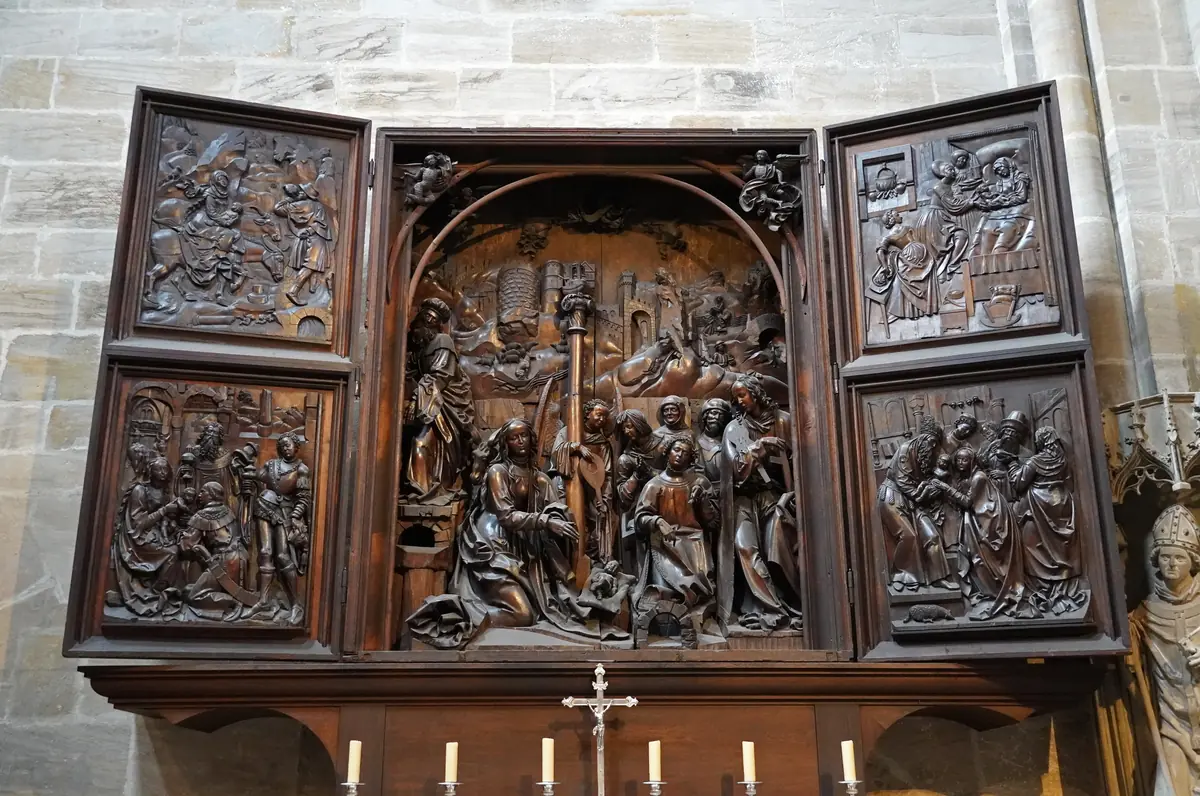
Image: Wikimedia Commons · CC BY 2.0 · Photo: Allie Caulfield The Bamberg Altar
Look closely. The wooden altarpiece with its wings open, now in Bamberg Cathedral (it was made for the Carmelite church in Nuremberg). The center shrine shows the Adoration of the Child; the wings carry other scenes in relief. Look at the tall candlestick in the middle, at the kneeling and standing figures around it, and at how the whole work is in unpainted wood rather than the gold of the Kraków shrine.
In the library: The Bible (KJV) · Jesus Christ · Mary, mother of Jesus
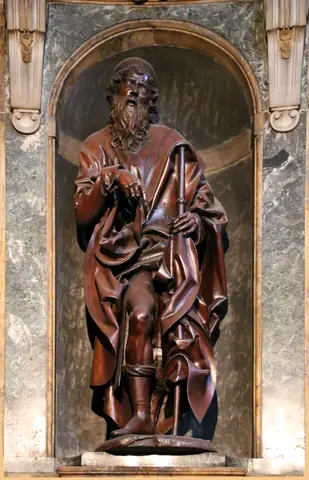
Image: Wikimedia Commons · CC BY 3.0 · Photo: Sailko Saint Roch
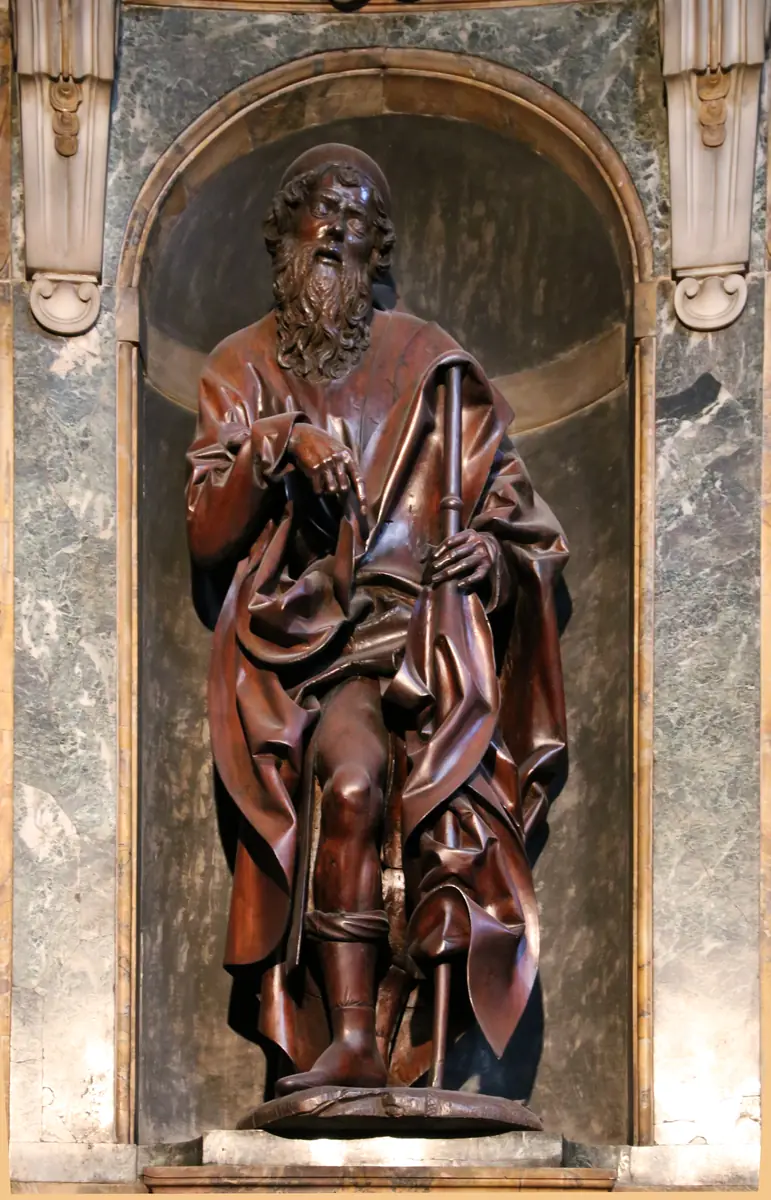
Look closely. The standing wooden pilgrim in his niche: a staff in one hand, a hat and cloak, the robe lifted from one thigh so that the plague sore can be seen, which is how Roch is known as a helper of the sick. Look at the lifted drapery, at the worn face and beard, and at how the figure fills the arch without stiffness.
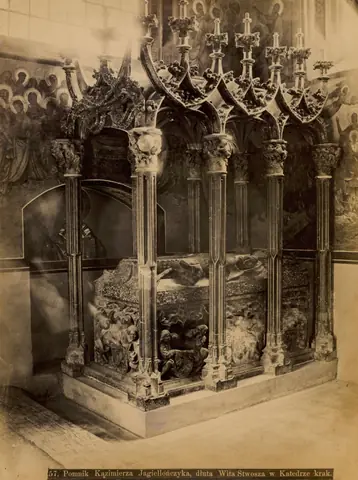
Image: Wikimedia Commons · CC0 (public domain) Tomb of King Casimir IV
Look closely. A nineteenth-century photograph of the tomb in Wawel Cathedral: the king lies in armor on the sarcophagus, under a tall Gothic canopy of openwork stone, with reliefs on the sides of the chest. Look at the canopy, which is a small architecture of its own, and at the recumbent figure, which is a king at rest rather than a standing effigy.


What to watch for in Veit Stoss
Look slowly- A crowd that is also a prayer. In the Kraków shrine, look at the apostles around the dying Virgin, each face and hand distinct under the gold.
- An Annunciation that hangs. In St. Lorenz the figures do not stand on a floor; they are held in a wreath in the air of the church.
- A king at rest under stone architecture. Casimir lies in armor under a canopy of openwork, as if the tomb itself were a small chapel.
- Wings that tell a story in wood. On the Bamberg altar, the center is an Adoration; the wings carry other scenes in relief, all in the same dark wood.
- A pilgrim who shows his wound. Saint Roch lifts the robe from his thigh because that sore is the sign of his intercession.
For older students
These famous works include nudity, so they are named here but not shown. Teachers and parents can decide when to look at them together.
- Crucifix, early sixteenth century, Attributed works include carved crucifixes for churches in Kraków and Nuremberg. Stoss carved crucifixes in which the figure of Christ is shown unclothed except for a loincloth. They are named here but not shown.
Dates and collections follow the holding museums and Wikidata. Images of paintings are photographs of public-domain pictures from Wikimedia Commons or museum open-access releases; photographs of sculpture are used only when the photograph itself is Public domain, CC0, or CC BY with a named credit. Each picture links to its source page with full licence details.