Adam Smith
1723–1790 · Scottish philosopher whose Wealth of Nations founded modern economics.
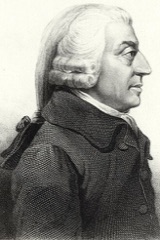
Adam Smith was born in Kirkcaldy, Scotland; his father, a customs official, died before he was born. As a small child he was briefly carried off by a band of travelers and soon returned. He studied at Glasgow and at Oxford, then became professor of moral philosophy at the University of Glasgow. His first book, The Theory of Moral Sentiments, published in 1759, explained moral judgment through sympathy, our ability to imagine ourselves in another's place. In 1764 he left to tutor a young duke on a tour of France, where he met leading French thinkers. Back home, he spent ten years writing An Inquiry into the Nature and Causes of the Wealth of Nations, published in 1776. It argued that wealth comes from labor and trade, that dividing work into specialized tasks greatly raises productivity, as in a pin factory, and that people pursuing their own interest in free markets are led, as by an invisible hand, to benefit society. He criticized monopolies and trade restrictions. He was a close friend of David Hume. He died in 1790.
Adam Smith is also an author in the library: author page and works.
Faith: Scholars continue to debate the nature of his personal religious views. Source: Wikipedia
Further reading
- Adam Smith: A Very Short Introduction by Christopher J. Berry (Oxford University Press, 2018), ISBN 9780198784456

Key dates
- 1723 Born in Kirkcaldy
- 1751 Professor at Glasgow
- 1759 The Theory of Moral Sentiments
- 1776 The Wealth of Nations
- 1778 Commissioner of customs in Edinburgh
- 1790 Dies in Edinburgh
In their words
“It is not from the benevolence of the butcher, the brewer, or the baker that we expect our dinner, but from their regard to their own interest.”
“No society can surely be flourishing and happy, of which the far greater part of the members are poor and miserable.”
Read about them
Grades 9–12
- The Wealth of Nations · In the library
More lives
Cesare Beccaria · George Berkeley · Edmund Burke · Denis Diderot · Jonathan Edwards · David Hume