Work record
The Wealth of Nations
1776 · 18th Century · Political Theory · English
Abstract
Background. A Glasgow professor of moral philosophy who had already published on sympathy and conscience, Smith drafted his economic inquiry over a decade, partly in France among the physiocrats, and issued it as Britain's quarrel with America became war.
Thesis. Prosperity means the necessaries and conveniences a people produce each year. It grows as tasks are subdivided and markets widen, and as savings are invested; it is checked by monopolies, bounties and the trade restrictions that British policy favoured.
Structure. Book I covers labour, money, prices and incomes; II capital and banking; III the economic history of Europe since Rome; IV the commercial and agricultural schools of policy, including the long chapter on colonies; V the expenses, revenues and debts of government.
Key Concepts. Specialization, the propensity to exchange, natural and market price, productive labour, the self-ordering of a free economy (pictured once as an unseen guiding hand), and the sovereign's narrower but real duties in defence, courts, infrastructure and schooling. Taxation is judged by four rules of fairness, certainty, convenience and thrift.
Significance. The book founded classical economics, guided British trade reform from Pitt to the repeal of the Corn Laws, and remains the starting point for debates about markets, government and the moral basis of commercial life.
Key figures
- Adam Smith: Scottish moral philosopher writing as an inquirer into national prosperity
- François Quesnay: Court physician and leader of the French economists answered in Book IV
- Thomas Mun: Merchant-writer cited as a spokesman for the doctrine of the trade balance
- Bernardino Ramazzini: Italian physician cited for his work on ailments of tradesmen

Summary
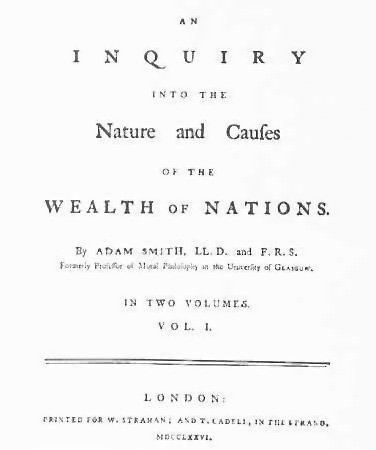
Adam Smith's An Inquiry into the Nature and Causes of the Wealth of Nations, published in London by Strahan and Cadell on 9 March 1776, asks what makes a nation rich and what policies help or hinder that growth. Smith's answer is that wealth is not a store of gold and silver but the annual produce of a nation's labour, and that it grows chiefly through the division of labour, the accumulation of capital and the freedom to trade. The library text is the Project Gutenberg edition, which follows a later revised edition of the five books. Book I opens in a pin factory, where ten workers who divide the trade into some eighteen operations can make upwards of forty-eight thousand pins a day, while each alone could hardly make twenty. Division of labour arises from a human propensity to truck, barter and exchange, and it is limited by the extent of the market. We expect our dinner not from the benevolence of the butcher, the brewer or the baker but from their regard to their own interest. Smith then explains money, the real and nominal price of goods, the component parts of price (wages, profit and rent), and the difference between natural and market price. He argues that high wages are a sign of a growing society, that no society can flourish while most of its members are poor and miserable, and that merchants and manufacturers of the same trade seldom meet without conspiring against the public. Book II treats stock, or capital: its divisions, banking, saving, and the line between productive and unproductive labour. Book III traces the progress of opulence in Europe after the fall of Rome, showing how towns and commerce gradually brought order and liberty to the countryside, reversing what Smith considered the natural order of agriculture first. Book IV examines the two systems of political economy. The larger part attacks the mercantile system, which confused wealth with money and sought it by import restraints, bounties, drawbacks, treaties of commerce and the monopoly of trade with the colonies. In chapter ii an individual who prefers domestic industry, intending only his own gain, is led by an invisible hand to promote an end which was no part of his intention. The long chapter on colonies proposes for British America either union with representation or separation. The French economists' agricultural system is treated more gently. Consumption, Smith concludes, is the sole end of production. Book V describes the proper duties of the sovereign under a system of natural liberty: defence, the administration of justice, public works and institutions such as roads, canals and education, the support of religious instruction, and the dignity of the sovereign. It examines taxes, setting out four maxims of equality, certainty, convenience and economy, and closes with the growth of public debts. Smith urges the public to support schools for the common people, because the division of labour can leave workers dull and ignorant.
Virtues in this work
- Industry: The pin factory and the account of parsimony in Book II make diligent, well-directed labour and saving the sources of national wealth.
- Justice: Smith's natural liberty operates only within the laws of justice, and he condemns monopolies that let producers profit at the public's expense.
- Prudence: Book II praises the frugal man who saves and invests, and Book V ends by urging Britain to fit its designs to its real circumstances.
- Charity: Book I, ch. viii insists that those who feed, clothe and lodge the nation deserve to be tolerably fed, clothed and lodged themselves.
Plot or Argument
- Introduction and Plan: the annual labour of every nation
Wealth is the annual produce of land and labour, and a nation is well or ill supplied according to the skill and dexterity with which its labour is applied and the proportion of useful labourers to the whole population. The plan of the five books follows from those two questions.
- Book I, ch. i–iii: the pin factory and the extent of the market
Dividing a trade into many small operations multiplies output through dexterity, saved time and the invention of machines. This division is not the product of human wisdom but of a natural propensity to exchange, which rests on self-interest; and it can go only as far as the market extends, which is why water carriage and coastal towns lead the way.
- Book I, ch. iv–vii: money, price and the natural rate
Money arises to overcome the inconvenience of barter. Labour is the real measure of exchangeable value; price resolves into wages, profit and rent; and market price gravitates toward a natural price set by the ordinary rates of each, unless monopoly or regulation holds it above.
- Book I, ch. viii–xi: wages, profits, employments and rent
Wages rise where national wealth is increasing, and liberal wages encourage industry and population. Profits tend to fall as capital grows. Chapter x explains why wages differ among trades (hardship, cost of learning, trust, chance of success) and how the policies of Europe, apprenticeships, corporations and settlement laws, distort them. Chapter xi, the longest, examines rent and the history of the value of silver.
- Book II: capital, banking and productive labour
Stock is divided into what is kept for consumption, fixed capital and circulating capital. Paper money and banking, illustrated by the Scottish banks and a recent Scottish bank failure, economize on gold. Capital grows by parsimony and shrinks by prodigality; labour that fixes itself in a vendible object is productive, while that of servants, soldiers, clergy and even sovereigns is not. Capitals are most usefully employed, in order, in agriculture, manufactures, wholesale and retail trade.
- Book III: the progress of opulence in Europe
The natural order of development runs from country to town to foreign trade, but in Europe after the fall of Rome it was inverted by primogeniture, entails and feudal dependence. Towns won freedom first, and the commerce of towns, by giving great proprietors something to spend their revenue on, dissolved the retinues of feudal lords and brought order and good government to the countryside.
- Book IV, ch. i–viii: the mercantile system and the invisible hand
Smith traces the mercantile error of confusing wealth with money and reviews its instruments: restraints on imports, bounties on exports, drawbacks, treaties of commerce and the colony trade. In chapter ii he argues that each person directing capital toward domestic industry for his own gain is led by an invisible hand to promote the public interest. Chapter vii, on colonies, praises the prosperity of the British American colonies, condemns the monopoly of their trade as a burden on both sides, and suggests representation in Parliament or a peaceful parting.
- Book IV, ch. ix: the French economists and natural liberty
The agricultural system of Quesnay and the economists, who treat land as the sole source of wealth, is called the nearest approximation to truth yet published, though mistaken about manufactures. Once preferences and restraints are removed, the obvious and simple system of natural liberty establishes itself, leaving the sovereign three duties.
- Book V, ch. i: the duties of the sovereign
Defence passes from militia to standing army as societies divide labour; justice needs an independent judiciary; public works such as roads and canals should be paid for chiefly by those who use them. Smith reviews the universities, which he thinks lax where teachers are paid regardless of effort, recommends parish schools for the common people on the Scottish model, and discusses the support of religious teachers and the effects of established churches and sects.
- Book V, ch. ii–iii: taxes and public debts
Taxes should follow four maxims: equality, certainty, convenience of payment, and economy in collection. Smith examines taxes on rent, profit, wages and consumption, and closes with the growth of public debts, warning Britain that its American empire has been a project rather than a gold mine and urging its rulers to fit their designs to their real circumstances.
Characters
- François Quesnay, interlocutor
Physician to Louis XV and founder of the French economists, whose agricultural system Smith discusses in Book IV, ch. ix.
- The pin-maker, illustrative figure
The workman of Book I, ch. i, whose trade, divided among ten hands, shows the power of the division of labour.
- The butcher, the brewer and the baker, illustrative figures
Tradesmen of Book I, ch. ii, from whose regard to their own interest, not their benevolence, we expect our dinner.
- Thomas Mun, opponent
Seventeenth-century merchant whose England's Treasure in Foreign Trade (so titled in this text) Smith cites as a statement of the mercantile doctrine.
- Bernardino Ramazzini, authority cited
Italian physician (spelled Ramuzzini in this text) whose book on the diseases of tradesmen Smith mentions in Book I, ch. viii.
- The sovereign, subject
The government of Book V, whose duties under natural liberty are defence, justice and certain public works and institutions.
Lessons
Specialization multiplies what labour can produce
The pin factory shows that dividing a task among many hands multiplies output far beyond what the same people could make alone. Smith traces much of the difference between rich and poor nations to how far this division has gone, and how far markets allow it to go.
- What three reasons does Smith give for the increase in output in the pin factory?
- Why is the division of labour limited by the extent of the market?
- What does Book V say the same division of labour may cost the worker, and what remedy does Smith propose?
Exchange works through interest, not only benevolence
Smith observes that most of what we need comes to us through exchange with strangers who serve us because it serves them. This does not deny benevolence, which his Theory of Moral Sentiments treats at length; it explains how cooperation can reach far beyond the circle of friends.
- Why does Smith say we address ourselves not to the humanity but to the self-love of the butcher, brewer and baker?
- Is Smith saying that self-interest is a virtue? How would you support your answer from the text?
- How might the beggar, who alone depends chiefly on benevolence, fit into Smith's picture?
Watch the interests of the producer
Smith repeatedly warns that merchants and manufacturers seek monopolies and regulations that raise their profits at the public's expense, and that the mercantile system was built on their advice. The interest of the consumer, he says, should come first, since consumption is the end of all production.
- What does Smith say happens when people of the same trade meet together?
- Why does he think the mercantile system served producers rather than consumers?
- Why does Smith distrust laws proposed by merchants even though he favours commerce?
A system of natural liberty still needs a sovereign
Smith is not against government. Under natural liberty the sovereign still has duties of defence, impartial justice, and the public works and institutions, including schools, that individuals cannot profitably provide. Taxes should be equal, certain, convenient and cheap to collect.
- What three duties does Smith assign to the sovereign at the end of Book IV?
- Why does he want the common people to be taught to read, write and account?
- Which of the four maxims of taxation seems most important to you, and why?
The wealth of a people, not of its treasury
Smith measures national wealth by the necessaries and conveniences of life enjoyed by the people, and holds that the labouring poor who feed, clothe and lodge the nation should themselves be well fed, clothed and lodged. Generous wages are a sign of a growing society.
- How does Smith define wealth in the Introduction, and how is it different from gold and silver?
- Why does he call the liberal reward of labour both the effect and the cause of increasing wealth?
- What evidence about the Highlands of Scotland does he use to show the effects of poverty on children?
Context
Smith wrote during the Scottish Enlightenment, a generation after the Union of 1707 had opened English and imperial markets to Scotland, and amid a European debate about trade, taxation and national power. British policy was largely mercantilist: Navigation Acts reserved shipping and the trade of the American colonies to British merchants, bounties encouraged exports, and duties discouraged imports. In France the economists or physiocrats around Quesnay argued that land alone produced a surplus and urged free trade in grain. The book appeared in March 1776, as the quarrel with the American colonies was turning into war, and its chapter on colonies addresses that crisis directly.
Composition
Smith's Glasgow lectures on jurisprudence in the early 1760s already contained much of the economic argument, including the division of labour. He began the book in France around 1764 and worked on it at Kirkcaldy and then in London from 1773 to 1776. It was published in two quarto volumes by William Strahan and Thomas Cadell on 9 March 1776. The third edition (1784) added substantial new material, including the conclusion of the mercantile system (Book IV, ch. viii); the Project Gutenberg text follows a later edition that includes these additions.
Reception
The first edition sold out within about six months, and the book went through five editions in Smith's lifetime. David Hume praised it shortly before his death in 1776. William Pitt the Younger publicly acknowledged Smith's influence, and the book shaped the move toward freer trade in Britain over the following century. Hamilton's Report on Manufactures (1791) engages its arguments, and Jefferson recommended it. Later economists from Malthus and Ricardo onward built on it, and scholars still discuss how its account of self-interest fits with the sympathy and impartial spectator of the Theory of Moral Sentiments.
Comparisons
- the-federalist-papers
Hamilton's papers on commerce and union (Federalist 11 and 12) treat a large free-trade area among the states as a source of wealth and revenue, an argument with clear affinity to Smith's claim that the division of labour is limited by the extent of the market.
- the-communist-manifesto
Marx and Engels accept Smith's picture of a productive commercial society built on the division of labour but treat the relation of wages and profit as a class struggle, where Smith sees interests that a system of natural liberty can bring into general advantage.
- the-spirit-of-the-laws
Montesquieu's Books XX–XXII describe commerce as a force that softens manners and binds nations by mutual need; Smith gives the same intuition a full economic analysis and adds his critique of the mercantile monopolies Montesquieu largely accepted.
- on-liberty
Mill, who wrote his own Principles of Political Economy in Smith's tradition, separates the case for free trade from the case for individual liberty, while Smith joins economic freedom to his system of natural liberty.
- a-christmas-carol
Dickens's Scrooge, who treats the poor as surplus population, caricatures a hard reading of political economy; Smith himself argued that no society can be flourishing and happy while most of its members are poor and miserable.
Quotes
“Those ten persons, therefore, could make among them upwards of forty-eight thousand pins in a day.”
“the propensity to truck, barter, and exchange one thing for another.”
“It is not from the benevolence of the butcher, the brewer, or the baker that we expect our dinner, but from their regard to their own interest.”
“No society can surely be flourishing and happy, of which the far greater part of the members are poor and miserable.”
“People of the same trade seldom meet together, even for merriment and diversion, but the conversation ends in a conspiracy against the public, or in some contrivance to raise prices.”
“he intends only his own gain; and he is in this, as in many other cases, led by an invisible hand to promote an end which was no part of his intention.”
“Consumption is the sole end and purpose of all production; and the interest of the producer ought to be attended to, only so far as it may be necessary for promoting that of the consumer.”
“generally becomes as stupid and ignorant as it is possible for a human creature to become.”
For Students
A reading companion for classical Christian high school students. See the student guide.
Reading Guide
Watch for
- The pin factory in Book I, ch. i and the labourer's woollen coat at the end of the same chapter, which show how many hands cooperate in ordinary goods.
- The butcher, brewer and baker in Book I, ch. ii, and the reason Smith gives for why exchange depends on interest rather than benevolence.
- Smith's warnings about merchants and manufacturers who combine against the public, in Book I, ch. x and again in Book IV.
- The single appearance of the invisible hand in Book IV, ch. ii, and what argument it actually belongs to.
- The passage on schooling in Book V, ch. i, where Smith names a cost of the division of labour he praised in Book I.
Key terms and names
- Division of labour
- The splitting of a trade into separate operations performed by different workers, which Smith calls the greatest cause of improvement in the productive powers of labour.
- Natural price
- In Book I, ch. vii, the price that just pays the ordinary rates of wages, profit and rent; market prices gravitate toward it when competition is free.
- Stock
- Smith's word for accumulated goods and capital, divided in Book II into what is reserved for consumption, fixed capital and circulating capital.
- Productive labour
- In Book II, ch. iii, labour that adds to the value of a vendible object and so replaces capital; Smith counts servants, soldiers and officials as unproductive in this technical sense.
- Mercantile system
- The policy Smith attacks in Book IV, which identified wealth with gold and silver and sought a favourable balance of trade through restraints, bounties and the monopoly of trade with the colonies.
- Invisible hand
- Smith's image, used once in Book IV, ch. ii, for the way an individual pursuing his own gain in domestic industry promotes a public good he did not intend.
- System of natural liberty
- The order that establishes itself, according to Book IV, ch. ix, when all preferences and restraints are removed, leaving each person free to pursue his interest within the laws of justice.
- Maxims of taxation
- The four rules of Book V, ch. ii: taxes should be proportioned to ability, certain, convenient in time and manner of payment, and economical to collect.
Seminar Questions
- Comprehension How does Smith define the wealth of a nation in the Introduction, and why does he reject the idea that wealth consists in gold and silver?
- Comprehension What three advantages of the division of labour does Smith find in the pin factory?
- Comprehension What are the three duties of the sovereign under the system of natural liberty?
- Interpretation In Book I, ch. ii Smith says we appeal to the self-love of the butcher, brewer and baker. Does this mean Smith thinks people are only selfish? How does the rest of the book support your answer?
- Interpretation Smith praises the division of labour in Book I and warns in Book V that it can leave workers stupid and ignorant. How does he reconcile these two judgments?
- Interpretation Why does Smith distrust merchants and manufacturers when they propose laws, even though he defends commerce?
- Big Question Can a society built on exchange among strangers be a good society, or does it need something more than interest to hold it together?
- Big Question Is the wealth of a nation best measured by its total production, or by how well its poorest members live?
Faith Connections
- 1 Corinthians 12:14-26 (Scripture)
Paul describes the church as one body with many members, each with its own function and none able to say it has no need of the others. Smith's division of labour describes a similar interdependence in economic life, though he explains it by exchange rather than by a shared spirit.
- Proverbs 11:26 (Scripture)
He that withholdeth corn, the people shall curse him. Smith's long digression on the corn trade in Book IV, ch. v takes up the old question of grain dealers in time of dearth and argues that free trade, not restraint, best prevents famine.
- Leviticus 19:13 (Scripture)
The wages of him that is hired shall not abide with thee all night until the morning. Smith's insistence in Book I, ch. viii that those who feed, clothe and lodge the nation should be tolerably fed, clothed and lodged themselves echoes the biblical concern for the labourer's due.
- Thomas Aquinas, Summa Theologiae II-II, q. 77 (Great Conversation)
Aquinas asks whether one may sell a thing for more than it is worth and discusses the just price and the merchant's gain. Smith's natural and market price in Book I, ch. vii offers a different account of value, set by competition, which a reader can test against the older question of justice in exchange.
Logic and Rhetoric
Central argument: The wealth of a nation is the annual produce of its labour. That produce grows chiefly through the division of labour, which depends on the extent of the market, and through capital accumulated by saving. Restraints, bounties and monopolies, the instruments of the mercantile system, divert labour and capital from their most productive uses for the benefit of particular producers. Therefore a nation grows richest under a system of natural liberty, in which each person may pursue his own interest within the laws of justice, while the sovereign provides defence, justice and those public works and institutions that individuals cannot profitably supply.
Rhetorical device: exemplum. Smith opens with the pin factory in Book I, ch. i, a single homely example worked out in figures, so that a general law of economic life becomes something the reader can picture and count.
Debate: Resolved: That the consumer's interest should always take precedence over the producer's in making trade policy.
Memory Work
It is not from the benevolence of the butcher, the brewer, or the baker that we expect our dinner, but from their regard to their own interest.
No society can surely be flourishing and happy, of which the far greater part of the members are poor and miserable.
Writing Prompts
Essay: Smith uses the image of an invisible hand only once. Read Book IV, ch. ii closely and explain what argument the image serves, then argue whether it supports the broader claim that self-interest generally promotes the public good.
Comparison with The Communist Manifesto: Smith and Marx both describe the division of labour and the growth of commercial society. Compare how each explains the relation between wages and profits, and argue which account better describes the condition of the worker.
Medical Lens
The Wealth of Nations is an economic treatise, but it touches the history of medicine at several points. In Book I, ch. viii Smith notes that workmen paid by the piece overwork themselves into the peculiar infirmities of their trades and cites Bernardino Ramazzini's De morbis artificum (1700), the founding text of occupational medicine. The same chapter reports, from Highland informants and army officers, high child mortality among the poor, an early use of mortality as an index of a population's condition. Book I, ch. x explains the high wages of physicians and lawyers by the trust placed in them and the long cost of their education. In Book V Smith argues that the mental torpor produced by repetitive labour is a kind of mutilation of the mind, and that the state should prevent it as it would prevent a leprosy from spreading, even if the disorder were neither mortal nor dangerous; this is an eighteenth-century public-health analogy, not a clinical claim. Smith himself was close to physicians, including William Cullen, and later economists of public health drew on his analysis of wages and risk.
- Book I, ch. viii
Overwork by piece-rate workers leads to infirmities peculiar to each trade; Ramazzini's book on the diseases of artificers is cited.
- Book I, ch. viii
Poverty and child mortality in the Highlands of Scotland; the poor bear many children but rear few.
- Book I, ch. x, Part I
The reward of physicians explained by the trust society places in them with health, and by the cost of their training.
- Book V, ch. i, Part III, Art. II
Mental torpor from repetitive work likened to mutilation, and public instruction compared to preventing a leprosy from spreading among the people.
Creative Prompts
- Classroom
Run a pin-factory experiment: have students fold paper boxes alone and then as an assembly line of specialized tasks, record the output, and compare their findings with Book I, ch. i.
- Essay
Trace a single ordinary object (a pencil, a loaf of bread, a woollen coat as in Book I, ch. i) back through all the trades that contribute to it, as Smith does for the labourer's coat.
- Dialogue
Write a conversation between Smith and a London merchant in 1776 who wants Parliament to raise duties on foreign linen.
Further Reading
- The Theory of Moral Sentiments, Adam Smith
Smith's first book, on sympathy and the impartial spectator.
- Adam Smith: An Enlightened Life, Nicholas Phillipson
- The Life of Adam Smith, Ian Simpson Ross
- Adam Smith: What He Thought, and Why It Matters, Jesse Norman
- The Worldly Philosophers, Robert L. Heilbroner
A popular history of economic thought with a chapter on Smith.
Verification notes
Publication facts, the structure of the five books and the main arguments are standard. All eight quotations were found by search in the stored Project Gutenberg text (content/texts/the-wealth-of-nations.txt) and copied exactly, including the later-edition wording; book, chapter, part and article locators follow that text's headings. The text spells Ramazzini as Ramuzzini. That Book IV, ch. viii was added in the third edition (1784) is standard bibliographical information.
- The claim that the first edition sold out in about six months.
- Jefferson's recommendation of the book (he praised it in a 1790 letter, usually cited) and Pitt's public acknowledgment of Smith.