Arthur Eddington
1882–1944 · English astrophysicist who studied the interiors of stars and led the 1919 eclipse expedition that tested Einstein's theory of general relativity.
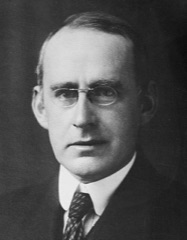
Arthur Stanley Eddington was born in Kendal, in the north of England, in 1882 and was raised by his mother as a Quaker after his father's early death. He studied at Owens College, Manchester, and at Trinity College, Cambridge, worked at the Royal Observatory at Greenwich, and in 1913 became Plumian Professor of Astronomy at Cambridge, later also directing its observatory. He was one of the first scientists in Britain to understand and explain Albert Einstein's theory of general relativity. In 1919 he led an expedition to the island of Príncipe, off West Africa, to photograph stars during a total eclipse of the Sun; the measurements of starlight bending near the Sun were taken as confirming Einstein's prediction. Eddington did pioneering work on the internal structure of stars and on the relation between a star's mass and its brightness. He was also a gifted popular writer, and The Nature of the Physical World (1928) explained modern physics to general readers. He died in Cambridge in 1944.
Arthur Eddington is also an author in the library: author page and works.
Faith: Grew up in a Quaker setting; his pacifism arose from his strongly held Quaker beliefs. Source: Encyclopaedia Britannica
Key dates
- 1882 Born in Kendal
- 1913 Plumian Professor of Astronomy at Cambridge
- 1919 Eclipse expedition to Príncipe
- 1926 The Internal Constitution of the Stars
- 1928 The Nature of the Physical World published
- 1944 Dies in Cambridge
Record-breaker
Firsts and records, worded as the sources give them ("first known", "at the time").
- He was the first to suggest, correctly, that stars shine by fusing hydrogen into helium. (Source: Arthur Eddington (Wikipedia))
Watch


Videos load from YouTube in privacy-enhanced mode only when you press play.
Read about them
Grades 9–12
- The Nature of the Physical World · In the library
More lives
Niels Bohr · Vannevar Bush · George Washington Carver · Marie Curie · Albert Einstein · Alexander Fleming