Niels Bohr
1885–1962 · Danish physicist who explained the structure of the atom using quantum ideas.
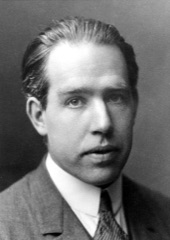
Niels Bohr was born in Copenhagen, Denmark; his father was a professor of physiology and his mother came from a Jewish banking family. He and his brother Harald were both excellent footballers. After earning his doctorate he worked in England with Ernest Rutherford, who had discovered that atoms have a small, heavy nucleus. In 1913 Bohr proposed that electrons orbit the nucleus only at certain fixed energy levels and give off or absorb light when they jump between them, which explained the colors of light given off by hydrogen. He received the Nobel Prize in Physics in 1922. His institute in Copenhagen became the world center for the new quantum physics, and he debated its meaning for years with Einstein. In 1943, under German occupation, Bohr, whose mother was Jewish, escaped by fishing boat to Sweden; he helped persuade Sweden to offer refuge to Danish Jews. He then went to Britain and the United States and advised on the atomic bomb project. After the war he urged international control of atomic weapons and helped found CERN. He died in 1962.
Faith: Faith not well documented; his mother came from a Jewish family. Source: Wikipedia
Further reading
- Niels Bohr: A Very Short Introduction by J. L. Heilbron (Oxford University Press, 2020), ISBN 9780198819264

Key dates
- 1885 Born in Copenhagen
- 1913 Model of the atom
- 1921 Institute for Theoretical Physics opens
- 1922 Nobel Prize in Physics
- 1943 Escapes to Sweden
- 1962 Dies in Copenhagen
Fun facts
- The chemical element bohrium (number 107), the asteroid 3948 Bohr and a crater on the Moon are all named after him. (Source: Niels Bohr (Wikipedia))
Record-breaker
Firsts and records, worded as the sources give them ("first known", "at the time").
- In 1957 he received the first-ever Atoms for Peace Award. (Source: Niels Bohr (Wikipedia))
More lives
Vannevar Bush · George Washington Carver · Marie Curie · Arthur Eddington · Albert Einstein · Alexander Fleming