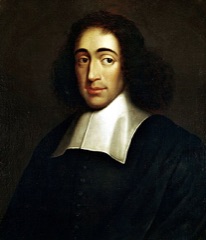
Baruch Spinoza
1632–1677 · Dutch philosopher of Portuguese Jewish descent, author of the Ethics and the Theological-Political Treatise.
Baruch Spinoza was born in Amsterdam in 1632 into a family of Portuguese Jewish merchants who had fled persecution in Portugal. He was educated in the Jewish community's schools and worked in the family business after his father's death. In 1656 the leaders of the Amsterdam synagogue issued a writ of herem, expelling him from the community, apparently because of his opinions. He later took the Latin name Benedictus. Spinoza supported himself in part by grinding optical lenses and lived modestly in Rijnsburg, Voorburg and The Hague, corresponding with scientists and philosophers. His Theological-Political Treatise (1670), published anonymously, argued for reading the Bible historically and for freedom of thought, and it caused a scandal. He declined a professorship at Heidelberg in order to keep his independence. His Ethics, set out in the style of geometry with definitions and proofs, describes God or Nature as a single substance. It was published after his death from lung disease in The Hague in 1677.
Baruch Spinoza is also an author in the library: author page and works.
Faith: Raised in Amsterdam's Portuguese-Jewish community, which issued a writ of excommunication (herem) against him in 1656. Source: Stanford Encyclopedia of Philosophy
Further reading
- Spinoza: A Very Short Introduction by Roger Scruton (Oxford University Press, 2002), ISBN 9780192803160

Key dates
- 1632 Born in Amsterdam
- 1656 Expelled from the Jewish community
- 1670 Theological-Political Treatise published anonymously
- 1673 Declines a chair at Heidelberg
- 1677 Dies in The Hague; Ethics published posthumously
Read about them
Grades 9–12
- Ethics · In the library
- A Theologico-Political Treatise · In the library
More lives
Francis Bacon · René Descartes · Desiderius Erasmus · Robert Filmer · Hugo Grotius · James Harrington