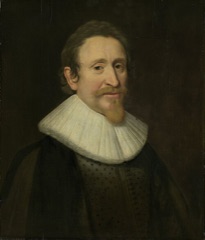
Hugo Grotius
1583–1645 · Dutch jurist called a father of international law, author of The Rights of War and Peace.
Hugo de Groot, known by the Latin name Grotius, was born in Delft in the Dutch Republic and was a famous child prodigy who entered the University of Leiden at eleven. At fifteen he accompanied a Dutch embassy to the king of France, who called him the miracle of Holland. He became a lawyer and official, and in The Free Sea of 1609 argued that the oceans were open to all nations for trade. Caught up in a fierce religious and political dispute in the Netherlands, he was arrested in 1618 and sentenced to life imprisonment in Loevestein Castle. In 1621 his wife, Maria van Reigersberch, helped him escape hidden in a chest meant for carrying books. He fled to Paris, where in 1625 he published The Rights of War and Peace, which argued that natural law, grounded in human nature and reason, binds all nations, that war is just only for certain causes, and that even in war there are limits on conduct. He died in 1645 after a shipwreck.
Hugo Grotius is also an author in the library: author page and works.
Faith: Dutch Protestant who sided with reformers against orthodox Calvinists and worked for Christian unity. Source: Stanford Encyclopedia of Philosophy

Key dates
- 1583 Born in Delft
- 1609 The Free Sea
- 1618 Imprisoned at Loevestein
- 1621 Escapes in a book chest
- 1625 The Rights of War and Peace
- 1645 Dies at Rostock
In their words
“Natural right is the dictate of right reason”
Read about them
Grades 9–12
- The Rights of War and Peace (Book I) · In the library
More lives
Francis Bacon · Sir Edward Coke · René Descartes · Desiderius Erasmus · Robert Filmer · James Harrington