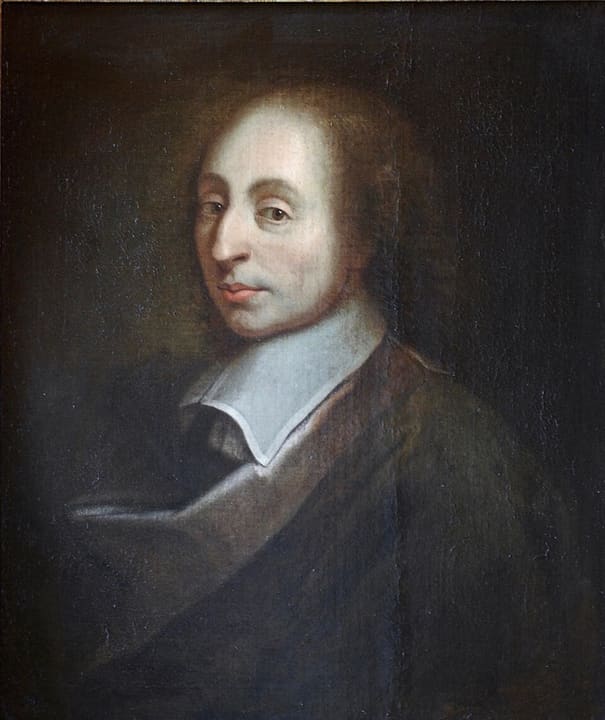
Blaise Pascal
1623–1662 · French mathematician, inventor and Christian thinker, author of the Pensées.
Blaise Pascal was born in Clermont, France. His mother died when he was three, and his father, a tax official and amateur mathematician, educated him at home. Pascal showed astonishing talent: at sixteen he wrote an essay on conic sections, and at nineteen he invented a mechanical calculator to help his father with his work. He experimented with air pressure, showing with a barometer carried up a mountain that air pressure falls with height, and stated Pascal's principle about pressure in fluids. With Pierre de Fermat he founded the mathematics of probability. On the night of 23 November 1654 he had an intense religious experience, which he wrote down and sewed into his coat; it began with the word Fire. He drew close to the Jansenists at Port-Royal and wrote the Provincial Letters, a witty attack on Jesuit moral teaching. He planned a great defense of Christianity, and the notes for it, published after his death as the Pensées, include his famous wager. He also started a public carriage service in Paris. Long in poor health, he died in 1662 at thirty-nine.
Blaise Pascal is also an author in the library: author page and works.
Faith: A Catholic who in November 1654 had an ecstatic experience he interpreted as a religious conversion. Source: Stanford Encyclopedia of Philosophy
Key dates
- 1642 Invents a calculating machine
- 1648 Air-pressure experiment on the Puy de Dôme
- 1654 Probability correspondence with Fermat; night of fire
- 1656–57 Provincial Letters
- 1662 Dies in Paris
Watch

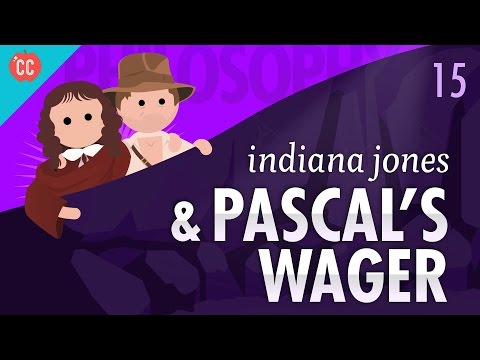

Videos load from YouTube in privacy-enhanced mode only when you press play.
In their words
“The heart has its reasons, which reason does not know”
“Man is but a reed, the most feeble thing in nature; but he is a thinking reed”
Read about them
Grades 9–12
- Pensees · In the library
- The Provincial Letters · In the library
- Scientific and Mathematical Treatises · In the library
More lives
Francis Bacon · Robert Boyle · Filippo Brunelleschi · John Bunyan · Robert Burton · John Calvin