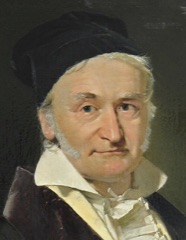
Carl Friedrich Gauss
1777–1855 · German mathematician called the prince of mathematicians.
Carl Friedrich Gauss was born in Brunswick, Germany, to a poor family; his father was a laborer and his mother could not read. A famous story says that as a schoolboy he quickly added the numbers from one to a hundred by pairing them. The Duke of Brunswick paid for his education. At nineteen he showed how to construct a regular seventeen-sided polygon with only a compass and straightedge, a problem unsolved since ancient times, and he asked that the figure be carved on his tomb. In 1801, at twenty-four, he published Disquisitiones Arithmeticae, which laid the foundations of modern number theory. That same year he calculated the orbit of the newly discovered dwarf planet Ceres, allowing astronomers to find it again after it disappeared behind the Sun. He became director of the observatory at Göttingen, where he stayed for the rest of his life. He also worked on surveying, the shape of the Earth, magnetism, and with Wilhelm Weber built an early electric telegraph. He published only what he considered perfect. He died in Göttingen in 1855.
Faith: A member of the Lutheran church who spoke of God and grace; his biographer described him as religiously tolerant. Source: Wikipedia

Key dates
- 1777 Born in Brunswick
- 1796 Constructs the seventeen-sided polygon
- 1801 Disquisitiones Arithmeticae; predicts the orbit of Ceres
- 1807 Director of the Göttingen observatory
- 1833 Builds a telegraph with Weber
- 1855 Dies in Göttingen
Fun facts
- More than 100 ideas in mathematics and science are named after him. (Source: Carl Friedrich Gauss (Wikipedia))
- His favourite English author was Walter Scott. (Source: Carl Friedrich Gauss (Wikipedia))
Record-breaker
Firsts and records, worded as the sources give them ("first known", "at the time").
- He worked out a version of the fast Fourier transform, a key method in modern computing, about 160 years before it was rediscovered. (Source: Carl Friedrich Gauss (Wikipedia))
More lives
Edwin A. Abbott · Charles Babbage · Claude Bernard · George Boole · Josef Breuer · Lewis Carroll