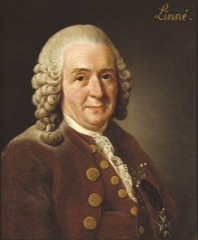
Carl Linnaeus
1707–1778 · Swedish botanist who created the modern system of naming living things.
Carl Linnaeus was born in Råshult, in southern Sweden, the son of a Lutheran pastor who was a keen gardener. He studied medicine at Lund and Uppsala, though he was most interested in plants. In 1732 he traveled through Lapland in northern Sweden, collecting plants and recording the customs of the Sami people. He earned his medical degree in the Netherlands, and in 1735 he published Systema Naturae, a short book that sorted plants, animals and minerals into a clear order of classes, orders, genera and species. He became professor at Uppsala, where he was a lively teacher who led students on long botanical walks, and he sent his students, called apostles, around the world to collect specimens; several died on their travels. His greatest lasting contribution was binomial naming, giving each species a two-part Latin name, such as Homo sapiens for human beings, which he used consistently in Species Plantarum of 1753. Scientists still use this system today. He was ennobled in 1761 as Carl von Linné. He died in Uppsala in 1778.
Faith: Son of a Lutheran parish pastor in Sweden. Source: Encyclopaedia Britannica (1911) (via Wikisource)

Key dates
- 1732 Expedition to Lapland
- 1735 Systema Naturae
- 1741 Professor at Uppsala
- 1753 Species Plantarum introduces two-part names
- 1778 Dies in Uppsala
Fun facts
- His favourite flower was the little twinflower, which was given the scientific name Linnaea borealis in his honour. (Source: Carl Linnaeus (Wikipedia))
Record-breaker
Firsts and records, worded as the sources give them ("first known", "at the time").
- His system of naming living things was the first to group humans scientifically with apes. (Source: Carl Linnaeus (Wikipedia))
More lives
Leonhard Euler · Benjamin Franklin · Antoine Lavoisier · Alessandro Volta · Gilbert White