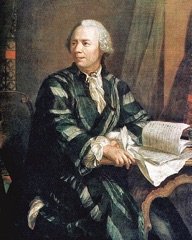
Leonhard Euler
1707–1783 · Swiss mathematician, one of the most productive in history, who kept working after going blind.
Leonhard Euler was born in Basel, Switzerland, the son of a pastor who hoped he would become a minister. At the University of Basel, the mathematician Johann Bernoulli recognized his talent and gave him private lessons on Saturdays. In 1727 he went to the new Academy of Sciences in St. Petersburg, Russia, and later spent twenty-five years at the Berlin Academy under Frederick the Great before returning to St. Petersburg. He wrote more mathematics than perhaps anyone in history, on calculus, number theory, geometry, mechanics, optics, astronomy and music. He introduced much of the notation used today, including f(x) for functions, e for the base of natural logarithms, i for the square root of minus one, and the Greek letter pi. He solved the puzzle of the seven bridges of Königsberg, founding graph theory, and found the formula linking e, i and pi. He lost the sight of one eye in his thirties and became almost totally blind in 1771, but with a remarkable memory and the help of his sons he kept producing papers. He died in St. Petersburg in 1783.
Faith: Son of a Calvinist pastor. Source: Encyclopaedia Britannica (1911) (via Wikisource)

Key dates
- 1707 Born in Basel
- 1727 Moves to St. Petersburg
- 1736 Solves the Königsberg bridge problem
- 1741–1766 At the Berlin Academy
- 1771 Becomes almost totally blind
- 1783 Dies in St. Petersburg
Fun facts
- He memorised Virgil's long poem the Aeneid early in life, and even in old age could recite it and give the first and last sentence of every page of his copy. (Source: Leonhard Euler (Wikipedia))
- The asteroid 2002 Euler and a crater on the Moon are named after him. (Source: Leonhard Euler (Wikipedia))
Record-breaker
Firsts and records, worded as the sources give them ("first known", "at the time").
- He was the first to write f(x) for a function, the notation still used in maths classes today, and he is credited with founding graph theory through the puzzle of the Seven Bridges of Königsberg. (Source: Leonhard Euler (Wikipedia))
More lives
Benjamin Franklin · Antoine Lavoisier · Carl Linnaeus · Alessandro Volta · Gilbert White