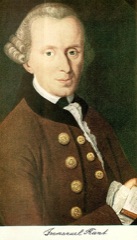
Immanuel Kant
1724–1804 · German philosopher of the Critique of Pure Reason and the categorical imperative.
Immanuel Kant was born in Königsberg, in East Prussia, the son of a harness maker, and was raised in a devout Pietist Lutheran household. He studied at the university there and worked for years as a private tutor and lecturer before becoming professor of logic and metaphysics in 1770. He never traveled far from his home city, and his daily walks were said to be so regular that neighbors set their clocks by them. Reading David Hume, he said, woke him from his dogmatic slumber. In the Critique of Pure Reason, published in 1781, he argued that the mind does not simply receive the world but shapes experience through built-in forms such as space, time and cause, and that reason cannot prove things beyond all possible experience. In his moral philosophy he taught the categorical imperative: act only on a rule you could will to be a law for everyone, and treat people always as ends, never merely as means. He also wrote on science, religion, beauty, history and lasting peace among nations. He died in Königsberg in 1804.
Immanuel Kant is also an author in the library: author page and works.
Faith: Raised in Pietism, an evangelical Lutheran movement. Source: Stanford Encyclopedia of Philosophy
Further reading
- Kant: A Very Short Introduction by Roger Scruton (Oxford University Press, 2001), ISBN 9780192801999
Key dates
- 1724 Born in Königsberg
- 1770 Becomes professor
- 1781 Critique of Pure Reason
- 1785 Groundwork of the Metaphysics of Morals
- 1795 Perpetual Peace
- 1804 Dies in Königsberg
Watch
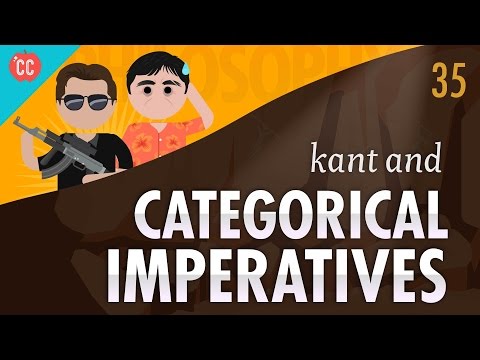

Videos load from YouTube in privacy-enhanced mode only when you press play.
In their words
“Act only on that maxim whereby thou canst at the same time will that it should become a universal law”
“Thoughts without content are void; intuitions without conceptions, blind”
Read about them
Grades 9–12
- Groundwork of the Metaphysics of Morals · In the library
- Perpetual Peace · In the library
- Critique of Pure Reason · In the library
- Critique of Practical Reason · In the library
- The Metaphysical Elements of Ethics · In the library
- The Science of Right · In the library
- The Critique of Judgement · In the library
More lives
Cesare Beccaria · George Berkeley · Edmund Burke · Denis Diderot · Jonathan Edwards · David Hume