Euclid
fl. c. 300 BC · Greek mathematician of Alexandria whose Elements taught geometry for over two thousand years.
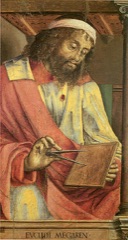
Euclid taught mathematics in Alexandria, Egypt, around 300 BC, during the reign of Ptolemy I. Almost nothing is known about his life; even his dates are estimates. A later story says that when King Ptolemy asked for an easier way to learn geometry, Euclid replied that there is no royal road to geometry. His fame rests on the Elements, thirteen books that gather the mathematics known in his time into a single order. The Elements begins with definitions, a few postulates and common notions, such as that things equal to the same thing are equal to each other, and from them proves, step by step, hundreds of propositions about triangles, circles, parallel lines, proportions, numbers and solid figures. Among its results are the Pythagorean theorem and the proof that there are infinitely many prime numbers. The book was copied and translated into Arabic and Latin and printed in 1482, and it remained the standard way of teaching geometry and logical proof into the twentieth century. Euclid also wrote on optics and other subjects.
Euclid is also an author in the library: author page and works.
Faith: Faith not well documented. Source: Wikipedia
Key dates
- c. 300 BC Teaches in Alexandria and writes the Elements
- 1482 First printed edition of the Elements
Fun facts
- The European Space Agency's Euclid space telescope, a crater on the Moon and a minor planet are named after him. (Source: Euclid (Wikipedia))
Watch


Videos load from YouTube in privacy-enhanced mode only when you press play.
In their words
“A line is length without breadth.”
“The whole is greater than its part.”
Read about them
Grades 6–8
- Elements, Book I · In the library
Grades 9–12
- Elements, Books I-VI · In the library
More lives
Archimedes · Aristotle · Pedanius Dioscorides · Herophilus · Nicomachus of Gerasa · Pliny the Elder
Notes: Birth and death years are estimates; only his active period (about 300 BC) is known.