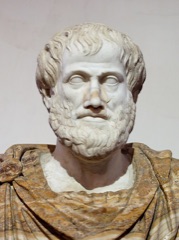
Aristotle
384–322 BC · Greek philosopher and scientist, tutor of Alexander, whose works shaped learning for two thousand years.
Aristotle was born at Stagira in northern Greece, the son of a physician to the king of Macedon. At seventeen he went to Athens to study at Plato's Academy and stayed for twenty years. After Plato's death he lived on the coast of Asia Minor and on the island of Lesbos, where he studied sea creatures and animals with great care. In 343 BC King Philip II invited him to tutor his son Alexander. Returning to Athens, he founded his own school, the Lyceum, where he taught while walking in its covered walkways. Aristotle wrote or lectured on almost every subject: logic, physics, biology, the soul, ethics, politics, rhetoric and poetry. He taught that every living thing has a purpose, that virtue is a settled habit found between extremes, and that human beings are by nature political animals. After Alexander's death in 323 BC, anti-Macedonian feeling in Athens led him to leave the city. He died the next year. Medieval Muslim, Jewish and Christian thinkers called him simply the Philosopher.
Aristotle is also an author in the library: author page and works.
Faith: Faith not well documented beyond the Greek religion of his time. Source: Wikipedia
Further reading
- Aristotle: A Very Short Introduction by Jonathan Barnes (Oxford University Press, 2000), ISBN 9780192854087
Key dates
- 384 BC Born at Stagira
- 367 BC Enters Plato's Academy
- 343 BC Becomes tutor to Alexander
- 335 BC Founds the Lyceum in Athens
- 322 BC Dies at Chalcis
Fun facts
- His teacher Plato nicknamed him 'the mind of the school'. (Source: Aristotle (Wikipedia))
- A crater on the Moon is named Aristoteles after him. (Source: Aristotle (Wikipedia))
Watch


Videos load from YouTube in privacy-enhanced mode only when you press play.
In their words
“for as it is not one swallow or one fine day that makes a spring, so it is not one day or a short time that makes a man blessed and happy”
“A whole is that which has a beginning, a middle, and an end.”
Read about them
As an Amazon Associate I earn from qualifying purchases. As a Bookshop.org affiliate I earn from qualifying purchases, which also support independent bookstores.
Grades 9–12
- The Nicomachean Ethics · In the library
- Politics · In the library
- Poetics · In the library
- Posterior Analytics and Physics · In the library
- De Anima · In the library
- Aristotle for Everybody by Mortimer J. Adler (Simon & Schuster, Limited, 1997; ISBN 9781439104910)
Bookshop.org · Amazon - Categories · In the library
- On Interpretation, Prior Analytics, Topics and Sophistical Refutations · In the library
- Metaphysics · In the library
- On the Heavens · In the library
- On Generation and Corruption · In the library
- Meteorology · In the library
- Parva Naturalia (Short Treatises on Nature) · In the library
- History of Animals · In the library
- Parts of Animals · In the library
- On the Motion and Gait of Animals · In the library
- Generation of Animals · In the library
- Rhetoric · In the library
More lives
Archimedes · Cicero · Confucius · Pedanius Dioscorides · Epictetus · Epicurus