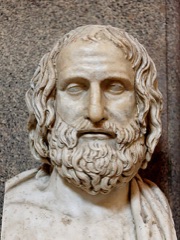
Euripides
c. 480–406 BC · Athenian tragedian, author of Medea, The Trojan Women and The Bacchae.
Euripides was born around 480 BC, according to tradition on the island of Salamis, near Athens. He was the youngest of the three great Athenian tragic playwrights, after Aeschylus and Sophocles. He first competed at the festival of Dionysus in 455 BC and wrote about ninety plays, of which eighteen or nineteen survive, more than for either of the other two. He won first prize only a few times during his life, but his plays became very popular after his death. Euripides was known for portraying gods and heroes in a more human and questioning way, for strong and complex female characters such as Medea, Phaedra and Electra, and for clever debate between characters. Several of his plays, such as The Trojan Women (415 BC), show the suffering caused by war, written during the long conflict between Athens and Sparta. Late in life he left Athens for the court of King Archelaus of Macedon, where he died in 406 BC. The Bacchae and Iphigenia in Aulis were staged after his death.
Euripides is also an author in the library: author page and works.
Faith: Faith not well documented; scholars disagree about whether his plays show religious skepticism or belief. Source: Wikipedia

Key dates
- c. 480 BC Born, by tradition on Salamis
- 455 BC First competes at the Dionysia
- 431 BC Medea staged
- 415 BC The Trojan Women staged
- 406 BC Dies in Macedon
- 405 BC The Bacchae staged after his death
Record-breaker
Firsts and records, worded as the sources give them ("first known", "at the time").
- He was the youngest of the three great writers of Greek tragedy, after Aeschylus and Sophocles. (Source: Euripides (Wikipedia))
Read about them
Grades 9–12
- Medea and Other Plays · In the library
- The Bacchae and Other Plays · In the library
- The Trojan Women and Other Plays · In the library
- Iphigenia in Aulis and Other Plays · In the library
More lives
Aeschylus · Aesop · Apollodorus · Apollonius of Rhodes · Apuleius · Aristophanes