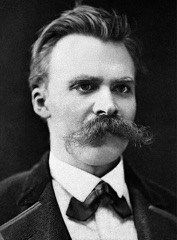
Friedrich Nietzsche
1844–1900 · German philosopher, author of Thus Spoke Zarathustra and Beyond Good and Evil, who challenged traditional morality and religion.
Friedrich Nietzsche was born in 1844 in Röcken, Prussia, the son of a Lutheran pastor who died when Friedrich was four. He studied classical philology at Bonn and Leipzig and was so brilliant that in 1869, at the age of only 24, he was appointed professor at the University of Basel in Switzerland. He became a friend of the composer Richard Wagner, and his first book, The Birth of Tragedy (1872), contrasted the Apollonian and Dionysian spirits in Greek culture. He later broke with Wagner. Poor health forced him to resign his professorship in 1879, and for the next ten years he lived on a small pension, moving among boarding houses in Switzerland, Italy and France and writing a series of books, including The Gay Science, Thus Spoke Zarathustra, Beyond Good and Evil and On the Genealogy of Morality. He announced the 'death of God' and wrote of the 'will to power' and the 'overman'. In January 1889 he collapsed in Turin and never recovered his sanity. He was cared for by his mother and sister and died in Weimar in 1900.
Friedrich Nietzsche is also an author in the library: author page and works.
Faith: Son of a Lutheran minister; he is famous for his criticism of Christianity and the morality founded on it. Source: Stanford Encyclopedia of Philosophy
Further reading
- Nietzsche: A Very Short Introduction by Michael Tanner (Oxford University Press, 2000), ISBN 9780192854148

Key dates
- 1844 Born in Röcken, Prussia
- 1869 Professor at Basel at 24
- 1872 The Birth of Tragedy published
- 1879 Resigns his professorship
- 1883–1885 Thus Spoke Zarathustra
- 1889 Mental collapse in Turin
- 1900 Dies in Weimar
Fun facts
- He also composed music, writing pieces for voice, piano and violin. (Source: Friedrich Nietzsche (Wikipedia))
Record-breaker
Firsts and records, worded as the sources give them ("first known", "at the time").
- He became a professor at 24 and is still among the youngest tenured professors of classics on record. (Source: Friedrich Nietzsche (Wikipedia))
Read about them
Grades 9–12
- Thus Spoke Zarathustra · In the library
- The Gay Science · In the library
- The Antichrist · In the library
- Twilight of the Idols · In the library
- The Birth of Tragedy · In the library
- Beyond Good and Evil · In the library
- Ecce Homo · In the library
- On the Genealogy of Morality · In the library
More lives
Frédéric Bastiat · Eugen von Böhm-Bawerk · Thomas Carlyle · Carl von Clausewitz · Samuel Taylor Coleridge · John Dewey