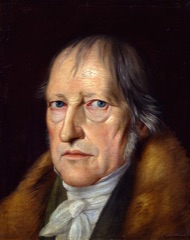
G. W. F. Hegel
1770–1831 · German idealist philosopher, author of the Phenomenology of Spirit and lectures on the philosophy of history.
Georg Wilhelm Friedrich Hegel was born in Stuttgart in 1770, the son of a civil servant. He studied theology and philosophy at the seminary in Tübingen, where he shared a room with the future philosopher Friedrich Schelling and the poet Friedrich Hölderlin, and the three followed the French Revolution with excitement. He worked as a private tutor, then taught at the University of Jena, where he finished his Phenomenology of Spirit (1807) just as Napoleon defeated the Prussians nearby. After the university closed, he edited a newspaper and served for eight years as headmaster of a secondary school in Nuremberg, where he wrote his Science of Logic. He became professor at Heidelberg in 1816 and at Berlin in 1818, where he grew famous. His philosophy describes history and thought as the development of reason, or Spirit, toward freedom, through the conflict and resolution of opposing ideas. His Philosophy of Right appeared in 1820, and his lectures on the philosophy of history were published after his death. He died in Berlin in 1831, probably of cholera.
G. W. F. Hegel is also an author in the library: author page and works.
Faith: Identified as a Lutheran all his life, though his understanding of Christianity was unconventional. Source: Wikipedia
Further reading
- Hegel: A Very Short Introduction by Peter Singer (Oxford University Press, 2001), ISBN 9780191604416
Key dates
- 1770 Born in Stuttgart
- 1807 Phenomenology of Spirit published
- 1808–1816 Headmaster in Nuremberg
- 1818 Professor at Berlin
- 1820 Philosophy of Right published
- 1831 Dies in Berlin
Watch


Videos load from YouTube in privacy-enhanced mode only when you press play.
Read about them
Grades 9–12
- The Philosophy of History · In the library
- Philosophy of Right · In the library
More lives
Frédéric Bastiat · Eugen von Böhm-Bawerk · Thomas Carlyle · Carl von Clausewitz · Samuel Taylor Coleridge · John Dewey