Charles Darwin
1809–1882 · English naturalist who proposed evolution by natural selection.
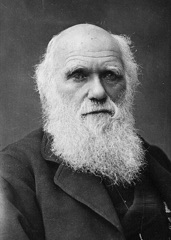
Charles Darwin was born in Shrewsbury, England, the son of a doctor and grandson of the potter Josiah Wedgwood. He began studying medicine at Edinburgh but could not bear operations without anesthetic, and then studied at Cambridge to become a clergyman, while collecting beetles and learning geology and botany. In 1831 he joined HMS Beagle as a naturalist on a five-year voyage around the world. In South America and the Galápagos Islands he collected fossils, plants and animals and noticed how species varied from place to place. Back in England he married his cousin Emma Wedgwood, settled at Down House in Kent, and, often ill, spent twenty years gathering evidence for a theory that species change over long periods through natural selection, as individuals better suited to their surroundings survive and leave more offspring. When Alfred Russel Wallace sent him a paper with similar ideas, their work was presented together in 1858, and On the Origin of Species appeared in 1859, provoking intense debate. He also wrote on barnacles, orchids, earthworms and human origins. He died in 1882 and was buried in Westminster Abbey.
Charles Darwin is also an author in the library: author page and works.
Faith: His mother's family were Unitarians; he was an agnostic. Source: Encyclopaedia Britannica
Further reading
- Darwin: A Very Short Introduction by Jonathan Howard (Oxford University Press, 2001), ISBN 9780192854544
Key dates
- 1809 Born in Shrewsbury
- 1831–1836 Voyage of the Beagle
- 1839 Marries Emma Wedgwood
- 1858 Joint paper with Wallace
- 1859 On the Origin of Species
- 1882 Dies at Down House
Fun facts
- In the Galápagos Islands he heard that each island's tortoises had differently shaped shells, but he did not collect any, even after eating tortoises taken on board the ship as food. (Source: Charles Darwin (Wikipedia))
Record-breaker
Firsts and records, worded as the sources give them ("first known", "at the time").
- He was the first person to recognise how important it is that some plants are meat-eaters, catching insects for food. (Source: Charles Darwin (Wikipedia))
Watch


Videos load from YouTube in privacy-enhanced mode only when you press play.
In their words
“There is grandeur in this view of life, with its several powers, having been originally breathed into a few forms or into one”
“from so simple a beginning endless forms most beautiful and most wonderful have been, and are being, evolved”
Read about them
Grades 9–12
- The Voyage of the Beagle · In the library
- On the Origin of Species · In the library
- The Descent of Man · In the library
- The Expression of the Emotions in Man and Animals · In the library
More lives
Edwin A. Abbott · Charles Babbage · Claude Bernard · George Boole · Josef Breuer · Lewis Carroll