Gottfried Wilhelm Leibniz
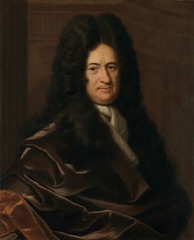
1646–1716 · German philosopher and mathematician who invented calculus independently of Newton.
Gottfried Wilhelm Leibniz was born in Leipzig, Germany, the son of a professor of moral philosophy. As a boy he taught himself Latin from his late father's library. He earned a doctorate in law at twenty and worked for most of his life as a diplomat, librarian, historian and adviser to German princes, especially the dukes of Hanover. In Paris in the 1670s he studied mathematics and developed calculus, publishing it in 1684; Isaac Newton had worked out similar methods earlier but not published them, and a bitter dispute followed over who deserved credit. The notation Leibniz invented, such as dx and the integral sign, is still used today. He built a calculating machine that could multiply and divide, and he studied binary arithmetic, using only ones and zeros. In philosophy he argued that the world is made of simple substances called monads and that God chose to create the best of all possible worlds. He worked for the reunion of Protestant and Catholic churches and helped found the Berlin Academy of Sciences. He died in Hanover in 1716, largely neglected.
Gottfried Wilhelm Leibniz is also an author in the library: author page and works.
Faith: Born into a Lutheran family. Source: Stanford Encyclopedia of Philosophy
Further reading
- Leibniz: A Very Short Introduction by Maria Rosa Antognazza (Oxford University Press, 2016), ISBN 9780198718642
Key dates
- 1646 Born in Leipzig
- 1672–1676 In Paris; develops calculus
- 1684 Publishes his calculus
- 1700 First president of the Berlin Academy
- 1714 Monadology
- 1716 Dies in Hanover
Record-breaker
Firsts and records, worded as the sources give them ("first known", "at the time").
- In 1685 he was the first to describe a pinwheel calculator, and he invented the Leibniz wheel, later used in the arithmometer, the first mass-produced mechanical calculator. (Source: Gottfried Wilhelm Leibniz (Wikipedia))
Watch
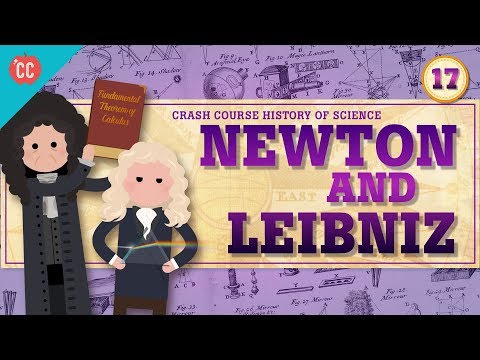

Videos load from YouTube in privacy-enhanced mode only when you press play.
Read about them
Grades 9–12
- Logical Writings on Binary Arithmetic and Universal Character · In the library
More lives
Francis Bacon · Robert Boyle · Nicolaus Copernicus · René Descartes · Desiderius Erasmus · Robert Filmer