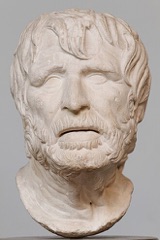
Hesiod
fl. c. 700 BC · Early Greek poet of Boeotia, author of the Theogony and Works and Days.
Hesiod was a Greek poet who lived around 700 BC, roughly in the same period as Homer, and is one of the earliest Greek poets whose works survive. What little is known of his life comes from his own poems. He says that his father had left the city of Cyme, in Asia Minor, because of poverty and settled at Ascra, a village in Boeotia in central Greece, near Mount Helicon. Hesiod tended sheep there, and he describes how the Muses appeared to him on the mountain and gave him the gift of song. He also mentions winning a prize, a tripod, at a poetry contest at Chalcis. His Theogony tells of the origins of the world and the gods, from Chaos and Earth to the rise of Zeus. Works and Days, addressed to his brother Perses, with whom he had a dispute over their inheritance, gives practical advice on farming, the seasons and honest work, and includes the myths of Prometheus, Pandora and the ages of mankind. Ancient tradition said he died at Locris.
Hesiod is also an author in the library: author page and works.
Faith: Faith not well documented beyond the Greek religion his poems describe. Source: Wikipedia

Key dates
- c. 700 BC Active as a poet at Ascra in Boeotia
- c. 700 BC Wins a tripod at a contest in Chalcis
- Ancient tradition Dies at Locris
Read about them
Grades 9–12
- Theogony and Works and Days · In the library
More lives
Aeschylus · Aesop · Apollodorus · Apollonius of Rhodes · Apuleius · Aristophanes
Notes: His dates are approximate and come from his own poems and later tradition.