Horace
65–8 BC · Roman lyric poet and satirist of the age of Augustus, author of the Odes, Satires and Epistles.
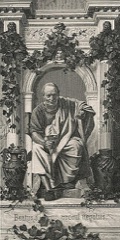
Quintus Horatius Flaccus, known as Horace, was born in 65 BC in Venusia, in southern Italy. His father was a freedman, a formerly enslaved man, who worked as an auctioneer's agent and spent his savings to give his son the best education in Rome and then in Athens. While Horace was studying in Athens, civil war broke out after the murder of Julius Caesar, and he served as an officer in the army of Brutus, which was defeated at Philippi in 42 BC. Returning to Italy, he found his family property confiscated and worked as a treasury clerk while writing poetry. The poet Virgil introduced him to Maecenas, a wealthy friend of Octavian (the future emperor Augustus), who became his patron and gave him a farm in the Sabine hills. Horace wrote the Satires, conversational poems about life and human folly, the Epodes, four books of Odes, the Epistles and the Ars Poetica, on the art of poetry. Phrases from his Odes, such as carpe diem, 'seize the day', became famous. He died in 8 BC, shortly after Maecenas.
Horace is also an author in the library: author page and works.
Faith: Faith not well documented beyond the Roman religion of his time. Source: Wikipedia
Further reading
- Horace: A Very Short Introduction by Llewelyn Morgan (Oxford University Press, 2023), ISBN 9780192849649

Key dates
- 65 BC Born in Venusia
- 42 BC Fights for Brutus at Philippi
- c. 35 BC First book of Satires
- 23 BC Odes, books 1–3
- 17 BC Writes a hymn for Augustus's Secular Games
- 8 BC Dies in Rome
In their words
“Seize the present; trust to-morrow e'en as little as you may.”
Read about them
Grades 9–12
- The Satires of Horace and Persius · In the library
- The Odes and Carmen Saeculare · In the library
- The Art of Poetry (Ars Poetica) · In the library
More lives
Aeschylus · Aesop · Apollodorus · Apollonius of Rhodes · Apuleius · Aristophanes