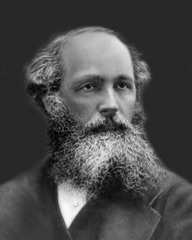
James Clerk Maxwell
1831–1879 · Scottish physicist who showed that light is an electromagnetic wave.
James Clerk Maxwell was born in Edinburgh and grew up on his family's estate at Glenlair in southwestern Scotland. His mother died when he was eight. At school his country clothes and accent earned him the nickname Dafty, but at fourteen he published a paper on drawing oval curves. He studied at Edinburgh and Cambridge and held professorships at Aberdeen, King's College London and Cambridge. He showed that Saturn's rings must be made of many small particles, and he made the first color photograph, of a tartan ribbon, in 1861. His greatest work joined electricity, magnetism and light. Building on Faraday's lines of force, he wrote a set of equations, now called Maxwell's equations, describing how electric and magnetic fields behave, and found that they predicted waves traveling at the speed of light; he concluded that light itself is an electromagnetic wave. This led later to radio. He also helped found the theory of gases. A devout Christian, he was the first director of the Cavendish Laboratory at Cambridge. He died of cancer in 1879, at forty-eight.
Faith: An evangelical Presbyterian who had a conversion experience in 1853 and later became an elder of the Church of Scotland. Source: Wikipedia

Key dates
- 1831 Born in Edinburgh
- 1859 Explains Saturn's rings
- 1861 First color photograph
- 1865 A Dynamical Theory of the Electromagnetic Field
- 1874 Opens the Cavendish Laboratory
- 1879 Dies in Cambridge
Fun facts
- At eight he could recite long passages of John Milton's poetry and the whole of Psalm 119, all 176 verses. (Source: James Clerk Maxwell (Wikipedia))
- He turned up for his first day at school in homemade shoes and a tunic, and the other boys nicknamed him 'Daftie'. (Source: James Clerk Maxwell (Wikipedia))
Record-breaker
Firsts and records, worded as the sources give them ("first known", "at the time").
- He was the first to work out the Maxwell–Boltzmann distribution, which describes how fast the particles in a gas move. (Source: James Clerk Maxwell (Wikipedia))
More lives
Edwin A. Abbott · Charles Babbage · Claude Bernard · George Boole · Josef Breuer · Lewis Carroll