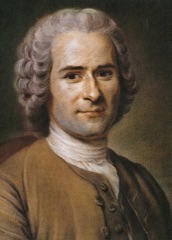
Jean-Jacques Rousseau
1712–1778 · Geneva-born writer of The Social Contract and Emile, whose ideas influenced the French Revolution.
Jean-Jacques Rousseau was born in Geneva; his mother died days after his birth, and his father, a watchmaker, later left him with relatives. At sixteen he ran away and wandered for years, becoming a Catholic convert and living for a time with a patroness, Madame de Warens. In Paris he worked as a music copyist and wrote an opera. In 1750 he won an essay prize by arguing that the arts and sciences had corrupted morals. His Discourse on Inequality claimed that humans are naturally good but are made unhappy and unequal by society and property. In 1762 he published The Social Contract, which begins by saying that man is born free and everywhere he is in chains, and argues that legitimate government rests on the general will of the people. That year he also published Emile, a novel about education. Both books were condemned and burned in Paris and Geneva, and he fled. With his companion Thérèse Levasseur he had five children, all of whom he placed in a foundling hospital. His Confessions were published after his death in 1778.
Jean-Jacques Rousseau is also an author in the library: author page and works.
Faith: Left Calvinist Geneva at sixteen and converted to Roman Catholicism in Turin in 1728; his later beliefs were his own. Source: Stanford Encyclopedia of Philosophy
Further reading
- Rousseau: A Very Short Introduction by Robert Wokler (Oxford University Press, 2001), ISBN 9780192801982

Key dates
- 1712 Born in Geneva
- 1750 Wins the Dijon essay prize
- 1755 Discourse on Inequality
- 1762 The Social Contract and Emile; condemned and flees
- 1778 Dies at Ermenonville
Fun facts
- As a boy his favourite book was Plutarch's Lives, which he read aloud to his father while his father made watches. (Source: Jean-Jacques Rousseau (Wikipedia))
In their words
“Man is born free; and everywhere he is in chains.”
Read about them
Grades 9–12
- The Social Contract · In the library
- Discourse on the Origin of Inequality · In the library
- Confessions · In the library
- A Discourse on Political Economy · In the library
More lives
Cesare Beccaria · George Berkeley · Edmund Burke · Denis Diderot · Jonathan Edwards · David Hume