John Locke
1632–1704 · English philosopher of natural rights and government by consent, admired by the American founders.
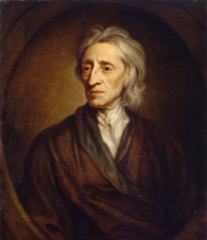
John Locke was born in Somerset, England, the son of a lawyer who fought for Parliament in the Civil War. He studied at Westminster School and Oxford, where he became interested in medicine and science and worked with the chemist Robert Boyle. He became physician and adviser to the Earl of Shaftesbury, a leading politician who opposed the Catholic heir to the throne, and when Shaftesbury fell, Locke fled to the Netherlands in 1683. He returned after the Glorious Revolution of 1688. In 1689 and 1690 he published his major works. His Two Treatises of Government argued that people have natural rights to life, liberty and property, that government exists by the consent of the governed to protect those rights, and that a government that violates them may be resisted. His Essay Concerning Human Understanding argued that the mind begins like a blank page and gains its ideas from experience. His Letter Concerning Toleration argued that the state should not force religious belief. He also wrote on education. His ideas strongly influenced the Declaration of Independence. He died in 1704.
John Locke is also an author in the library: author page and works.
Faith: Raised in a Puritan family; a Christian who argued for religious toleration. Source: Stanford Encyclopedia of Philosophy
Further reading
- Locke: A Very Short Introduction by John Dunn (Oxford University Press, 2003), ISBN 9780192803948
Key dates
- 1632 Born in Wrington, Somerset
- 1667 Joins the Earl of Shaftesbury
- 1683 Flees to the Netherlands
- 1689 Returns; Letter Concerning Toleration
- 1689–90 Two Treatises and the Essay published
- 1704 Dies in Essex
Watch


Videos load from YouTube in privacy-enhanced mode only when you press play.
In their words
“where there is no law, there is no freedom”
“No man can be forced to be Rich or Healthful, whether he will or no.”
Read about them
Grades 9–12
- Second Treatise of Government · In the library
- A Letter Concerning Toleration · In the library
- An Essay Concerning Human Understanding · In the library
More lives
Francis Bacon · René Descartes · Desiderius Erasmus · Robert Filmer · Hugo Grotius · James Harrington