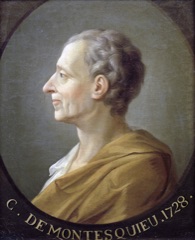
Montesquieu
1689–1755 · French political philosopher who described the separation of powers.
Charles-Louis de Secondat, Baron de Montesquieu, was born near Bordeaux in France to a noble family. At his baptism a beggar was chosen as his godfather, so he would remember his duty to the poor. He studied law and inherited from his uncle the office of president of the regional court, the Parlement of Bordeaux. In 1721 he published the Persian Letters, a witty novel in which two Persian visitors write home about the strange customs of France, poking fun at French society, the Church and the king. He later sold his judicial office, traveled across Europe, and spent nearly two years in England, which he admired. In 1748 he published The Spirit of the Laws, the work of twenty years. It compared governments around the world and argued that laws must suit a people's climate, customs and religion. Most famously, he argued that liberty is safest when the legislative, executive and judicial powers are held by separate bodies that check one another. James Madison and other American framers cited him often. He was nearly blind in his last years and died in Paris in 1755.
Montesquieu is also an author in the library: author page and works.
Faith: Married a practicing Protestant; he wrote that Protestantism suits republics and Catholicism monarchies. Source: Stanford Encyclopedia of Philosophy

Key dates
- 1716 Becomes president of the Parlement of Bordeaux
- 1721 Persian Letters
- 1729–1731 Lives in England
- 1748 The Spirit of the Laws
- 1755 Dies in Paris
Read about them
Grades 9–12
- The Spirit of the Laws · In the library
- Persian Letters · In the library
More lives
Cesare Beccaria · George Berkeley · William Blackstone · Edmund Burke · Samuel Chase · Denis Diderot