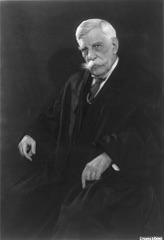
Oliver Wendell Holmes Jr.
1841–1935 · Civil War veteran and Supreme Court justice famed for his dissents and the clear and present danger test.
Oliver Wendell Holmes Jr. was the son of the famous Boston doctor and poet of the same name. He left Harvard to fight in the Civil War and was seriously wounded three times, at Ball's Bluff, Antietam and Chancellorsville. After the war he studied law, practiced in Boston, and in 1881 published The Common Law, which opens by saying that the life of the law has not been logic but experience. He served on the Massachusetts Supreme Judicial Court for twenty years and in 1902 Theodore Roosevelt appointed him to the U.S. Supreme Court, where he served until he was ninety. Holmes argued that courts should usually defer to legislatures, and in Lochner v. New York in 1905 he dissented from striking down a law limiting bakers' hours. In Schenck v. United States in 1919 he wrote that speech could be punished only when it posed a clear and present danger, and later that year, dissenting in Abrams, he defended the free trade in ideas. In Buck v. Bell in 1927 he wrote the opinion upholding a state law on compulsory sterilization. He died in 1935.
Faith: Faith not well documented; his ancestors were Puritans, and as a judge he rejected natural-law theories. Source: Wikipedia
Key dates
- 1861–1864 Serves in the Union army; wounded three times
- 1881 The Common Law
- 1902 Appointed to the U.S. Supreme Court
- 1905 Dissent in Lochner v. New York
- 1919 Schenck opinion; Abrams dissent
- 1932 Retires
- 1935 Dies in Washington
Record-breaker
Firsts and records, worded as the sources give them ("first known", "at the time").
- He retired from the U.S. Supreme Court at 90 years and 10 months, the oldest justice in the Court's history. (Source: Oliver Wendell Holmes Jr. (Wikipedia))
Watch


Videos load from YouTube in privacy-enhanced mode only when you press play.
Read about them
Grades 9–12
- Schenck v. United States · In the library
- Lochner v. New York · In the library