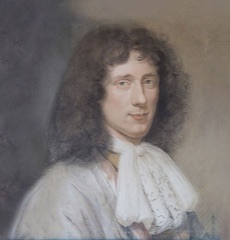
Christiaan Huygens
1629–1695 · Dutch mathematician, physicist and astronomer who discovered Saturn's moon Titan, invented the pendulum clock and proposed the wave theory of light.
Christiaan Huygens was born in The Hague in 1629, the son of Constantijn Huygens, a diplomat and poet who was a friend of René Descartes. He studied law and mathematics at Leiden and Breda. With his brother he ground lenses and built improved telescopes, and in 1655 he discovered Saturn's largest moon, Titan, and soon after explained that Saturn is surrounded by a thin, flat ring. In 1656 he invented the pendulum clock, which made timekeeping far more accurate, and his book Horologium Oscillatorium (1673) analyzed the mathematics of pendulums. He also wrote an early book on probability. In 1666 he became a founding member of the French Academy of Sciences and lived in Paris for about fifteen years. In his Treatise on Light (1690), he described light as a wave spreading through space, a principle still known as Huygens' principle, which explained reflection and refraction. He returned to The Hague, where he died in 1695.
Christiaan Huygens is also an author in the library: author page and works.
Faith: Faith not well documented. Source: Wikipedia

Key dates
- 1629 Born in The Hague
- 1655 Discovers Titan
- 1656 Invents the pendulum clock
- 1666 Founding member of the French Academy of Sciences
- 1673 Horologium Oscillatorium
- 1690 Treatise on Light published
- 1695 Dies in The Hague
Fun facts
- The European Space Agency probe that landed on Titan, Saturn's largest moon, in 2005 was named Huygens after him. (Source: Christiaan Huygens (Wikipedia))
Record-breaker
Firsts and records, worded as the sources give them ("first known", "at the time").
- On 25 March 1655 he became the first to identify Titan as a moon of Saturn, and he was the first to explain Saturn's strange shape as a thin, flat ring. (Source: Christiaan Huygens (Wikipedia))
- He invented the pendulum clock in 1657. (Source: Christiaan Huygens (Wikipedia))
Read about them
Grades 9–12
- Treatise on Light · In the library
More lives
Francis Bacon · Robert Boyle · Filippo Brunelleschi · Nicolaus Copernicus · René Descartes · Galileo Galilei