Galileo Galilei
1564–1642 · Italian astronomer and physicist who turned the telescope on the sky and studied motion.
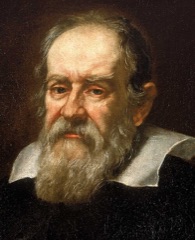
Galileo Galilei was born in Pisa, the son of a musician. He studied medicine but turned to mathematics and became a professor at Pisa and then at Padua. He studied falling bodies and swinging pendulums, using careful experiments and mathematics to describe motion. In 1609, hearing of a Dutch spyglass, he built his own telescopes and turned them on the sky. He saw mountains on the Moon, countless stars in the Milky Way, four moons circling Jupiter, and the phases of Venus, which he published in The Starry Messenger in 1610. These discoveries convinced him that Copernicus was right that the Earth moves around the Sun. In 1616 Church authorities ordered him not to defend that view. His Dialogue Concerning the Two Chief World Systems of 1632 seemed to mock the pope's position, and in 1633 he was tried by the Inquisition, forced to recant, and kept under house arrest for the rest of his life. There, though going blind, he wrote Two New Sciences, his greatest work on motion. He died in 1642.
Galileo Galilei is also an author in the library: author page and works.
Faith: His advocacy of Copernicanism led to his condemnation by the Catholic Inquisition. Source: Stanford Encyclopedia of Philosophy
Further reading
- Galileo: A Very Short Introduction by Stillman Drake (Oxford University Press, 2001)

Key dates
- 1564 Born in Pisa
- 1609 Builds his first telescope
- 1610 Publishes The Starry Messenger
- 1632 Publishes the Dialogue
- 1633 Tried by the Inquisition
- 1642 Dies at Arcetri
In their words
“for two truths can never contradict each other.”
Read about them
As an Amazon Associate I earn from qualifying purchases. As a Bookshop.org affiliate I earn from qualifying purchases, which also support independent bookstores.
Grades 3–5
- Who Was Galileo? by Patricia Demuth (2015; ISBN 9780448479859)
Bookshop.org · Amazon
Grades 9–12
- Galileo: The Starry Messenger, Letter to the Grand Duchess Christina, and Two New Sciences (First Day) · In the library
- Galileo's Daughter by Dava Sobel (Bloomsbury Publishing USA, 2011; ISBN 9780802779656)
Bookshop.org · Amazon - Dialogues Concerning Two New Sciences (Second to Fourth Days) · In the library
More lives
Francis Bacon · Robert Boyle · Nicolaus Copernicus · René Descartes · William Gilbert · Christiaan Huygens