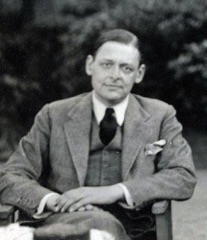
T. S. Eliot
1888–1965 · American-born British poet, critic and playwright, author of The Waste Land and Old Possum's Book of Practical Cats.
Thomas Stearns Eliot was born in 1888 in St. Louis, Missouri, into a prominent family; his grandfather had moved there to found a Unitarian church. He studied at Harvard University, the University of Paris and Merton College, Oxford. In 1914 he settled in England, and the next year he married Vivienne Haigh-Wood. He taught for a time and from 1917 worked at Lloyds Bank in London while writing poetry. 'The Love Song of J. Alfred Prufrock' (1915) and The Waste Land (1922) made him one of the leading poets of the modern movement. In 1925 he became a director of the publishing firm Faber and Faber. In 1927 he joined the Church of England and became a British subject. His later poems include Four Quartets, and he wrote verse plays such as Murder in the Cathedral (1935), about the death of Thomas Becket. His light verse in Old Possum's Book of Practical Cats (1939) later inspired the musical Cats. In 1948 he received the Nobel Prize in Literature. After Vivienne's death, he married Valerie Fletcher in 1957. He died in London in 1965.
T. S. Eliot is also an author in the library: author page and works.
Faith: Identified as Anglo-Catholic, calling himself 'anglo-catholic in religion'. Source: Wikipedia

Key dates
- 1888 Born in St. Louis, Missouri
- 1915 The Love Song of J. Alfred Prufrock published
- 1922 The Waste Land published
- 1927 Becomes a British subject
- 1939 Old Possum's Book of Practical Cats published
- 1948 Nobel Prize in Literature
- 1965 Dies in London
Fun facts
- His friend Ezra Pound nicknamed him 'Old Possum', and his light-hearted Old Possum's Book of Practical Cats (1939) later became the basis of the musical Cats. (Source: T. S. Eliot (Wikipedia))
Record-breaker
Firsts and records, worded as the sources give them ("first known", "at the time").
- His first published poem, 'A Fable for Feasters', began as a school exercise and appeared in his school magazine in 1905. (Source: T. S. Eliot (Wikipedia))
Read about them
Grades 9–12
- The Waste Land · In the library
- Journey of the Magi · In the library
- The Sacred Wood · In the library
More lives
Marguerite de Angeli · Richard and Florence Atwater · Mariano Azuela · Samuel Beckett · W. E. B. Du Bois · Bertolt Brecht