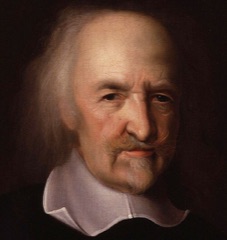
Thomas Hobbes
1588–1679 · English philosopher whose Leviathan argued for a strong sovereign to prevent civil war.
Thomas Hobbes was born at Westport, near Malmesbury, in England; he later said that his mother gave birth to twins, himself and fear, because news of the Spanish Armada caused her to go into labor early. His father, a quarrelsome vicar, abandoned the family, and an uncle paid for his education at Oxford. He spent most of his life as tutor and secretary to the Cavendish family, the Earls of Devonshire, traveling in Europe, where he met Galileo and discussed philosophy with French thinkers. At forty he discovered Euclid's geometry and was charmed by its method of proof. Fearing the coming civil war, he fled to Paris in 1640. In Leviathan, published in 1651, he argued that without government, life would be a war of all against all, solitary, poor, nasty, brutish and short, and that people therefore agree to give power to a sovereign strong enough to keep the peace. His views on religion made him many enemies on all sides. He translated Homer into English in his eighties and died in 1679, aged ninety-one.
Thomas Hobbes is also an author in the library: author page and works.
Faith: His religious views remain disputed; positions attributed to him range from atheism to orthodox Christianity. Source: Stanford Encyclopedia of Philosophy
Further reading
- Hobbes: A Very Short Introduction by Richard Tuck (Oxford University Press, 2002), ISBN 9780192802552
Key dates
- 1588 Born near Malmesbury
- 1640 Flees to Paris
- 1651 Leviathan published
- 1660 Returns to favor under Charles II
- 1679 Dies at Hardwick Hall
Watch


Videos load from YouTube in privacy-enhanced mode only when you press play.
In their words
“the life of man, solitary, poore, nasty, brutish, and short”
Read about them
Grades 9–12
- Leviathan · In the library
More lives
Francis Bacon · René Descartes · Desiderius Erasmus · Robert Filmer · Hugo Grotius · James Harrington